Ellie Pascoe
Good Morning, Midnight (Reginald Hill Edition)Ellie Pascoe is Peter Pascoe’s wife, Rosie’s mother, and a close friend of Cressida Maciver. The scenes in which she appears move between the ordinary pressures of family life and sudden emergencies: she tries to maintain her boundaries with Cressida, helps respond when Helen Dunn goes into labour, and offers Peter the frankness that he associates with his role as the police force’s moral conscience. Her importance lies less in a separate investigative plot than in the practical care and personal judgment she brings to the people around her.
Identity and Family Life
Ellie is married to Detective Chief Inspector Peter Pascoe and has a daughter, Rosie. The marriage is shown through the coordination of childcare and work as much as through affection. One evening, Peter has expected to remain at his desk dealing with neglected paperwork, so Ellie arranges for him to collect her at about half past ten rather than pay for a taxi. When plans are disrupted, her irritation is not simply about the delay: the evening with Cressida has already run late, and the arrangements that were meant to let Ellie get home safely and on time have come undone.
The family’s routine also includes Rosie’s clarinet playing. Peter is expected at a school concert where Rosie will perform in public for the first time, a family occasion he privately finds daunting but does not voice to his daughter. The detail places Ellie and Peter in the familiar work of supporting a child through a first public performance, even when professional demands threaten to intrude. The next morning, while Ellie is still asleep, Rosie answers the door to a visitor for Peter; he goes upstairs to ask Ellie to take Rosie to her lesson. Their household is presented as a set of shared responsibilities, adjusted in small ways around Peter’s work and Rosie’s activities.
Friendship and Boundaries with Cressida Maciver
Ellie’s friendship with Cressida is genuine and sustaining, but it is not uncomplicated. During one evening together, Cressida struggles with a tightly corked bottle while Ellie notices that it is already half past eight, that two empty bottles are on the floor, and that no food appears to be underway. The domestic details make the evening’s imbalance plain: time is passing, the meal has not begun, and Ellie is watching the situation become less comfortable.
Her unease comes from a pattern she has encountered before. On previous evenings, the opening of a third bottle had been followed by advances Ellie did not welcome. She has prepared ways to head them off, and has managed to leave without being harmed, but the tension complicates her fondness for Cressida. When sober, Cressida appears not to remember these episodes; when drinking, she also fails to remember a personal confidence Ellie once shared. Ellie is therefore dealing not only with the immediate mood of the evening but with a recurring mismatch between her own recollection of events and Cressida’s apparent forgetfulness.
That history does not erase the closeness between them. Ellie values Cressida and describes their shared tastes, political interests, and humour as making their evenings delightful before drinking changes the atmosphere. The friendship is neither dismissed nor treated as uncomplicated: affection and compatibility persist alongside Ellie’s need to protect her own boundaries. When Cressida leaves the room to answer the telephone, Ellie promptly uses her mobile to call Peter and speaks quietly. The brief action shows her seeking contact while she has an opportunity, rather than waiting for the evening to resolve itself.
The Emergency at Moscow House
A later emergency brings Ellie into the crowded response at Moscow House. When Peter arrives, she opens the door to him and greets him brightly, though her expression conveys that she is aware he is later than expected. Peter explains that the babysitter is unwell and that an emergency at work has made him unable to take Ellie home; instead, he brings her to the scene. Their exchange places domestic arrangements and police duty in immediate collision, without turning their frustration into a breach of their partnership.
As activity gathers around the house and an ambulance, Ellie stands beside Peter and urges him to exercise his authority. The remark is practical: the scene is becoming difficult to manage, with people demanding information and trying to reach the vehicle. Peter chooses to wait for them to discover that the ambulance is empty rather than confront them at once, and Ellie answers his restraint with a brief, teasing rebuke. Their difference in approach is visible, but so is their ease in speaking plainly to one another.
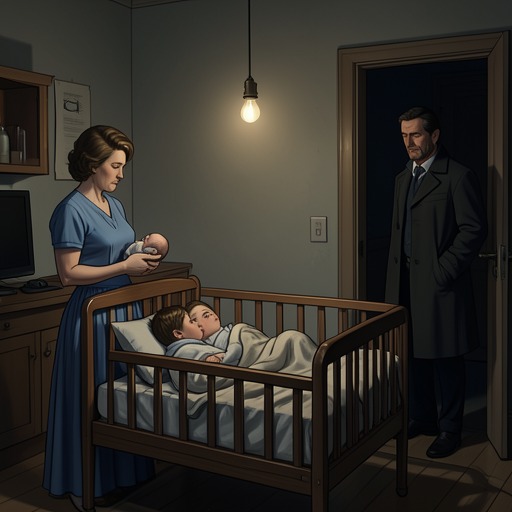
When Helen Dunn’s labour begins in the car, Ellie runs with the other women to help. The episode culminates in her appearing at the doorway with blood on her hands and an exultant expression, announcing that Helen has delivered twins, a boy and a girl. The account gives Ellie an active place in the urgent work surrounding the birth, while keeping the focus on the outcome: she has been present at a difficult arrival and is able to report the two babies’ sexes to the paramedics as they enter. Her response contrasts with the confusion outside and marks a moment when practical participation gives way to unmistakable relief and excitement.
Judgment, Affection, and Narrative Role
Ellie’s influence on Peter is especially clear in his recollection of a conversation about his position within the CID. He had asked why others treated him as its moral conscience; Ellie answered by asking how else they should treat him, then refused to remain for an answer. The exchange presents her as direct rather than ceremonious. She does not provide Peter with a theory of his role or soothe his discomfort; she returns the question to him and leaves him to face its implication.
That memory helps explain why Ellie’s presence matters even when she is not part of the investigation itself. Her domestic decisions, attention to other people’s needs, and willingness to challenge Peter supply a personal counterpoint to the pressures of his work. Andrew Dalziel makes a joke about Peter reading Ellie’s emails, briefly bringing her into a conversation about the broader affairs occupying the detectives, but the stronger evidence of her influence is intimate: Peter remembers what she said and how decisively she declined to elaborate. Ellie’s scenes repeatedly join care with candour. She can help at a birth, preserve a difficult friendship without denying its risks, and puncture her husband’s self-questioning with a single pointed response; the result is a character whose moral authority is suggested through conduct and relationship rather than formal office.