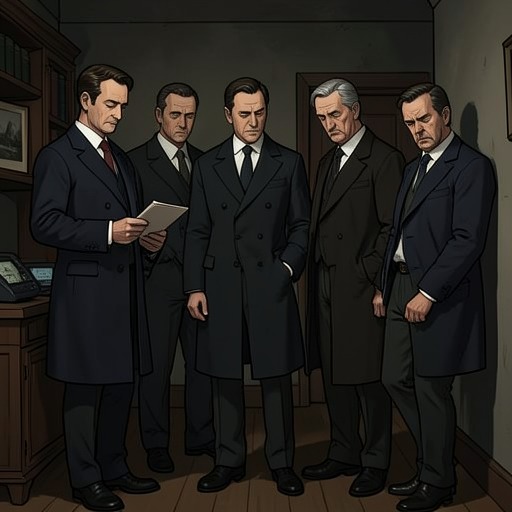
Finding is the first Act
Good Morning, Midnight (Reginald Hill Edition)“Finding is the first Act” is the opening of Emily Dickinson’s poem 870, which Pascoe retrieves after the number appears on a sheet of paper associated with the investigation at Moscow House. The poem does not solve the mystery or explain its sender; its significance is that it connects a new, unexplained message to a volume recovered among the remnants of Pal Maciver Senior’s suicide, and gives Pascoe another reason to keep his doubts alive.
Identification and appearance
The expression is identified in the text through its numbered form rather than through a title on the sheet: the paper bears the number 870, printed in the same hand as the address. Ireland finds it in a clear plastic evidence bag. Pascoe wonders aloud whether the number might be a date or hymn number, but neither possibility is established. The sheet gives him no explanatory sentence, only a number whose meaning must be sought elsewhere.
The poem’s opening supplies the expression’s familiar wording: “Finding is the first Act / The second, loss,”. The text also reproduces the striking phrase “Jason–sham–too.” These fragments suggest a sequence of stages and a disconcerting final phrase, but the evidence does not provide a settled interpretation of the poem or show that its speaker’s meaning matches the sender’s intention. The number identifies a place to look; it does not provide a key that makes the message transparent.
The number’s return
At first, Pascoe attempts to dismiss 870 as meaningless and the letter as the work of a malicious troublemaker. Yet the number returns to his thoughts. During an effort at free association, he finds it paired with 1062, another number he cannot immediately explain. The recurrence matters because it leads him away from speculation about the sender and back to a concrete object already connected with the case.
Pascoe retrieves a bin liner containing the remnants of Pal Maciver Senior’s suicide and takes out the volume of Emily Dickinson’s poetry. It is open at poem 1062. Turning back through the pages, he reaches poem 870 and recognizes the wording. Thus 870 is not just an arbitrary mark on the addressed paper: it also points to a poem in the same book as the one marked by 1062. The connection is material and verifiable, although what the connection is meant to communicate remains uncertain.
Reading without resolution
Pascoe reads poem 870 three times. Repetition yields no definite interpretation: he remains no closer to understanding either Dickinson’s poem or the sender’s purpose. The scene therefore keeps two questions distinct. The poem has words that can be read, and the paper has a number that can be traced to a particular page; neither fact establishes why the number was sent or what conclusion Pascoe should draw from it.
The poem’s appearance beside 1062 also gives the message a particular relation to the earlier case evidence, without proving who selected the number or why. Pascoe’s inability to interpret it is not a failure to notice the clue: he finds the matching poem and follows its wording carefully. Rather, the discovery clarifies the reference while leaving its purpose open. The expression functions as a clue whose reference can be recovered but whose significance cannot yet be secured.
Function in the investigation
Pascoe treats the poem as an additional reason for caution, describing it to himself as another feather of doubt on the scales. He does not present it as a solution. Instead, he decides that he wants another set of initials on the file, a practical step that registers his unease without turning the ambiguous message into proof of a particular account.
He carefully copies out the poem and carries the sheet to Andy Dalziel’s room. That action moves the expression from private association into the investigation: Pascoe shares the text with his superior rather than allowing the unexplained number to remain only in his own thoughts. The passage ends with the poem still undeciphered. Its narrative force comes from this combination of exact identification and unresolved meaning: 870 can be followed from the evidence bag to the poetry volume, but neither Pascoe’s repeated reading nor that discovery settles what the sender intended.