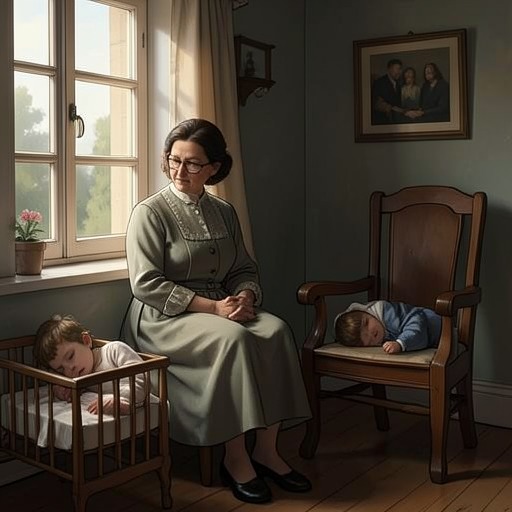
Kay Kafka and Helen Dunn’s stepmother–stepdaughter bond
Good Morning, Midnight (Reginald Hill Edition)Kay Kafka and Helen Dunn’s stepmother–stepdaughter bond is one of chosen affection, carefully shaped by Kay’s wish to be Helen’s friend rather than claim a maternal place she believes would complicate the family. Their regular Wednesday evenings give that closeness a settled form, while Helen’s pregnancy brings the relationship to a new threshold: Kay must confront how much it means to be welcomed not as a substitute mother, but as a grandmother.
A closeness built by choice
The relationship is presented as a delight to Kay, and its strength rests partly on what it does not depend upon. Kay and Helen share neither blood nor an automatic coincidence of tastes and opinions; their affection has grown without those usual guarantees of kinship. On their Wednesday visits they generally discuss films, fashions, and local gossip rather than the harsher realities of life. The ease of those subjects does not make the bond shallow. For Kay, their ordinary conversation is pleasurable because it takes place within a dependable sense of love.
That dependable routine also shows the particular shape of Kay’s place in the family. When she married Helen’s father, she asked the children to call her Kay. The two older children largely avoided addressing her politely, while Helen, being younger, eventually wanted to call her mum. Kay resisted that possibility, not because she lacked affection for Helen, but because she feared that such a name would create a difficulty between Helen and her brother and sister. She wanted closeness without making Helen’s relationship with her siblings harder.
The boundary between friend and mother
Kay explained her preference to her husband, Tony Kafka, as a wish to remain Helen’s friend rather than become a mother in name. But the narration distinguishes the principle she expressed from the private cost of keeping to it: Kay never told him how difficult the restraint was for her. Her refusal therefore carries both care and longing. She maintains a boundary for Helen’s sake, while concealing that it asks something emotionally difficult of her.
The pregnancy offers a different name for their relationship. Helen is expecting twins, and the pregnancy has so far been comparatively easy. As the birth approaches, the two women can spend their visits on preparations: baby clothes, pushchairs, nursery decoration, and possible names. Helen refuses to learn the twins’ sexes in advance. If one is a girl, she intends to name her Kay; she also insists that both babies will call Kay grandma. The proposal is not presented as a formal change in household roles but as Helen’s affectionate decision about the place Kay will hold in her children’s lives.
For Kay, that decision reaches her deeply. She accepts the grandmother role without the resistance she had felt about being called mum. The difference matters: grandmotherhood does not displace Helen’s mother or require Kay to take a position that could divide the siblings. Instead, Helen makes room for Kay within the next generation of the family. Kay’s embrace and acceptance turn the naming discussion into a moment of direct recognition between them.
Pregnancy and a changing future
The grandmother conversation takes place against Helen’s growing awareness that the twins will alter her life permanently. Until then, the pregnancy has largely been approached through pleasurable preparations and the expectation of a celebratory arrival. Near the end of it, Helen begins to understand that birth is not simply a single happy occasion but the beginning of an enduring change. Kay tries to reassure her, but Helen is not persuaded by lightness or comfort.
In that unsettled conversation, Helen interprets Kay’s earlier refusal to let her use the word mum as a way of avoiding a binding maternal role. Her interpretation casts Kay’s chosen boundary in a new light: what Kay intended as protection from family complications can look, to Helen, like a refusal to be claimed. Kay is startled by the thought. Helen then connects her reaction to the strangeness of her family and wonders whether her brother, Palinurus Maciver Junior, has arrived. The exchange leaves their affection intact, but shows that even a loving bond can be understood differently by the people in it, especially when family roles and a major life change are at stake.
A bond that makes room
The relationship’s defining movement is not from distance to intimacy but from one form of intimacy to another. Kay and Helen already share a loving routine; the pregnancy makes that closeness newly consequential. Kay’s concern about the word mum reveals her effort to preserve Helen’s ties with her siblings, while her unspoken difficulty reveals the personal tenderness beneath that effort. Helen’s choice of Kay as a possible namesake and grandmother shows that she can affirm the bond without requiring Kay to undo the boundary she once set.
The text also links Helen’s firmness in making this decision to her dead father, Palinurus Maciver Junior. That comparison places a trace of family inheritance within the scene without diminishing the distinctly chosen character of Helen and Kay’s relationship. Helen is not simply accepting the role Kay offers; she acts with obduracy to define what she wants Kay to be. Their bond can therefore hold both friendship and kinship, restraint and attachment. Its importance lies in that accommodation: Kay is not made Helen’s mother, but is welcomed as a beloved presence in the family Helen is about to create.