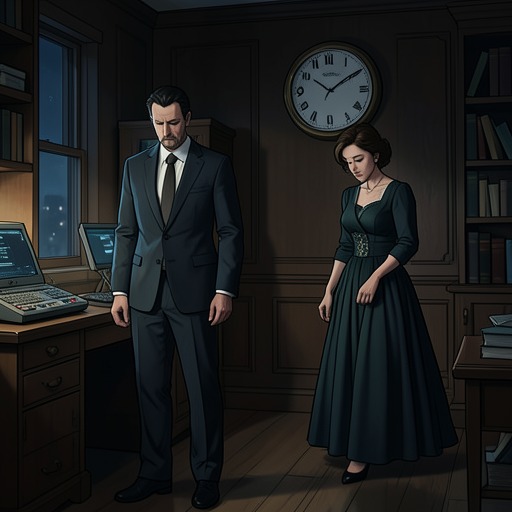
Like father, like son
Good Morning, Midnight (Reginald Hill Edition)“Like father, like son” is the thought that turns two Maciver deaths into a pattern in Tony Kafka’s mind, then draws Tony himself into that pattern through his reflection on his father and the cost of serving his country. The phrase does not establish that the men’s deaths or injuries have a single cause. Its force comes instead from the act of recognition: Tony sees likeness across generations, while the thought of debt makes that likeness feel less like a comforting inheritance than an obligation that remains unpaid.
Placement and Function
The phrase appears as a brief, isolated thought in the section headed “4 • like father, like son.” Its position gives it the shape of a conclusion: Tony has just imagined Palinurus Maciver Senior and Palinurus Maciver Junior, both ending at desks with shotguns beneath their chins, and reduces that grim parallel to a familiar saying. The proverb’s everyday simplicity stands against the starkness of the image it summarizes. A phrase ordinarily used to note a family resemblance here carries the weight of repeated deaths.
The thought follows Tony’s recollection of a Junius article and his suspicion about Junius’s identity. He has kept that suspicion to himself, including from Kay, because speaking would bring consequences he does not want on his already burdened conscience. The narrative does not say that this secrecy causes or explains his reflection on the Macivers. Its placement does, however, put two kinds of burden close together: the unspoken knowledge Tony carries and the inherited debt he thinks about in the next lines. The saying marks a shift from what he suspects about another person to what he recognizes about family resemblance and responsibility.
The Macivers as a Repeated Pattern
Tony calls the two men “both poor bastards Maciver” and sees them ending in the same posture: seated at a desk, a shotgun under the chin. The parallel is specific and physical, not merely a general observation that father and son shared a temperament. The repeated setting and weapon make the resemblance difficult to treat as a coincidence of appearance alone, but the passage supplies no further explanation of the circumstances. The phrase identifies a likeness in the deaths without resolving what produced it.
That distinction matters. “Like father, like son” can sound as though a son’s fate follows naturally from his father’s, turning repetition into destiny. Tony’s thought registers the disturbing resemblance, not a proven law of inheritance. The text gives the reader the repeated image and Tony’s formulation, but not a definitive causal account. The proverb therefore works both as recognition and as an inadequate explanation: it names the pattern compactly while leaving its meaning unsettled.
Tony’s Self-Identification
Tony’s reflection does not end with the Macivers. He adds himself to the comparison, thinking of himself as like his father. The link he makes is service to country and the wound that service may entail: if serving meant getting wounded, he reasons, that was its price. The passage does not specify the wound or provide details about either man’s service. What it does establish is Tony’s acceptance of a family resemblance organized around injury and obligation.
His next thought complicates the language of price: “And it still left you in debt.” Service may be imagined as a transaction in which injury is the cost, but the debt remains even after that cost has been paid. The sentence shifts the passage away from a neat equation between sacrifice and compensation. Injury does not settle the account. In this way, Tony’s reflection extends the proverb beyond physical resemblance: what can pass between generations is also a way of understanding duty, damage, and what remains owed.
Meaning and Limits
The passage builds its meaning through a sequence of narrowing associations: first the two Macivers, then father and son, then Tony and his father. Each step enlarges the proverb’s reach without demonstrating that all the men share the same history. The Macivers’ deaths furnish the immediate image; Tony’s thought about military service gives the pattern a second, distinct dimension. The text leaves those dimensions beside one another rather than explaining them away.
The phrase is therefore less a verdict than a hinge. It compresses the image of the two men at their desks, turns Tony’s attention toward his own family resemblance, and opens onto the unresolved account of injury and service. Its familiar wording offers a momentary order to frightening repetition, but the thought of debt prevents that order from becoming reassurance. What appears to recur is not simply a father’s fate in a son: it is the burden of interpreting inherited likeness when neither injury nor sacrifice can be said to have paid what is owed.