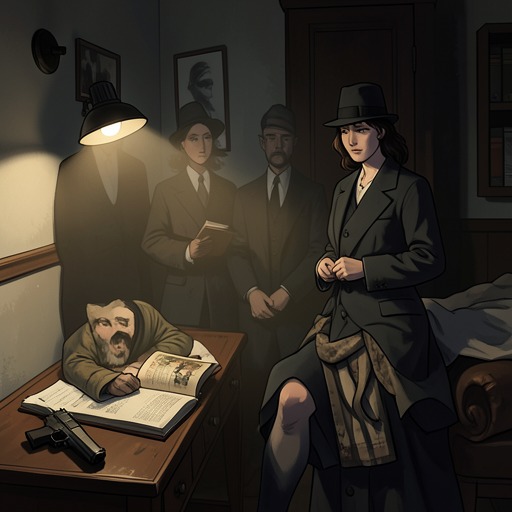
Pal Maciver’s death remains under investigation as suspicious
Good Morning, Midnight (Reginald Hill Edition)Palinurus Maciver Junior’s death remains under investigation as suspicious even after it is reported as suicide. The gap between those descriptions matters: witnesses and investigators try to understand both the circumstances of the death and the state of mind behind it, while the evidence leaves room for competing explanations rather than a definitive account.
Industrial and family background
The story places Palinurus Maciver Junior’s death against the rise and decline of the family business. His grandfather Liam built a successful machine-tools concern during the wartime and post-war demand for equipment. After a rival firm’s decline, Liam took over its plant, orders, and workers; by the time Palinurus Maciver Senior inherited the business, it was thriving. The firm was not merely a source of wealth for his son: it became his pride and the focus of his working life.
Palinurus Maciver Senior had once pursued climbing as well as the conventional pursuits expected of an English gentleman. After a serious fall left him unable to bend his left leg, he could no longer climb as before and turned his energies toward the business. The narrative makes that change a personal loss, but does not establish it as an explanation for either family death.
The firm’s fortunes later changed sharply. After 1979, its order book emptied and workers were laid off. Faced with the prospect of further redundancies, Palinurus Maciver Senior accepted an offer from Ashur-Proffitt. The business became Ashur-Proffitt-Maciver’s, also known as Ash-Mac’s, and he received money and a board position that Andrew Dalziel describes as largely a face-saving role. This history supplies a context of lost control and changing status; it does not, by itself, prove a motive for Palinurus Maciver Junior’s death.
The death and its investigative status
Laurence Waverley brings the news to Lavinia Maciver the morning after the death. He tells her that her nephew died at Moscow House and that, like his father, he had taken his own life. Lavinia is stunned and asks whether she is needed. Waverley advises her to come with him and find out what there is to learn. The intimate family news thus arrives alongside a reminder of an earlier death, making the apparent repetition impossible for her to treat as an isolated event.
The initial impression of a straightforward suicide does not settle the official question. One investigator explains that he had assumed the death was uncomplicated until he made inquiries and discovered that it was still being investigated as suspicious. That distinction redirects the case: the death may look like suicide, but its circumstances have not been closed off from criminal investigation.
Peter Pascoe also resists treating evidence about Palinurus Maciver Junior’s marriage as an easy explanation. A photograph delivered to Sue-Lynn Maciver points to her relationship with Tom Lockridge, and the investigators consider whether Palinurus Maciver Junior had hired Jake Gallipot to investigate his wife. Pascoe notes that the photograph appears to have been taken around the time of the death. He questions whether an affair provides a convincing account of a suicide, and whether it can explain the case at all. The evidence raises questions about motive and Gallipot’s role; it does not answer them.
Competing interpretations
The investigation’s uncertainty is also psychological. Peter Pascoe reflects that reconstructing a murderer’s state of mind is a kind of intellectual work, whereas trying to understand someone whose despair has made death seem like the only escape draws the investigator into a less bounded, more personal inquiry. The distinction helps explain why a finding of suicide would not end the work of interpretation: the act might be identified without the reasons for it becoming knowable.
In a later account, Waverley proposes that Palinurus Maciver Junior had learned something from Jake Gallipot about the real circumstances of his father’s death. He imagines that Palinurus Maciver Junior, like his father before him, hired Gallipot for one purpose and gradually induced him to disclose what he knew or suspected. Waverley thinks that revelation may have shocked him, but rejects it as a sufficient cause of suicide. Instead, he infers that a more immediate event prompted the decision, after which Palinurus Maciver Junior repeated the circumstances of his father’s death as closely as he could, using Gallipot’s imperfect account as a template.
Waverley presents this as a reconstruction, not as an established finding. His explanation depends partly on what Gallipot may have disclosed and partly on an inference about the timing and meaning of Palinurus Maciver Junior’s actions. Waverley acknowledges that the investigators would know more if Gallipot had remained available to question. His account therefore supplies a possible chain of events while underlining how much of it cannot be verified.
Family repetition and the limits of certainty
When Waverley tells Lavinia that her nephew is dead, he invokes the death of her brother: the two deaths appear to echo one another. The later theory of a deliberate repetition gives that echo a possible practical explanation, but not a complete one. It can suggest how Palinurus Maciver Junior chose to die without establishing why he made that choice, or whether the account he received about his father was accurate.
The narrative keeps those questions distinct. The police classification remains suspicious; characters discuss suicide, possible personal pressures, and the uncertain disclosures made by Gallipot; Waverley eventually believes matters are settled, yet his explanation remains explicitly inferential. Palinurus Maciver Junior’s death consequently stands at the intersection of family history and criminal inquiry, with resemblance between father and son sharpening the mystery rather than resolving it.