Peter Pascoe
Good Morning, Midnight (Reginald Hill Edition)Peter Pascoe is a Detective Chief Inspector whose inquiry into Pal Maciver’s death draws him from the immediate question of whether it was suicide into the unresolved history of Pal’s father’s death ten years earlier. His defining tension is between disciplined police procedure and a curiosity that keeps pulling him toward the motives, relationships, and disputed testimony behind the evidence. As the case deepens, he must also decide what the investigation can responsibly use when a recording may matter but its truth remains uncertain.
Identity and Working Method
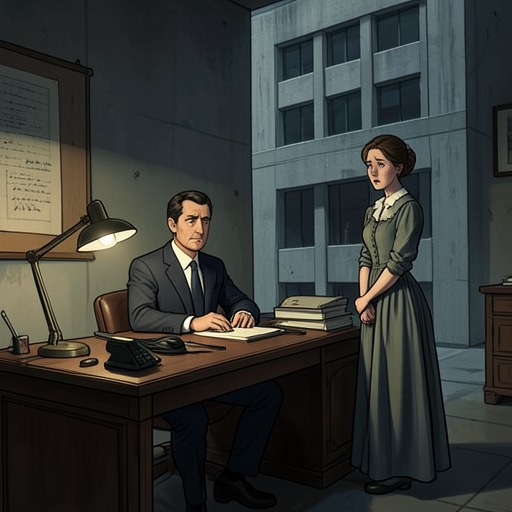
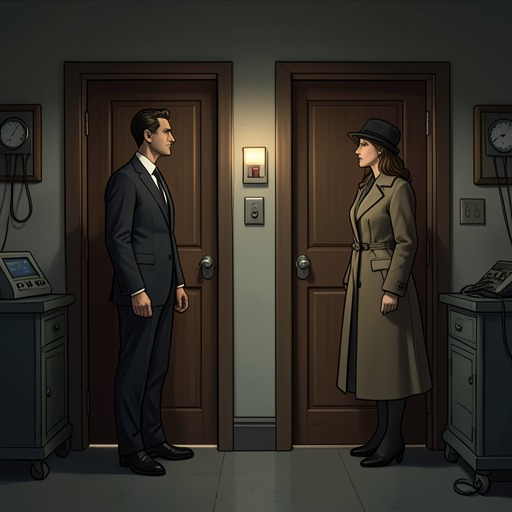
Pascoe is Ellie Pascoe’s husband and a senior police officer accustomed to balancing professional demands with domestic arrangements. When he had told Ellie that neglected paperwork would keep him at his desk late, she arranged for him to collect her from Cressida Maciver’s home rather than spend the money on both a babysitter and a taxi. The plan changed when the sitter became unwell and something came up at work: Pascoe arrived to take Ellie with him. His apparently ordinary pickup therefore became a threshold between a private evening and a developing police matter.
His manner is controlled, but not detached. When Pal’s disappearance is raised, Pascoe offers a simple explanation as possible and says he will call at the family house to see what is happening. He suggests that Ellie wait with Cressida until he knows how long he will be, while making clear that she can take a taxi if necessary. Ellie understands a warning beneath his relaxed delivery: he has heard enough to think she should remain with Cressida. She refuses, and the domestic exchange shows how police information can alter his judgment even before he has openly explained what concerns him.
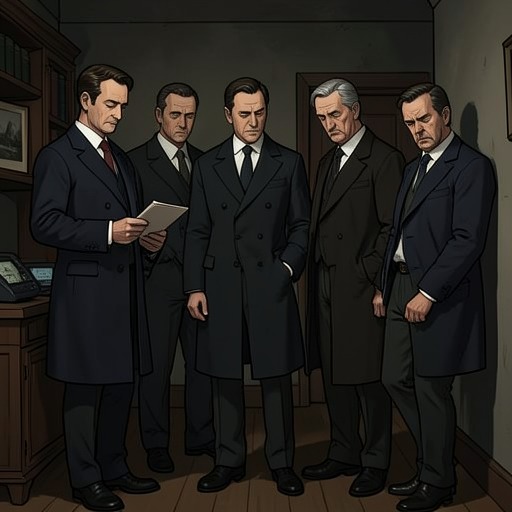
Pascoe’s position at the scene is more formal. With Helen Dunn and Jason Dunn back in their Volvo, Ellie speaking with Cressida beside the Spider, and Kay Kafka standing apart with a phone, he tells Dalziel that he should be the person to break the news because he is in charge. He treats the death as suspicious until he knows otherwise, a working presumption that makes the people connected with Pal potential suspects rather than merely grieving relatives. Dalziel, by contrast, questions both his judgment and his authority, chastising him for letting Helen and Jason leave after news of her brother’s apparent suicide, with a doctor and ambulance already at the scene. Pascoe responds by demanding a private briefing on what Dalziel knows about the family and place that he does not. The exchange makes their difference plain: Pascoe insists on the responsibilities attached to command, while recognizing that his superior possesses knowledge he needs.
The Old Case and a New Line of Inquiry
Pascoe’s decision to revisit the earlier suicide is deliberate. At the station he brings in Shirley Novello, an officer whose directness, quick learning, ability to follow orders while thinking independently, and demonstrated physical courage have earned his attention. He asks her to take him through the sequence of the previous case. In the account she begins, the dead man put a record on the turntable, set it playing, sat down, and started a note to his wife. Pascoe uses the file not as background to be passively absorbed but as material to be reconstructed step by step.
Dalziel notices the inquiry almost immediately. He has heard from Paddy Ireland that Pascoe is still dealing with the Maciver suicide, then learns that Pascoe has had Novello search the files on the older death and has gone off with her. When challenged about what he has been doing, Pascoe initially says he knows of nothing that Dalziel does not. The answer is evasive in effect, and the confrontation exposes a weakness in his attempt to keep the investigation’s direction to himself: Dalziel is watching both the case and Pascoe’s choices.
The old case also brings forward the recorded statement of Palinurus Maciver Junior. After the tape ends with the speaker identifying himself and giving the time and date as 1:53 p.m. on March 27, 1992, Pascoe asks Novello what she makes of it. His question turns her from listener into an investigator expected to interpret the evidence. Later, he asks Dalziel to engage with a poem, its envelope, the PM report, and the other details that trouble him. Dalziel’s theatrical astonishment at being asked to read poetry gives way to close attention. The contrast matters: Pascoe is willing to place an unconventional item beside more conventional investigative material if it may illuminate the case.
Curiosity, Family Testimony, and Doubt
Pascoe’s search is not simply procedural. He understands that Kay Kafka is the family’s focal point: people seem either to worship or revile her. The old allegations on Pal Junior’s tape, together with Dalziel’s apparent efforts a decade earlier to protect Kay and make those accusations disappear, invite a question about who was abusing whom. Pascoe cannot yet see how the old conflict bears on the present death, and he hopes that it will not. He would rather establish that Pal died by suicide and return to statistical analysis than follow a trail whose implications remain unclear.
That wish does not hold. Pascoe recognizes that his own appetite for understanding human motives has helped bring him into police work, and it defeats his preference to stop at a simple finding. The recording leaves him weighing two possible lines of inquiry: Kay’s influence over people around her and the obsessive quality he detects in Pal Junior’s statement. He does not treat either as a settled explanation. Instead, he continues because the competing possibilities cannot be sorted out without further investigation.
His conversations with Kay show how he proceeds through personal history. On his way to see her at Casa Alba, he asks Dolly Upshott for directions and checks how Kay is bearing up. When he meets Kay, the conversation touches on Emily Dickinson before he brings it back to the case and asks how her relationship with her stepson had developed. Kay says it ended better than it began, while questioning the relevance of the subject. Pascoe presents the question as an attempt to add detail to a larger picture, drawing on what Dalziel has told him without claiming that the relationship itself proves anything.
A photograph supplies another precise but incomplete clue: its date and time place it on the same night as, and not long before, Pal’s suicide. Back at his car, Pascoe reviews what he has gathered and finds that it remains a mixture of doubts and whispers rather than a coherent report. The photograph narrows the chronology but does not settle what happened. His willingness to state the insufficiency of the material is as important as his drive to collect it; a clue can be significant without yet being conclusive.
Evidence, Trust, and Professional Conflict
Pascoe’s partnership with Dalziel is marked by both friction and dependence. When Pascoe asks where the inquiry should go next, Dalziel insists that its subject is whether Pal killed himself and that other matters are irrelevant if he did. Pascoe asks whether Dalziel still believes it was suicide, privately considering whether he himself is beginning to move toward that view. The exchange does not erase their disagreement; it forces Pascoe to test the boundaries of the case and consider whether his investigations into the past are clarifying the death or drawing him away from it.
Forensic comparison then connects Pascoe personally to a piece of evidence. Arnold Gentry tells him that a sheet of paper Pascoe left with the police bears exactly the same palm print as one found in the investigation. Gentry assumes Pascoe knows whose print it is, calling it one mystery solved. Pascoe avoids Dalziel’s accusing stare by pretending to lick the last drops from his tumbler. The gesture gives no explanation of the print, but it records the pressure of the discovery: an item Pascoe supplied has become part of the evidentiary picture, and the revelation changes how others look at him.
His handling of Dolly Upshott’s visit offers a quieter view of his professional conduct. She comes to see him at home rather than the station because she fears that going to the police station would expose her to a formal, public process. Her joking description of interrogation equipment cannot hide her agitation. Pascoe asks her to sit down, explains that he has not had breakfast and needs coffee before he can function, and offers her some. Once he has heard her statement, he carries its microcassette to Dalziel and identifies it as the reason he was late. The statement enters their work through a personal visit, but Pascoe brings it back into the shared investigation rather than keeping it to himself.
Judgment and the Limits of the Record
The most consequential decision comes when the recording is played and the question becomes what the investigators can do with it. Pascoe says it should be burned: they cannot use it, and they do not know how much of it is true. The decision is not a declaration that the recording is false, nor does it settle the accusations it contains. It acknowledges that evidentiary importance and evidentiary reliability are not the same thing. An account may alter the investigators’ understanding and still fail the standard needed for use.
That ending gathers the pressures running through Pascoe’s inquiry. He has pursued an older file because the present death cannot be understood in isolation; he has listened to people whose accounts challenge one another; and he has continued to ask about motives even when the practical case might be easier to close. Yet curiosity does not entitle him to convert suspicion into fact. His decision to reject the recording as usable evidence places restraint beside investigation: he keeps searching for an explanation, but refuses to treat uncertainty as proof. The novel’s account of Pascoe therefore rests not on a neat resolution in the available evidence, but on the difficult boundary between what a detective can suspect, what he can establish, and what he must not claim.