September 11 attacks
Good Morning, Midnight (Reginald Hill Edition)The September 11 attacks are not shown directly; their significance emerges through the changed judgments and choices they provoke. In the aftermath, Tony Kafka questions where he belongs, whether his work remains compatible with his understanding of American responsibility, and whether the business world around him has truly changed. The attacks thus become a turning point whose effects reach from his family life to the political assumptions underpinning his professional relationships.
Background and narrative treatment
The narrative approaches the attacks retrospectively, through conversations and reflections rather than a depicted scene. Tony and Kay Kafka discuss the period after the attacks, when, as Tony recalls it, certainty had given way to conversations about everything. The absence of a direct account of the event places emphasis on what follows: a personal and political reckoning that continues after the immediate crisis.
The book identifies September 11 as a break in the ordinary order of things, but its evidence here is chiefly about interpretation, not the attacks’ mechanics. Kay recalls that Tony’s instincts had told him to return permanently to America. At the same time, Helen Dunn was three months pregnant, and Tony understood how his wife would feel about such a departure. He stayed in Britain. The decision therefore emerges not as a simple rejection of home, but as a choice constrained by care for his family and accompanied by unresolved unease.
Tony Kafka’s divided loyalties
The attacks sharpen Tony’s existing connection to America into a question of obligation. He speaks of the country as a place where good Americans ought to be, yet distinguishes his attachment to Kay from his discomfort with Britain. Kay reassures him that they are as good Americans as they can be; Tony, however, suspects that a time is coming when more will be demanded of them. His words make national belonging feel less like a settled identity than an approaching test.
That uncertainty also unsettles Tony’s understanding of patriotic debt. His father had taught him that help received creates a debt that can never truly be repaid, recalling the American sergeant who carried him to safety and died after being shot. Tony recognizes that personal debts and patriotic debts are not always the same. After September 11, he looks again at where he is—in every sense—and wonders whether he should be there. The repeated question of place links his physical location, his family commitments, and his allegiance to the country he has not returned to.
Business and political consequences
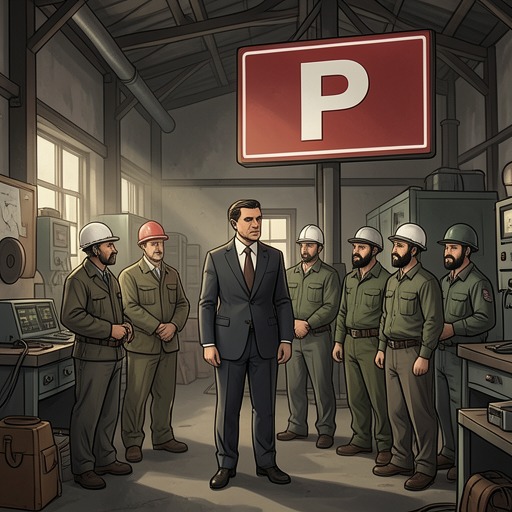
Tony’s doubts take professional form when he considers whether to slow or cool the business. In conversation with Victor Warlove and Timothy Gedye, he invokes the war against terrorism as a reason to ask whether continuing as before is wise. Victor, by contrast, treats the new situation as a marketing opportunity. Their exchange exposes a conflict of values: Tony sees circumstances demanding caution, while Victor sees the possibility of commercial advantage.
The disagreement is sharpened by the partners’ different readings of the political climate. Victor reflects that profit and patriotism once seemed inseparable, but that the atmosphere has changed. Timothy notices that Tony’s heart may no longer be in the work and suspects he has a particular reason for wanting to remain within the mainstream. Tony does not lay out every concern in the meeting; his hesitation, including raising soup and returning it untasted, registers his reluctance to proceed as though nothing has shifted. The contrast is not simply between American and British attitudes, but between Tony’s misgivings and colleagues who can absorb the crisis into familiar business calculations.
Aftermath and significance
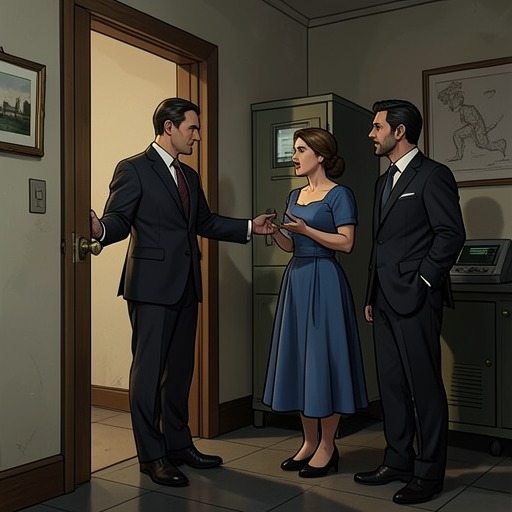
Kay sees the same divide from within Tony’s family life. She dislikes Joe Proffitt, head of the Ashur-Proffitt Corporation, but feels unable to speak too strongly against him. She believes Tony’s instincts had urged him home after the attacks, while her view of Joe is that his business certainties have scarcely been dented. Tony rejects the idea that Joe is indifferent: he says Joe feels things strongly, though they do not meet face to face often enough. Their disagreement leaves a meaningful uncertainty between Tony’s defense of his colleague and Kay’s suspicion that business has carried on largely unchanged.
Tony does try to communicate his concerns. On a train, he speaks with Joe on an open line, giving him what information he can, and they agree to bring forward the following month’s strategy meeting. Tony expects to return home within a day or so. The decision converts unease into action, even though the conversation does not establish that the corporation’s underlying course will change. For Kay, meanwhile, Tony’s continued presence in Britain remains tied to Helen’s pregnancy as well as to his divided sense of duty.
The event’s narrative force lies in this uneven aftermath. Tony experiences September 11 as a rupture that makes location, patriotism, and commercial loyalty newly uncertain. Victor can describe the same changed world as an opportunity, and Kay sees little evidence that Joe’s business outlook has been transformed. The attacks therefore do not supply a single shared interpretation; they expose the distance between a crisis felt as a demand for moral reconsideration and one treated as a condition to navigate commercially.