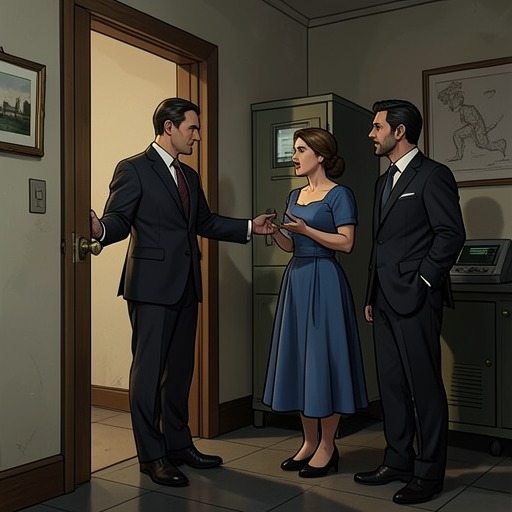
Thatcherite privatization
Good Morning, Midnight (Reginald Hill Edition)Thatcherite privatization is presented as the conspicuous public explanation for the transfer of Maciver’s to Ashur-Proffitt, but the account of the takeover steadily unsettles that explanation. What looks like a familiar sale of British industry is revealed as a covert arrangement involving government oversight, contested arms trading, and attempts to manage the evidence against the company.
Public account and hidden structure
To outside observers, the takeover appeared to be either another step in commercial globalization or part of the Thatcherite sell-off of British industry; which description seemed apt depended on the observer’s politics. The narrator then reverses the apparent meaning of the transaction: at a moment when privatization was the prevailing political language, the change amounted in practice to a kind of covert nationalization. The business, now known familiarly as Ash-Mac’s, had become the responsibility of people in Whitehall and Westminster, with others in Washington, D.C., keeping watch.
That reversal makes privatization more than a label for a change in ownership. The public account emphasizes a private commercial transaction, while the concealed arrangement places the firm’s activities and security within the concerns of the state. The gap between those versions is central to the novel’s treatment of political and economic power: the visible transfer does not disclose who is monitoring the company or whose interests its operations serve.
Arms trading and the cloak of invisibility
The novel links the company’s history to a wider pattern of politically convenient arms sales. In a deliberately whimsical account, American officials sell arms to Iran and direct the profits to the Contras, while British officials sell arms to Iraq during its war with Iran. The tale’s childlike language clashes with its account of conduct described as contrary to the laws of both countries. Its central image is that the participants are invisible to those who should be able to see what they are doing.
This image sharpens the criticism of the public story surrounding the takeover. In both the arms-trading account and the corporate account, official language and public appearances obscure the networks of responsibility beneath them. Privatization supplies the surface explanation for the company’s change of ownership; the cloak of invisibility suggests how unlawful or politically sensitive activity can persist behind respectable institutional appearances.
Maciver’s allegations and the management of risk
The hidden governmental interest becomes urgent when Palinurus Maciver Senior, the former owner, begins accusing the firm of breaking sanctions and engaging in other illegal trading. He has been moved into what those around the company regard as a meaningless advisory directorship. If he can produce hard evidence, his allegations could become a scandal, not simply a personal objection to losing control of the business.
The threat is handled as a problem of information and credibility. American management assures the British investigators that the matter is under control, but Laurence Waverley is sent to Yorkshire under the cover of a Value Added Tax investigation to assess the situation independently. His inquiry discovers that Maciver has hired Jake Gallipot to obtain evidence. Waverley describes Gallipot as ruthless and venal; a combination of threats and bribery brings him onto the investigators’ side. Meanwhile, Maciver has been isolated from legitimate access to sensitive areas of Ash-Mac’s, leaving him with accusations that could be dismissed as the complaints of a former owner who cannot accept his loss of power. Waverley’s recommendation is to undermine Maciver’s credibility and allow events to take their course.
Significance of the contrast
The account does not present privatization as a simple disappearance of state power. The takeover instead places the firm within a less visible structure of government responsibility and oversight, while the public vocabulary of globalization and privatization makes the transfer appear ordinary. Maciver’s allegations threaten to make that concealed structure visible, and the response described by Waverley focuses on controlling access to evidence and discrediting the person raising the alarm.
Thatcherite privatization thus names the public frame against which the novel sets a more complicated account of ownership and power. Its irony lies in the difference between what the takeover appears to be and what it becomes: a nominally private business whose security is watched by government, and a former owner whose warnings may be neutralized not by resolving them but by weakening his standing.