The Junius intrusion into Ashur-Proffitt’s website
Good Morning, Midnight (Reginald Hill Edition)The Junius intrusion into Ashur-Proffitt’s website is a corporate disclosure episode whose importance lies as much in its point of entry as in its allegations: a link presented as ordinary company information redirected visitors to an unauthorized site exposing material about the company’s past. The disclosures connected Ashur-Proffitt to the Arms for Iran scandal and to Iraq, while the intrusion also made visible the distance between the restructured business and the old Maciver’s. Its author’s identity remained uncertain, though Kay Kafka came to suspect Francis Phillips.
The intrusion and its disclosures
The site was not found through an especially difficult search. A sergeant explained that whoever had set up Junius had placed a hyperlink within the Ashur-Proffitt website itself. Clicking the company’s More Information about our overseas operations link unexpectedly transferred a visitor to Junius, where its material appeared. That route made the disclosure pointed: the company’s own informational doorway became the means by which visitors were directed to allegations against it.
Junius claimed that at least one Ashur-Proffitt subsidiary had been involved in the Arms for Iran scandal. As the sergeant summarized the allegation, it concerned sanction-breaking: arms were arranged for sale to Iran, and the profits were then used to subsidize the Contra guerrillas in Nicaragua. The site also contained extensive material about Iraq. These are presented as Junius’s claims, not as findings independently established in the episode; the account records the accusation and its political context without resolving its truth.
The name Junius recalled the pseudonym of an eighteenth-century writer who attacked the government, the judiciary, and George the Third, and whose identity was never conclusively established. The historical parallel gives the modern intrusion a recognizable posture: an anonymous critic using public argument to challenge powerful institutions. But the parallel does not identify the contemporary author. Even the historical candidate Kay later considered was only a clue around which she formed a suspicion.
A breach that exposes corporate change
The intrusion’s significance extends beyond the scandal allegations. The sergeant saw the material as demonstrating how far Ash-Mac’s had moved from the old Maciver’s. The company’s overseas operations and corporate structure represented a transformation that, in his reading, could have been deeply unsettling to Pal senior. Though given a job, Pal senior may have gradually understood it to be merely token; the sergeant speculated that he first tried to assert his influence, then had to face that he was no longer the man he had been.
That interpretation links corporate change to personal rupture. The sergeant imagined Pal senior feeling not only betrayed by the business but also as though he had betrayed its employees. He thought this might help explain how Pal senior could have cracked. The scene does not establish that the website’s disclosures caused Pal senior’s decline, nor that the company’s changes alone account for it. Rather, the intrusion supplies a way to see the institutional upheaval against which the sergeant interprets that decline: what had happened to Maciver’s was not an abstraction but a loss of authority, belonging, and responsibility as he understood them.
Removal and Kay Kafka’s suspicion
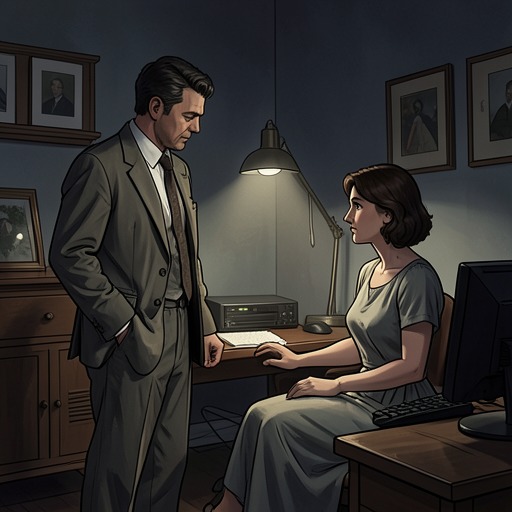
By the time Kay Kafka sat at her computer looking at the Ashur-Proffitt website, its designers had been alerted to the Junius invasion and had removed all visible traces of it. The cleanup ended the site’s immediate appearance on the company page, but it did not persuade Kay that the matter was over. She expected Junius to return. The contrast between rapid removal and anticipated recurrence leaves the intrusion unresolved: the company could erase the visible link, but that did not settle who was behind it or whether the disclosures would reappear.
Kay had investigated the pseudonym out of idle curiosity and learned that the identity of the original Junius had never been established, although Sir Philip Francis was considered the likeliest suspect. She took the resemblance between that name and Francis Phillips as more than coincidence, concluding privately that Frank was the person behind the modern Junius. Her reasoning drew force from the fact that Frank had cause to hate Ashur-Proffitt, just as she had cause to hate him. The narrative presents this as Kay’s conviction, not confirmation: no identification is made public or independently verified in these scenes.
Private knowledge and unresolved consequences
Kay considered telling Tony Kafka about her suspicion, then decided against it. Her decision was not a simple declaration of forgiveness: she acknowledged that Frank had wronged her and that she had sometimes taken revenge, though in a general rather than specifically targeted way. At the same time, she credited him with bringing her the greatest joy of her life and did not hold him responsible for its greatest pain. Those conflicting feelings help explain why the possible identity of Junius remained private knowledge rather than information she passed to her husband.
She was also concerned that some of Tony’s associates might react extremely to discovering who Junius was. From what Tony had said that morning, Kay understood that his attention had shifted away from identifying the intruder and toward the possible reactions of those around him. Her silence therefore sits at the intersection of personal history and corporate danger: she suspects an old adversary, recognizes the capacity for revenge on both sides, and withholds the suspicion while anticipating a volatile response. The intrusion leaves several matters open at once—the truth of the allegations, Junius’s identity, and the consequences of bringing that identity into the open.