Vic Chakravarty
Good Morning, Midnight (Reginald Hill Edition)Vic Chakravarty, a neurological consultant at Central Hospital, occupies a crucial intersection between medicine, inheritance, and private loyalty. What first looks like an uncertain lead in the investigation of Palinurus Maciver Junior’s will becomes more compromising when Peter Pascoe learns that Chakravarty was involved with Cressida Maciver, one of the will’s principal beneficiaries. His reluctance to confirm whether Palinurus was his patient is therefore not simply an obstacle to obtaining medical evidence; it is also a conflict between professional disclosure and personal attachment.
Identity and Introduction
Chakravarty is first identified through the name on a parking space at Central Hospital: V. J. R. S. Chakravarty, neurological consultant. The space belongs to a Maserati, a distinctive enough car for Peter Pascoe to pause over it. The name links a polished, expensive vehicle to a specialist whose possible connection to the Maciver family has not yet become clear. Pascoe’s first thought is not that Chakravarty must be treating Cressida, but that the possibility matters: if she is a patient, the car and its owner may have a bearing on what he is investigating.
Pascoe then encounters Chakravarty in a hospital corridor with Tom Lockridge. Lockridge is doing most of the talking and does not notice Pascoe until the two men are nearly face to face. Chakravarty, by contrast, pauses when Pascoe appears. The narration presents him as tall, slim, and handsome, and gives his departure its own emphasis: before rounds, he politely tells Lockridge not to worry about him, smiles at Pascoe, and walks away with conspicuous ease. The encounter establishes his professional setting and physical presence, but leaves the nature of his association with Lockridge open. Only after Chakravarty has gone does Lockridge identify him to Pascoe as the neurological consultant.
The Medical Connection
Lockridge supplies the first indication that Chakravarty may have treated Palinurus. A couple of months earlier, Lockridge saw Palinurus leaving Chakravarty’s consulting room. At the time, Lockridge attached little significance to the sight because the two men sometimes played squash together; a visit might have been social rather than medical. That uncertainty becomes important after Palinurus’s death and the discovery that he changed his will, sharply reducing what his wife, Sue-Lynn Maciver, would inherit.
Lockridge reasons that evidence of a neurological consultation could support an argument that Palinurus was mentally unstable when he altered the will. He is not a detached observer: he loves Sue-Lynn, believes their relationship has a future, and says their prospects depend on getting the will overturned. He therefore wants Chakravarty to disclose what he knows. His own financial anxiety, as well as his affection for Sue-Lynn, gives his appeal a personal stake; his suggestion that the medical evidence could help is an interested interpretation, not confirmation that Palinurus was incapable of making a rational decision.
That distinction remains unresolved when Edgar Wield visits Chakravarty. Wield reports that Chakravarty initially seemed ready to cooperate, but changed his position when asked directly about Palinurus. He would say only that he could not at that time confirm whether Palinurus had been his patient. The phrasing preserves uncertainty rather than establishing that Chakravarty treated him. It also marks the limit of what the investigators have been able to obtain: the consultant neither confirms the appointment nor supplies the medical information Lockridge hopes might affect the will dispute.
The Will Inquiry and Cressida Maciver
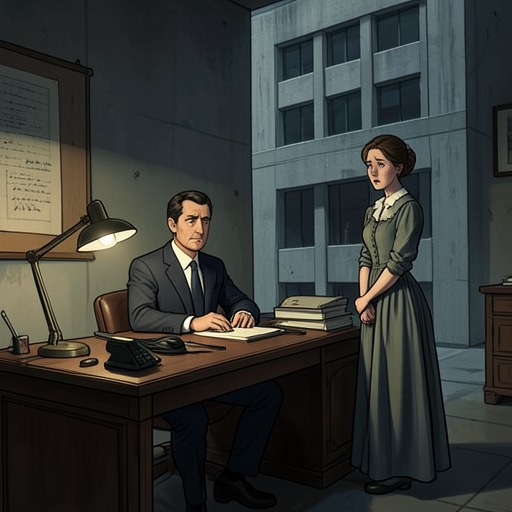
Chakravarty’s guarded response draws the police into a second line of inquiry. Wield reaches his office after his secretary initially blocks access; mentioning the name Maciver gets him admitted. When Wield explains that the police want information about Palinurus, Chakravarty withdraws from apparent cooperation and refuses to confirm the doctor-patient relationship. His professional position makes that refusal consequential, but the investigation eventually supplies a personal explanation for why a court appearance would be difficult for him.
Pascoe acts on that explanation indirectly. When he telephones Central Hospital, the secretary says Chakravarty has already spoken with an officer that morning and is very busy. Pascoe does not continue to ask for an interview about Palinurus. Instead, he asks her to tell Chakravarty that he would be willing to interview him at home, and specifies that he wants to discuss Cressida. The change in subject is a deliberate pressure point: Pascoe has recognized that the name of the beneficiary, rather than the medical question alone, may alter Chakravarty’s calculation.
The concealed relationship is then made explicit in the investigators’ account. Chakravarty had been involved with Cressida, Palinurus’s sister and one of the main beneficiaries under the altered will. Lockridge had approached him hoping to obtain evidence that could help Sue-Lynn challenge the will. In doing so, he had raised the prospect of Chakravarty giving evidence for the plaintiff in a dispute whose opposing interests included Cressida. The disclosure recasts Chakravarty’s silence: a witness statement about Palinurus’s health could also place him in court against the woman with whom he was involved.
Narrative Role and Significance
Chakravarty remains a character known chiefly through encounters and other people’s accounts. The reader sees him in the corridor, hears Lockridge’s uncertain recollection of Palinurus leaving his consulting room, and receives Wield’s report of a carefully limited answer; the explanation of his relationship with Cressida arrives through Pascoe’s deductions and the investigators’ conversation. This indirect presentation keeps the precise medical facts unresolved even as the personal conflict becomes clearer.
His role turns a seemingly straightforward evidentiary question into a collision of competing obligations. Lockridge wants medical information because it might support Sue-Lynn’s challenge to the will; Chakravarty’s professional confidentiality constrains what he can disclose, while his involvement with Cressida gives him a personal reason to avoid becoming a witness against her. The novel does not, in the supplied account, establish that Chakravarty did treat Palinurus or reveal what he might know about Palinurus’s condition. Instead, it shows how the possibility of medical evidence becomes entangled with the distribution of an inheritance and the loyalties of those drawn into the dispute.