Waverley's sleep-mode status
Good Morning, Midnight (Reginald Hill Edition)Waverley’s sleep-mode status is an intelligence operative’s conditional withdrawal from active work, not a true retirement. Laurence Waverley enters it after a gunshot wound leaves him unable to return to field work; years later, Palinurus Maciver Junior’s death draws him back into service. His return makes the arrangement’s double nature plain: he can come to Lavinia Maciver as a friend while also reporting to his agency, and when his reactivation ends, he expects to resume the dormant life from which he was recalled.
What sleep mode means
Waverley explains that sleep mode is the agency’s alternative to an ordinary desk assignment for an operative who can no longer work in the field. It permits him to pass the remainder of his life in what appears to outsiders to be normal retirement from whatever job he claims to have held. That appearance conceals a continuing obligation: in times of need, an operative in sleep mode may be reactivated. The status is therefore neither a conventional pension nor permanent release from service. It is a pause whose duration depends partly on the agency’s future needs.
The distinction is sharper in Waverley’s account of his profession. He tells Peter Pascoe that no one truly retires from the business and that resignation is the agency’s euphemism for death. Against that stark choice, sleep mode offers a living operative a way to withdraw without formally leaving the agency. The arrangement also protects its secrecy: to the outside world, the operative’s life can look like retirement, while the agency retains the means to call him back.
Injury and the choice to withdraw
Before Palinurus Maciver Junior’s death brings him back to Mid-Yorkshire, Waverley has already left the area and returned to his daily work. An altercation leaves him with a gunshot wound to the leg. During recovery, he chooses to return to Mid-Yorkshire for a convalescent holiday and to renew his acquaintance with Lavinia, a visit he recognises as contrary to the rules.
Waverley says the injury will impair his movement and that he is told he will not return to field work. He presents himself as disappointed, declines the routine desk job offered to him, and opts for sleep mode instead. His account allows for some performance in this response: he admits that he may have exaggerated the extent of his impairment. But the decisive practical limit remains—the agency has ruled out field work—and sleep mode is the alternative he actively chooses rather than desk service.
His return also renews his connection with Lavinia. He finds that her condition has noticeably deteriorated, though she continues to struggle without complaint. During his visit he helps her in various ways, and he later takes satisfaction in seeing her enter a long period of remission. She has kept the seriousness of her illness from her family, who, in Waverley’s view, have failed to notice more than what might be attributed to age. His convalescent visit thus belongs both to his personal friendship with Lavinia and to the life he leads between periods of agency activity.
Reactivation in Mid-Yorkshire
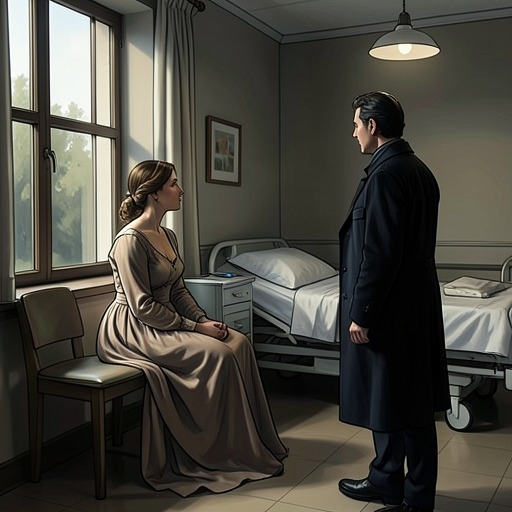
When Waverley hears of Palinurus Maciver Junior’s death, he goes straight to Blacklow Cottage to tell Lavinia the news, presenting the visit as an act of friendship. Palinurus has died by suicide at Moscow House, like his father before him. Waverley’s delivery of the news brings him and Lavinia onto first-name terms, but it also makes his position more complicated: as well as caring about her, he is obliged to report the unusual circumstances of the death to his superiors.
From then on, he says, he acts as the agency’s ears in Mid-Yorkshire. His work is not simply to pass on the news of a death; he develops an interpretation of what led to it. He suspects that Palinurus came across something that made him reconsider the circumstances of his father’s death, perhaps a record of his dealings with Jake Gallipot. Waverley sees a resemblance between the two cases: Palinurus, like his father, may have hired Gallipot ostensibly for one purpose and gradually turned him toward another. How he did so is unknown to Waverley, who speculates that bribery, alcohol, drugs, or some combination may have been involved. In his view, Gallipot eventually disclosed everything he knew or suspected about the elder man’s death.
Waverley treats this reconstruction as informed but incomplete. The accident that deprived Pascoe of the chance to question Gallipot has left a gap in the evidence. He believes the information would have shocked Palinurus, but doubts that it alone explains the suicide. He infers that a more immediate cause must have brought Palinurus to that decision; once his mind was deranged, Waverley suggests, he repeated his father’s death as closely as possible, using whatever garbled account Gallipot had given him as a template. These are Waverley’s conclusions about the case, not a complete account confirmed by direct questioning of Gallipot.
Return to sleep mode
Waverley describes his reactivation as interesting and says he is glad to have served his country again. Yet he does not present the renewed service as a permanent return to active work. Once the matter is satisfactorily settled, he looks forward to going back to sleep. The ending confirms the operating logic of his status: a dormant operative can be called back when the agency judges it necessary, serve for a limited period, and then anticipate another withdrawal.
That cycle gives sleep mode its particular tension. Waverley’s apparent retirement is real in its ordinary rhythms, but provisional in the eyes of the agency; personal ties persist through it, while professional duties can abruptly resume. In Mid-Yorkshire, the distinction is embodied in a single visit to Lavinia: he arrives bearing news as her friend, yet the same death activates his obligation to report and investigate. When his work is done, he expects not a final severance but another interval of sleep.