Aether
Good Morning, MidnightAether is the spacecraft at the center of the novel’s interplanetary mission: a six-person vessel that carries its crew to Jupiter and back, and the confined home in which they confront the loss of contact with Earth. Its significance lies in the contrast between extraordinary reach and physical vulnerability. The crew travels farther into space than any humans before them, yet their connection to home depends on delicate equipment, shared labor, and signals that may never come.
Construction and Mission
Aether had been planned for years and assembled in orbit from components built on Earth. During Sully’s earlier service aboard the International Space Station, she could sometimes see the craft glinting in sunlight from a distance. Its eventual return from Jupiter was expected to end in a docking with the station, where Aether would become a permanent addition. For astronauts competing for a place on the voyage, the mission promised not only a historic journey but a place in the history of spaceflight.
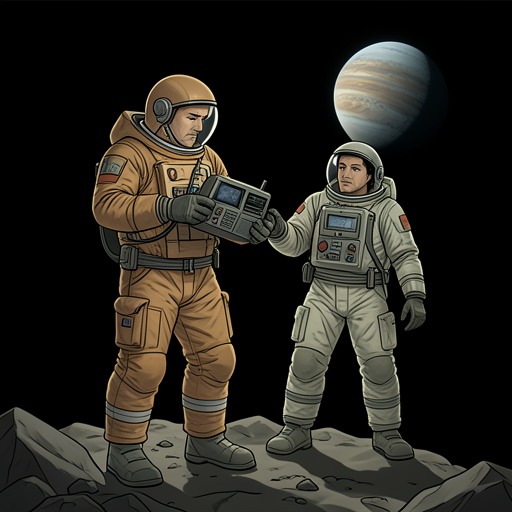
The six-person crew—Sully, Harper, Devi, Thebes, Ivanov, and Tal—conducted a survey of Jupiter and its moons. They gathered rock samples on Ganymede and left probes in the Jovian system, whose telemetry Sully monitored from the communications pod. The mission’s scientific work had a collective purpose: the discoveries were intended for the world, not merely for the astronauts making them. On the return leg, Jupiter was only days behind the spacecraft, and Aether was finally headed home.
A Home in Deep Space
The ship’s scale changed with the crew’s perspective. At first it had seemed immense; after more than a year in space, Sully thought of it as a small life raft. The living quarters were concentrated in a centrifuge, where the six astronauts shared a compact environment amid the larger spacecraft. Outside it were storage tanks, radiation shields, solar panels, the propulsion system, a greenhouse, life-support areas, and research pods. The cupola offered a clear view into the surrounding darkness, while the command deck and communications pod connected observation, navigation, and the crew’s work.
The crew retained the precise daily regimen prescribed by Mission Control even after it stopped responding. Sully’s clock read 0700 GMT when she woke; lights gradually simulated an Earth-like dawn, and the ship’s life-support systems and centrifuge supplied the familiar sounds of an otherwise quiet morning. Her habitual touch of a photograph in her sleeping compartment linked this routine to the life she had left behind. These repeated, practical details made the vessel feel inhabited, but they could not make it Earth.
Jupiter and the Silence from Earth
The survey transformed the crew’s sense of scale. As they contemplated Jupiter and its four Galilean moons, the strain and anxiety that had accompanied their departure gave way to reverence. Jupiter’s immense, storm-marked atmosphere and the distinct surfaces of Callisto, Ganymede, Europa, and Io made the astronauts feel small and newly oriented within a universe beyond their comprehension. The experience changed each of them differently: Ivanov turned eagerly to scientific analysis, Thebes and Devi spent long stretches looking out from the cupola, Tal became exuberantly energetic, and Harper filled notebooks with sketches. Sully immersed herself in probe data and, for a time, felt at peace with the sacrifices that had brought her into space.
That sense of purpose depended on being able to share what they learned. Mission Control had fallen silent shortly before the Jovian survey began. At first the crew continued working and treated the interruption as potentially temporary. But a day passed, then another, and nearly two weeks went by without contact. The Deep Space Network’s geographically separated sites were designed to maintain coverage as Earth rotated, so a failure at the Goldstone facility in the Mojave Desert should not by itself have ended communication. As the silence persisted, the crew’s anticipation of returning home became harder to separate from the possibility that no one was waiting. Aether could still receive signals from distant celestial sources; it was Earth that remained absent.
Sully kept searching the airwaves and sending transmissions, privately sustaining the hope that someone might answer. Her receivers continued to register space, and she checked their memory banks, probe connections, and telemetry. Then a cacophonous bang was followed by the loss of even the static she had been hearing. Looking out through the cupola, she saw what appeared to be the main communications dish drifting away from the ship. Aether’s route home remained known, but its means of reaching Earth had been severed.
Repair, Loss, and Return
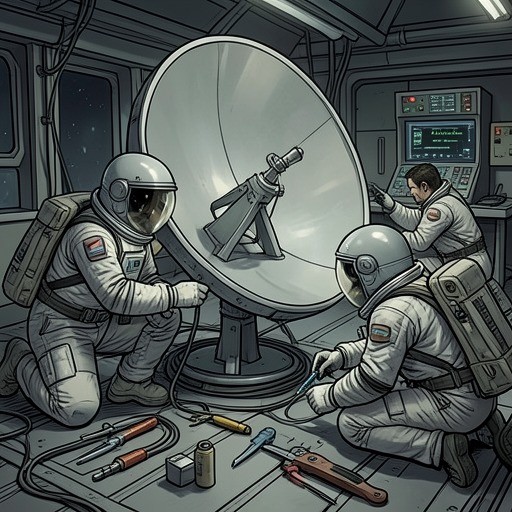
Sully and Devi went outside to install a replacement dish at the aft of Aether, where the original had been attached. The remote modification tool could not reach the site, so the two astronauts moved along the hull, tethered to the ship, while Harper followed their progress through the EVA cameras and helped guide their route. At the installation point, they secured the new dish, arranged its loose wires, and worked to connect its mast to the hull. The repair depended on careful cooperation: Devi handled the wiring, while Sully supplied the requested tools.
During the work, Devi’s suit scrubber failed because its lithium hydroxide cartridge had stopped functioning. She had not noticed the problem until she was already struggling to breathe. Harper urged her to return to the airlock, but Devi said there was not enough time. She convulsed, dropped a tool into the darkness, and lost consciousness while Sully remained gripping the dish mast. The attempt to restore Aether’s communications thus brought the danger of its isolation into immediate, devastating focus.
A week after the dish had broken away, the crew received a signal again. Sully and Thebes recovered telemetry from the probe on Europa, then calibrated the new communications system, adjusting its gain and squelch until its reception was as good as it could be. The restored equipment did not guarantee that anyone on Earth would answer, but it meant that Aether could listen and that the crew had done what they could to make contact. For Sully, that work offered a limited reprieve from helplessness and isolation.
Aether ultimately docked with the International Space Station. Through its windows the crew saw Earth’s blue oceans, clouds, and the station’s solar arrays spread around the central structure. But the station was not a waiting home: machines remained on, food packets floated in the kitchen, and no other astronauts were there. Two of its three Soyuz reentry pods were missing. The remaining pod had three seats, leaving the five survivors to face the possibility that three would descend while two remained in orbit. With no ground team known to be waiting and the condition of Earth uncertain, neither return nor continued residence in space was clearly safe. Aether brings its crew back to Earth’s vicinity, but the silence that began on the journey leaves the meaning of home unresolved.