Aether’s First Antenna-Repair Spacewalk
Good Morning, MidnightSully and Devi’s first antenna-repair spacewalk is the crew’s first practical response to the loss of Aether’s main communications dish: a hazardous exterior inspection that yields a viable plan, not a completed repair. The walk makes the ship’s communications failure physically visible, tests the crew’s trust and coordination, and sets up a second operation whose risks will prove fatal for Devi.
Causes and Stakes
The immediate cause was the main communications dish breaking away from Aether about a week earlier. Its loss had abruptly silenced the crew’s link to the outside and interrupted the reception of data from the probes. Sully had continued scanning for Earth’s radio noise, hoping that someone would answer, but the expected signal never came. The dish’s absence turned that persistent search into a repair problem the crew had to solve from the outside of the ship.
The loss also exposed how much the mission depended on infrastructure that was easy to take for granted while it worked. At the observatory, Augustine had found that satellite phones and broadband were unavailable, leaving ham radio as a weak backup: its power supply and antenna sensitivity were poor, and it could reach only a nearby transmitter or a fortunate sky-wave. Aether’s damaged dish posed a related but more immediate obstacle. Restoring a usable communications path required exterior labor in a place where a tether separated the astronauts from open space.
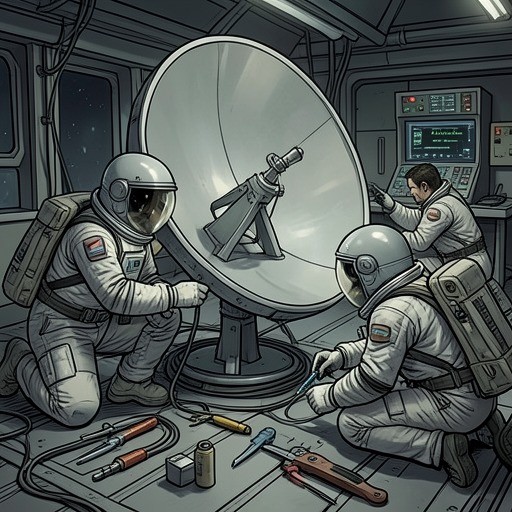
The repair was not a single straightforward task. The remote modification tool could reach problems near Aether’s living and working quarters, but its arm was too short to reach the dish’s former mounting point. Sully and Devi therefore had to travel along the hull themselves, inspect the site, and work out how a replacement could be installed. Their first excursion would establish whether that plan was practicable; it would not finish the installation.
The Walk Across Aether
Sully and Devi left through the airlock, with Sully taking a moment to look out from the chamber before moving into open space. From outside, Aether appeared much larger than it did from within. The storage tanks, radiation shields, solar panels, and propulsion system occupied much of the spacecraft’s exterior, while the centrifuge where the six crew members had lived seemed small by comparison. Sully passed the greenhouse, life-support areas, and research pods, then waved to the four crew members watching from the cupola.
The two women made their way aft toward the place where the communications dish had been attached, beyond the storage tanks and in front of the propulsion system. Tethered to the ship, they moved slowly over its enormous hull. Their steel cables floated behind them as they crawled across the surface, following a route that required them to navigate around the storage pods. The crew tracked their progress through cameras mounted on their helmets. Harper monitored the route from the command deck and offered suggestions when the women hesitated, but mostly allowed them to proceed at their own pace.
Sully’s recollection of an earlier space mission sharpened the meaning of that restraint. On the International Space Station, a former commander had directed her constantly during an earlier spacewalk, treating her as though she were following orders rather than exercising her own expertise. Harper’s quieter guidance offered a contrast: he kept the astronauts on course without taking over their work. As Sully moved from one handhold to the next, she considered how she had once wanted a place on the Aether crew so badly, and recognized that she had followed her calling. The reflection gave way to the immediate demands of the walk: Harper pointed out a ladder on a storage pod, Sully found its rungs, and she and Devi reached the aft at the same time.
Inspection and Return
At the damaged site, Sully put a gloved hand on Devi’s shoulder; Devi answered with a thumbs-up. They checked in with one another and tethered themselves to the work area. Their task was to inspect the damage and prepare for the replacement installation. The practical result was a viable plan and a clearer sense of what the next spacewalk would require.
The women spent more than five hours outside before closing the airlock behind them and waiting for the chamber to repressurize. The rest of the crew waited on the other side for their return. In the greenhouse corridor, Ivanov shook Sully’s hand, while Thebes and Tal hugged her. Harper’s visible worry gave way to relief. Thebes held on to Devi for a long time, like a parent reunited with a child. Their reception made the danger of the excursion palpable without changing its outcome: both astronauts had returned safely.
Afterward, the crew gathered in the cupola to review helmet-camera footage and discuss what should come next. They celebrated the successful planning and watched as damaged pieces of the old system were sent spinning into the asteroid belt, where they would drift for more than a million human lifetimes. Yet the debris’ long, silent journey was also a measure of what the crew had lost. The replacement still had to be installed, and the next walk would be less predictable: its repair work would be improvised, with no training for the task in the underwater facility.
Consequences and Significance
The first walk succeeded in a limited but consequential sense. It established that Sully and Devi could reach the mounting site, assess the damage, and prepare a workable replacement plan. It did not restore communications. Instead, it gave the crew a basis for attempting the more difficult follow-up operation, while making clear that technical recovery depended on the astronauts’ judgment and physical work as much as on the equipment itself.
The crew’s relief at the women’s return sits beside their concern about what remained. Harper ended the review by asking everyone to take a day of rest before the next excursion. The pause acknowledged both the intensity of the recent work and the uncertainty ahead. When the later repair effort went wrong, Devi’s failed lithium hydroxide scrubber cartridge left her suffocating inside her helmet; Sully was close by, but could not prevent her death. Afterward, the replacement system was calibrated, and signals from the Europa probe came through again. That later recovery gives the first walk a painful double significance: it was the necessary beginning of a successful restoration, but the beginning of a process that exacted a life.