Artemis Begins Replacing Its Communications Antenna
Good Morning, MidnightArtemis Begins Replacing Its Communications Antenna is the crew’s shift from arguing over the loss of their communications dish to organizing a risky, improvised repair. Aboard Aether, Sully proposes constructing a replacement from available parts, and Harper assigns the work to a team. The effort gives the ship a concrete purpose after months of quiet, but it begins without an explanation for the damage or any assurance that contact with Earth can be restored.
Background and Dispute
The repair begins in the aftermath of the antenna’s loss, with the crew gathered around the centrifuge and Ivanov demanding to know what Tal has done. Tal, holding his radar tablet, insists he has spent the morning monitoring the screen and detected no debris or asteroids within fifty miles. Ivanov counters that something must have collided with the dish, speculating that an asteroid in the main belt could have struck it, while also raising the possibility that the dish simply fell off. Neither explanation is established. The crew knows the antenna is gone, but not what caused it to break away.
Harper interrupts the argument and redirects attention from blame to the immediate communications problem. Retrieving the antenna now seems probably impossible, so he asks the crew to consider alternatives. The pause that follows makes the mood of the meeting visible: Tal turns away, Ivanov clenches his teeth, Thebes cracks his knuckles, and Devi traces a circle on the floor with her shoe. Harper repeats his request, this time more sharply. The scene’s turning point is not a discovery about the accident but a change of task: the crew must work with the damage they can address rather than settle a cause they cannot yet prove.
A Replacement Plan
Sully suggests making a new antenna, using the dish from the lunar landing module as its paraboloid and drawing on components she believes the ship already has. She warns that the substitute will have less gain, though she thinks it should function. Thebes considers the plan plausible but stresses that installation will require substantial extravehicular activity: one spacewalk to assess the damage and prepare the site, and another to install the replacement. He regards the danger as unavoidable, not trivial, and recommends proceeding without rushing.
The communications failure has broader consequences than the missing dish alone. Scheduled uplinks from the probes cannot be received while the receivers are dark, and Sully is uncertain whether the proposed system would be powerful enough to pick those signals up anyway. She also reports that Earth has been silent: she has detected no noise pollution or satellite activity. With no useful transmissions currently coming from Earth, the crew decides that restoring contact with it matters more than recovering the probe signals. The silence is therefore both a reason to take time over the repair and a condition that makes the repair’s eventual value uncertain.
Tal offers a parallel task. Given a few days, he will try to increase the radar system’s sensitivity, though he cannot promise that the adjustment will work. If crew members are to go outside, he wants a better understanding of the micrometeoroid population. Harper formalizes the division of labor: Sully, Devi, and Thebes will work on the replacement; Tal will investigate the radar and what may have struck the ship; Harper and Ivanov will examine the damage through the exterior cameras. Harper also tells Sully not to prioritize the Jovian probes. The plan thus pairs construction with investigation and hazard assessment, without pretending that any of them has already solved the underlying problem.
Salvage and Construction
Once the meeting breaks up, Sully and Devi head to the lunar module’s equipment. Devi, who had said nothing during the argument and planning, becomes animated as soon as they turn to the work, filling the walk with ideas for the replacement. Sully’s relief reflects the practical confidence she places in Devi’s ability to make the improvised plan work. The contrast gives Devi’s sudden talkativeness a specific function: the group’s earlier silence gives way to focused collaboration.
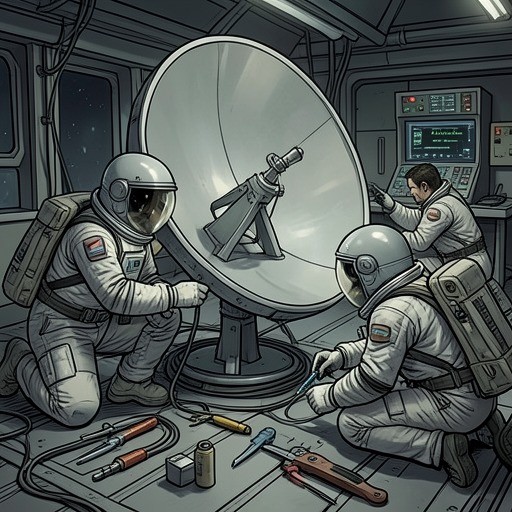
The three-person team searches the ship for components that can be spared. They take the dish from the lunar landing module and salvage redundancies from the communications pod. Sully and the engineers establish a staging area on the table in Little Earth, where tools are less likely to float away. They are already well into the replacement by the time Harper and Ivanov return from examining what little they can learn at the installation site. The work is not described as a finished repair: the crew has gathered materials and begun construction, while installation and the required spacewalks remain ahead.
Sully and Devi do most of the building, and Thebes supports them by handing over tools and preparing components. Their quick exchange over a drill and wire cutters shows a working rhythm forming through practical attention rather than further debate. The main lights in Little Earth dim automatically at the end of the day, leaving the individual bunk lamps to give the centrifuge a candlelit glow. By the crew’s watches it is midnight, but the problem has made the usual constraints of time feel less important. They are tired and invigorated at once; even Ivanov, who had been openly angry, becomes more amiable than he has been in months.
Consequences and Significance
The antenna project does not restore communications in this episode. Instead, it converts an unexplained failure into coordinated work: salvaging parts, assessing damage, improving radar, and preparing for two hazardous spacewalks. Its immediate consequence is a renewed sense of urgency and shared purpose aboard Aether. The contrast between the earlier argument and the crew working around a single table marks a meaningful change in their situation, even as the actual connection to Earth remains absent.
The replacement is necessarily provisional. Its expected gain is lower than the lost antenna’s, its capacity to receive probe signals is uncertain, and the source of the original damage is still unknown. The crew’s method is consequently careful rather than triumphant: investigate what can be assessed from inside, build with what can be spared, and avoid hurrying a repair that will expose people to risk. By ending on sustained construction rather than restored contact, the episode makes the crew’s renewed activity real while leaving its success unresolved.