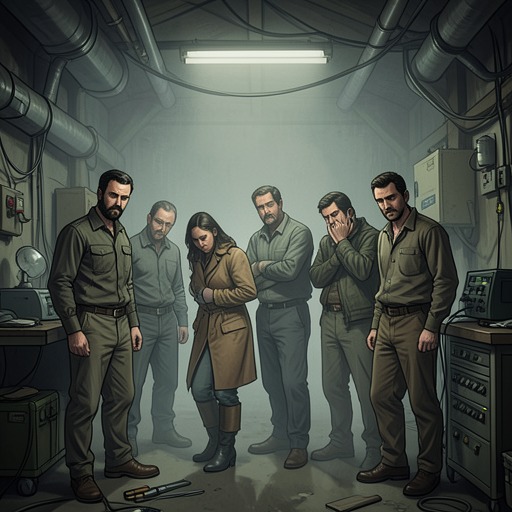
Artemis Crew’s Crisis of Isolation
Good Morning, MidnightThe Artemis Crew’s Crisis of Isolation is the gradual unravelling of the Aether crew as silence from Earth turns a long return journey into a test of purpose, routine, and connection. Its effects are individual—withdrawal, anger, distraction, grief—but their accumulation fractures the crew’s earlier harmony. Thebes and Sully try to care for their colleagues, yet neither effort can close the widening distance between the ship, Earth, and the people left behind.
A crew divided by silence
After the moon survey, the crew’s small community loses the cohesion that had sustained it. The Mission Control regimen, including shared schedules for sleeping, eating, and relaxing, falls away. The astronauts cease functioning as a united team and begin to live as separate people within the same ship. Sully eats tomatoes alone in the communications pod, a small instance of the larger separation taking hold around her.
Ivanov retreats to his lab for hours and grows reclusive and temperamental. Tal withdraws in a different way: though he can be found on the couch in Little Earth, his attention is absorbed by video games. He had once relished the precision of landing modules on Callisto and Ganymede and the ship’s slingshot around Jupiter. On the return trajectory, as Mission Control’s silence continues and uplinks from his young family in Houston stop, his mood deteriorates. The controllers and accessories—joysticks, gamepads, guns, steering wheels, and flight simulators—become outlets for his frustration. Games end with equipment hurled across Little Earth and curses in Hebrew and English echoing through the centrifuge.
After one outburst, Tal gathers the pieces of a shattered steering wheel and spends the rest of the day trying to repair it, gluing plastic, working with wires, and testing buttons. The project is futile, but it gives him something to do. Thebes draws him away to work on the control deck; Tal returns to the console the following day. From Sully’s perspective, the games offer either the repetitive comfort of their sounds and images or a brief release through their cycle of wins and losses. Neither has restored the buoyant presence Tal once brought to the crew.
Devi’s decline is quieter. The youngest crewmember and an exceptionally capable engineer, she had been more absorbed in machines than in colleagues. As the silence lengthens, she disengages from both. Repairs that once depended on her attention begin to suffer: she misses obvious problems, fails to hear troubling sounds, and passes over malfunctioning components. Thebes notices these lapses while she works through probe data, and Sully acknowledges that she has seen the change too. To her, the crew is coming apart slowly, one thread at a time.
Time, memory, and the lost home
The crisis deepens because the crew has so much time to fill. Weeks and then months stretch ahead, while the silent Earth remains ten months away. Without knowing what awaits them, prescribed tasks and routines seem pointless to the astronauts. Exercise and medication can feel futile if they may never experience Earth’s gravity again; research can feel equally futile if there is no one with whom to share its discoveries. The crew cannot establish what happened at home, and the absence of information becomes the only evidence available to them. Their initial curiosity gives way to apprehension and a sense of surrender.
Sully feels this slowing in her own work and movement. Nostalgia shifts from the defining events of her past to small particulars. She remembers marrying Jack at city hall, Lucy’s birth, and the day she left Jack and five-year-old Lucy for astronaut training in Houston. Then she dwells on Lucy’s changing hair and the star-patterned sheets she liked, on Jack’s rolled sleeves and the chalk smudges on his shirt, and on their Vancouver home with its copper saucepans and raspberry-red front door. These intimate details give form to what the crew fears losing: not an abstract Earth, but familiar people, rooms, objects, and habits.
Everyone aboard is absorbed in a private past, each bunk a separate bubble of memory. The crew had trained together in Houston for almost two years before launch and had grown close, but the bond formed through simulated emergencies cannot simply prepare them for imagining the end of the world while far from home. Their necessary exchanges continue, yet the shared present is increasingly difficult to inhabit.
Attempts to keep one another present
Thebes is the crew member who continues to reach outward. While Devi sleeps less and loses focus, he patiently works beside her. He sometimes coaxes Tal from the console into the greenhouse corridor to harvest vegetables. He visits Ivanov in the lab, asks attentive questions about his work, and sets aside leftovers for him. He also talks quietly with Harper; afterward, Harper seems softer and holds his head a little higher. These acts do not cure the crew’s distress. Thebes understands what is happening better than the others, but he is one person among six and can only make things a little easier.
Sully also tries to sustain Devi through ordinary care. She keeps her company during off hours and tries to ensure that she exercises, eats, and sleeps regularly. She asks about Devi’s family and childhood. At night, Devi comes to Sully’s bunk and lies beside her in the dark. Their bodies offer comfort where words cannot: Sully wants to reassure her but cannot promise that everything will be all right. Devi describes a recurring dream of her mother’s kitchen in Kolkata, her brothers eating rice and dal, and her parents watching them over chai. In the dream, the family’s meal lasts for hours until Devi realizes that they are gone and she is alone. She wakes from the beautiful memory into the isolation she is living through aboard the ship.
Sully lies still beside her, letting a foot brush Devi’s, and later cries with her. The moment brings Sully’s memories of Lucy seeking comfort after a nightmare, but also the recognition that Jack had usually been the one to take their daughter back to bed. The exchange does not resolve either woman’s grief; it gives their distress a shared, bodily presence when their future remains impossible to reassure one another about.
Loss and the return to work
The isolation continues into the crisis surrounding Devi’s death during the spacewalk. Sully watches her friend drift away and afterward cannot stop replaying the loss. She imagines alternative outcomes, including reaching the airlock in time or recognizing the failing carbon-dioxide scrubber earlier, but these imagined versions bring no relief. Devi is gone, and Sully remains aboard the ship. The danger that surrounded the spacewalk is also the environment in which the crew must continue living: the vacuum is their road, sky, and horizon, indifferent to whether they feel safe.
For a time, Sully withdraws behind her compartment curtain. The other crewmembers visit, some more than once, but their voices and knocks seem distant. Harper and Thebes look in on her; she can manage only to defer them until the next day. She needs to get through the day on which she held tight to the radio dish while Devi died beside her. Her grief is not confined to a private memory: the rest of the crew watched the same moment through helmet cameras, and Thebes’s shoulders seem diminished when he works beside her afterward.
Work becomes a way to endure what cannot yet be spoken through. Thebes and Sully concentrate on bringing the new communications system online, speaking only about the task. At lunch, Sully sees the others gathered around the table. Ivanov is crying, and Sully realizes that she is crying too. They share the last foil dish of shepherd’s pie, which the crew had saved for a special occasion, then take one another’s hands and bow their heads. The meal does not undo the loss; it makes visible that the grief belongs to all of them.
A fragile reconnection
Afterward, Sully returns to the communications equipment. She tests the gain and adjusts the squelch while the signal grows slightly clearer and the feedback softens. By day’s end, she and Thebes have calibrated the system as well as they can. Its reception is the best it will be, and anyone trying to call the ship home should be able to reach them.
Sully stays to listen after Thebes leaves. She does not mistake the possibility of a signal for an existing connection: there is still no one on the other end. Yet she feels less alone because she has done what she can to make contact possible. The distinction matters. The crisis has not ended, and the silence has not been explained, but responsibility for the unanswered welcome no longer rests on a failure to try. She is ready to see what comes next.
The ship’s social life also shows a small change. Sully finds Ivanov playing a game beside Tal, the first time she has seen them play together. Nearby, Harper and Thebes play five-card draw, wagering nuts and bolts from Thebes’s toolbox. These modest scenes do not establish that the crew has recovered, but they contrast with the earlier pattern of private retreat: two men share a console, and two others share a game. The crisis is defined not by a single breakdown but by the repeated loss and partial renewal of contact, as routine, memory, work, and companionship alternately fail and hold.