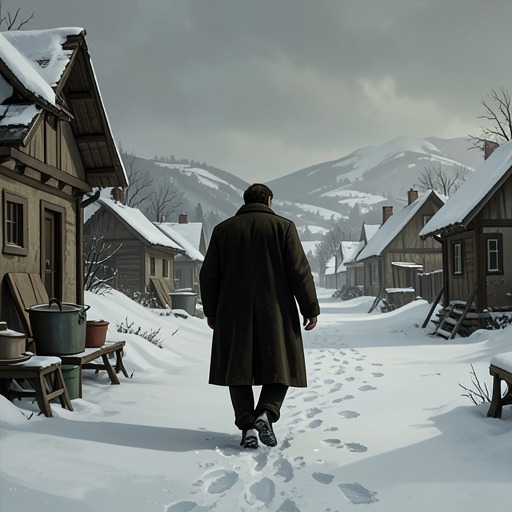
Augustine Decides to Take Iris to Lake Hazen
Good Morning, MidnightAugustine’s decision to take Iris to Lake Hazen turns a night of listening for absent voices into a plan for movement. The journey offers the pair a change from the observatory’s snow and silence, but it is also a practical response to the limits of Augustine’s radio equipment. He chooses a destination that might restore their spirits and improve their chance of contacting anyone beyond their isolation.
Background: Silence at the Observatory
After returning from the tundra with Iris, Augustine cannot sleep. While she rests in their sleeping bags, he slips out quietly, sits at the ham station, and listens to white noise. The scene places the decision inside the observatory’s familiar routine of waiting for a signal that does not come: he checks that Iris is still breathing, then returns his attention to the receiver and the atlas in his lap.
That waiting has become harder to justify. When Iris was first left at the observatory, Augustine expected someone to return for her. Instead, evening passed without anyone coming back. The next day he tried to reach the Alert military base, then scanned other frequencies. The military aviation channels, emergency communication satellites, and amateur radio bands all yielded silence. He told himself the failure might be a glitch or a storm, but repeated attempts offered nothing to answer him.
The equipment at the observatory gives that silence a material explanation as well as an emotional weight. Satellite phones and broadband are unavailable, leaving ham radio as the remaining option. Its weak power supply and insensitive antenna were intended only as backup; a signal would need to be nearby, unusually powerful, or carried by a lucky sky-wave to register. Augustine’s old practice of calling into the amateur bands had taught him to expect a response eventually. Here, even the possibility of an answer is constrained by the limits of the system.
Lake Hazen Becomes a Destination
As the tuner scans automatically, Augustine opens an Arctic atlas and comes to a well-worn map of Lake Hazen, roughly fifty miles east of the observatory. The place is not new to him. Researchers had organized fishing trips there, and he remembers hearing stories about them, though he had never joined in. At the time, he dismissed such outings as pursuits for people attached to earthly pleasures; when he took time off, he preferred to imagine tropical beaches, expensive resorts, and dense jungles.
His view changes because this journey is now feasible and the destination has become desirable. The mountain’s year-round snow and ice give way, lower down, to the prospect of wildflowers and warmer breezes. The archipelago’s warmest recorded temperatures were said to occur near the lake, reaching the low seventies in high summer. Augustine follows the lake’s western shore on the map and considers what a change in surroundings might do for Iris and for him. The journey becomes an answer to the stagnation of listening in place, not simply a recreational detour.
A Practical Reason to Go
The atlas also prompts Augustine to remember a small weather station on Lake Hazen’s shore. It had operated seasonally for decades, dating back to the 1950s, when radio was the only means of communication. More recent photographs had shown him an aerial array far larger and better than the observatory’s. He reasons that the station’s transmitting equipment should be more powerful too. The destination thus offers a concrete advantage: they might find a better way to transmit than the weak backup system at the observatory allows.
That possibility joins the change of scenery in his decision. Augustine has spent long enough listening to white noise and transmitting into the void, and his hope has begun to shrink against the likelihood that nobody will answer. Lake Hazen cannot guarantee contact, and the decision does not claim that anyone will be there. Instead, it gives him a reachable objective in a situation where continued waiting has produced only silence. If they leave soon, they can use one of the snowmobiles in the hangar; the snow cover will not last indefinitely, though there is still time.
The Decision and Its Meaning
At dawn, Augustine is still writing plans and supply lists when Iris wakes. Wrapped in a sleeping bag like a hooded cloak, she approaches his chair, touches the pad, and rests a hand on his shoulder. Her gesture asks for an explanation without words. Augustine covers her hand with his and turns to face her before telling her, “Let’s take a trip.” The decision is therefore made not only over a map and a list of equipment, but in direct response to Iris’s quiet presence beside him.
The moment marks a shift from passive vigilance to shared purpose. Augustine does not abandon the radio or claim that the silence has been solved; instead, he chooses to carry their search elsewhere, toward a station whose aerial may improve their chances. His earlier indifference to Lake Hazen also gives the choice a personal reversal: what he once dismissed as a merely terrestrial outing now matters because it is attainable, useful, and potentially good for both of them. The scene establishes the plan and its reasons, not the outcome of the journey. At sunrise, what Augustine can offer Iris is a destination, an adventure, and a reason to move.