Augustine Lofthouse
Good Morning, MidnightAugustine Lofthouse is a celebrated but deeply dissatisfied astronomer whose ambition has long been to make discoveries worthy of history. At seventy-eight, isolated at the Arctic Barbeau Observatory, he believes his life can end with his work and his solitude intact. His refusal to evacuate and his unexpected bond with Iris gradually challenge that belief: the man who once measured a life by scientific legacy begins to imagine a future shaped by another person’s need for connection.
Identity and scientific ambition
Augustine has built his career by following the instruments and facilities best suited to studying the sky. He moved readily from a postgraduate fellowship in Chile’s Atacama Desert, where he began studying dying stars, to work in South Africa, Puerto Rico, Hawaii, New Mexico, and Australia. His small leather suitcase held what he considered essential; when a place no longer suited him, he could be gone within a week. Continents mattered less to him than the conditions for observing beyond Earth’s atmosphere.
His professional success never satisfied him. Augustine wanted more than recognition: he wanted to crack open the universe’s mysteries, understand the earliest moments of time, and leave behind a discovery that would secure his place in scientific history. At Barbeau, however, he has reached what he regards as the end of his life’s work and confronts the limits of what he knows. The gap between his grand ambition and his remaining ignorance gives his Arctic project the character of both a scientific finale and a personal reckoning.
Arctic isolation and refusal to leave
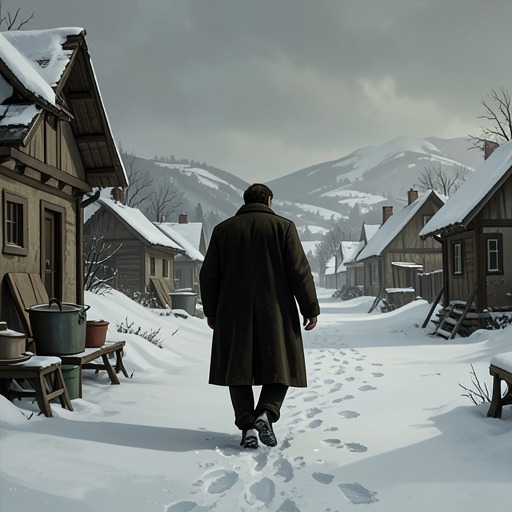
The return of the sun after months of darkness briefly transforms the landscape around Augustine. He waits outside for natural light, watching the dawn color the clouded sky pink, orange, and crimson. The light lasts only about ten minutes before fading. From the observatory’s mountain slope, he sees snow-covered peaks to the north and tundra stretching south. The land can soothe him or provoke thoughts of madness; either way, it offers no easy escape.
Barbeau Observatory stands at the center of a remote outpost built around its telescope. A neglected airstrip and empty hangar lie about a kilometer to the south. The base has stores intended to support a dozen researchers for nine months, including fuel, food, purified water, medical supplies, firearms, fishing gear, skis, climbing equipment, and research instruments. But the last planes came more than a year earlier to collect the researchers, and the last news from civilization had been of war.
When the Air Force evacuation team gathers the scientists and announces the departure plan, Augustine refuses to board. The captain warns that there will be no return trip and that anyone who stays will be marooned. Augustine understands the consequence and insists that his work and life are at the observatory. After the other researchers leave, he watches their plane disappear, then rearranges the control room around his solitary presence. The captain’s warning echoes in the quiet. Augustine tries not to dwell on its finality, telling himself that there is no one waiting for him elsewhere.
Iris and the disruption of solitude
A day or two after the evacuation, Augustine finds Iris hidden in an empty dormitory, curled on a bare mattress as if she had been left behind with the abandoned belongings. He estimates that she may be eight. Her dark, tangled hair reaches her shoulders; her hazel eyes move alertly around the room, and she is so still that he initially doubts what he sees. When he beckons her to come with him, she follows without speaking.
Augustine gives Iris dried fruit and nuts, heats water, and makes her instant oatmeal; she eats both. He offers her a book but cannot tell whether she is reading it. Her silence and unexplained presence bewilder him, and he tries to return to his research rather than engage with the inconvenience of having a child in the control room. Yet his actions already include the basic work of keeping her fed and bringing her with him. His solitary routine has been interrupted before he has decided what the interruption means.
Illness, memory, and reciprocal care
During a fever, Augustine is confined by memories that turn his past into a series of physical and emotional reckonings. He recalls the knife cutting into a deer’s living skin, the animal’s blood, and the guilt he had once mistaken for bodily illness. He also revisits his childhood home: his father striking walls and family members, and his mother moving between long periods beneath a quilt and bursts of restless activity before collapsing again. The fever traps him in memories he would rather forget, drawing old violence and remorse into the present.
When he wakes, weak and hungry, the control room is unchanged, but Iris is still there, watching the twilight from a windowsill. He sees her smile, a missing lower tooth, and a dimple in her cheek. She tells him he looks terrible and says she is glad he is awake. Then she approaches cautiously and offers him vacuum-packed jerky, canned green beans, and a spoon. The exchange reverses their earlier pattern: Augustine had fed a silent child who seemed to appear in his life without explanation; now Iris has stayed beside him and brings him food while he is too weak to manage for himself. Her presence is no longer merely something he tries to ignore.
The bear and a changed horizon
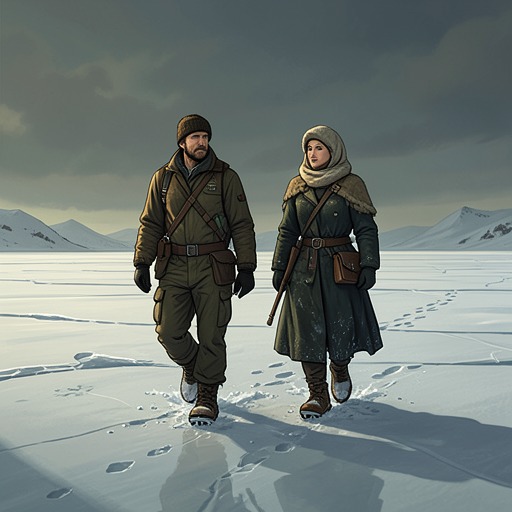
A sighting of a great yellow Polar bear across the Arctic mountains marks a change in how Augustine thinks about his future. The bear appears self-contained, with the sea as the limit of its world. Augustine feels discontent on the animal’s behalf, but recognizes that the feeling belongs to him as well: surviving his fever has not yet given him a reason to live beyond his work. Nearby, Iris plays in the snow, rolling to a stop with her green pompom dusted white and waving up at him. On the walk back, she stays close, checks his progress, and takes his mittened hand for the final climb to the observatory.
Augustine had conceived of the Arctic project as his last, a capstone to a career that he imagined a future biographer might record. He had come prepared for the end of his work to coincide with the end of his life, and the evacuation had seemed only to make dying alone easier. But the bear’s appearance makes him think of Iris; he feels gratitude for someone’s presence rather than relief at an absence. The response is unfamiliar, and it opens a possibility he had kept outside his plans.
Change and narrative significance
At first, Augustine thinks about what will happen to Iris when he dies only in passing. After the encounter with the bear, he begins to consider her future more seriously and to think beyond his own remaining years. He wants her to have connection, love, and community, and recognizes that he cannot keep making excuses for offering her the same emptiness he accepted for himself. The change is not a completed resolution: the evidence shows him beginning to imagine care and a life oriented toward another person, not what ultimately becomes of either of them.
That emerging shift gives his character its central tension. Augustine has spent a lifetime moving between observatories and treating human attachments as less compelling than the work of understanding the universe. At Barbeau, the brief return of sunlight, the isolation after the plane departs, his fever-bound memories, and Iris’s practical care all press against that self-sufficient identity. His ambitions do not disappear, but they cease to be the only measure of what a life might leave behind. The astronomer who wanted to be remembered begins, instead, to consider what he might help someone else inherit.