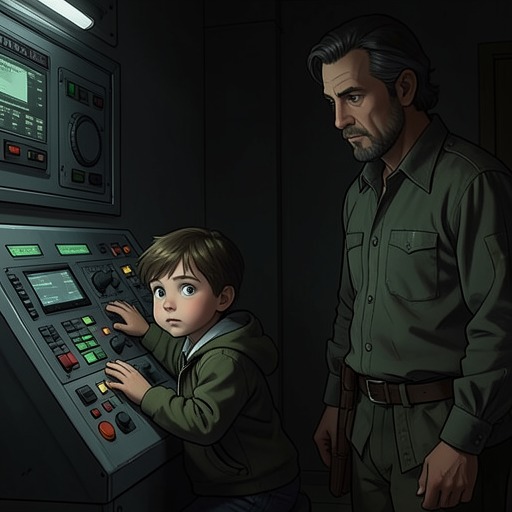
Augustine Lofthouse and Iris
Good Morning, MidnightAugustine Lofthouse and Iris’s relationship grows from an accidental encounter into a bond of mutual care that changes what Augustine believes he has left to live for. At the isolated observatory, he first treats the child as an inconvenient stranger he must feed and keep safe; over time, her quiet presence becomes a source of companionship, and his concern for her gives him a reason to imagine a future beyond his own. Their closeness is made not through declarations or formal family ties, but through repeated acts of attention: a meal prepared, a hand held, a parka wrapped around a small body, and a life Augustine had not wanted becoming one he feels responsible for protecting.
Left Behind at the Observatory
After the other researchers evacuate, Augustine finds Iris curled on a bottom-bunk mattress in an empty dormitory. She is small, perhaps eight years old, with tangled dark hair and watchful hazel eyes. He is unsure whether he has seen her before. She follows when he beckons, but does not speak. He gives her dried fruit and nuts, then oatmeal, and watches her eat both without learning anything about who she is or how she came to be alone.
Augustine expects that someone will return for her. He imagines she was overlooked amid the disorder of the evacuation and waits for the mistake to be corrected. No one comes. When he radios Alert military base and scans the other frequencies, he finds only silence and static. That silence makes the possibility of rescue less certain, but it does not immediately turn him into a willing guardian. He continues to experience Iris’s presence as inexplicable and inconvenient, trying to work around the child rather than understand her.
His early care is real but tentative. He feeds her when he feeds himself, takes her for walks, and offers objects to occupy her: a walkie-talkie, a constellation map, a potpourri sachet, and an Arctic field guide. He does not know how to speak to her or what she needs, and he privately resists the idea that she belongs to him or that he is a man who takes in abandoned children. The things he offers cannot replace a family or give Iris a history, but they mark the first practical form of their connection: Augustine begins meeting the needs of the child who is actually there, even while telling himself that the arrangement is temporary.
Silence, Companionship, and Learning to Care
Iris remains quiet for weeks. During the long polar night, as the darkness stretches on, she finally asks Augustine how long it will last. Later, on a walk around the outpost, she points to Polaris and names it. Her brief statement is not a question or an invitation to explain; she simply shares what she sees. Augustine follows her gaze and realizes that he is glad of her company. The moment is small, but it marks a change: Iris is no longer only a presence he has to manage. She is someone beside whom he can stand beneath the sky.
The observatory’s work and Iris’s calm presence help Augustine endure the isolation. He continues maintaining the telescope and its data archive, while the world beyond the observatory offers no reassuring voice. He once treats his work as the main barrier against despair; now Iris’s steadiness also anchors him. She can lose herself in a book, a meal, or the landscape while he struggles with the possibility that human civilization has ended. Their different responses do not require conversation. Her quiet attention to the world gives their shared days a rhythm that is not organized solely around his fear.
The care between them gradually becomes reciprocal. When Augustine wakes from a fever, weak and hungry, Iris is at the window looking out over the tundra. She turns toward him with a smile he has never seen before, then brings him jerky, green beans, and a spoon. In another period of illness, she stays beside him when his legs fail on the ice and touches his forehead as if playing doctor. Back at camp, she makes coffee and later reproduces a meal he had cooked the night before. Augustine feels pride that she has learned by watching him, and the thought that follows—that perhaps this is how fathers feel—reveals how far his attachment has moved beyond reluctant provision.
Protection and Shared Vulnerability
Their closeness is tested when Augustine shoots a wolf. Iris holds on to the dying animal’s fur, its blood on her face, hair, and hands, and makes a low, keening sound. Augustine puts a hand on her back, but cannot undo what has happened or explain it away. He recognizes that he acted before thinking, and that his claim to be protecting Iris does not account for everything driving him. The incident leaves him feeling helpless, lonely, and afraid. His usual refuge in the indifferent scale of the stars fails him; with Iris beside him, the emotional consequences of his actions are no longer something he can keep at a distance.
Later, when Augustine sees Iris outside in only her winter silks and socks, he runs down the mountain path and wraps her in his parka. He checks her hands and feet, frightened that she may have suffered frostbite. Iris, meanwhile, appears more concerned about him than herself: she touches his bristled cheek and points out that the musk oxen have returned to the valley. Augustine has barely noticed their absence, but Iris has. Watching the herd together, he draws her onto his lap; she settles against his heart while he holds her. The scene binds protection to attention in both directions. He is responsible for her safety, but her way of noticing the living world also steadies him.
Back inside, Augustine checks Iris’s pulse and confirms that she is healthy. He asks her not to leave the observatory without him, then recognizes his own irritation at the burden of responsibility he never wanted. Yet he acts on that responsibility: troubled by her matted hair, he fetches a wooden comb and tries to untangle it. When the comb proves inadequate, he cuts away the worst knots and shapes her hair as best he can. Iris tests the short curls with her hands and seems pleased. The awkward haircut is not a grand rescue, but it is intimate, sustained care: Augustine tries to make a child who has been left without her own things feel attended to as a girl, not merely kept alive as a dependent.
Love and a Future Beyond His Own
The relationship alters Augustine’s understanding of his own life. He had come north expecting his research to be a final achievement before a quiet death. He had accepted the possibility that the world was over and that there was no one left to contact. But as he becomes attached to Iris, the question of what will happen to her after he is gone begins to matter. After seeing a polar bear across the Arctic mountains, he feels gratitude for a presence rather than an absence and begins thinking beyond his own timeline. He wants Iris to have connection, love, and community, not the emptiness he had accepted for himself.
That change turns his attention outward. Augustine abandons the telescope’s work as his primary task and returns to the radio waves, determined to find another human voice despite believing that the search is unlikely to find survivors or lead to rescue. The importance lies increasingly in connection itself. His desire to search is connected to the child in his care: he no longer regards isolation as a condition he can simply accept on his own behalf when Iris’s future is also at stake.
Iris’s presence also throws Augustine’s earlier refusal of fatherhood into sharper relief. He once rejected a pregnant partner and kept his biological daughter at a distance, sending gifts and occasional money without becoming part of her life. Iris is not that daughter, and their bond does not erase the history of his abandonment. Instead, their relationship shows a different form of kinship taking shape through shared life and daily responsibility. Augustine begins as a man who insists that Iris does not belong to him; he becomes someone who feeds her, protects her, learns from her attention, and fears what will happen to her. The bond does not depend on a claim of blood or a declaration. It becomes real in the care he practices—and in the future he begins, at last, to imagine for someone other than himself.