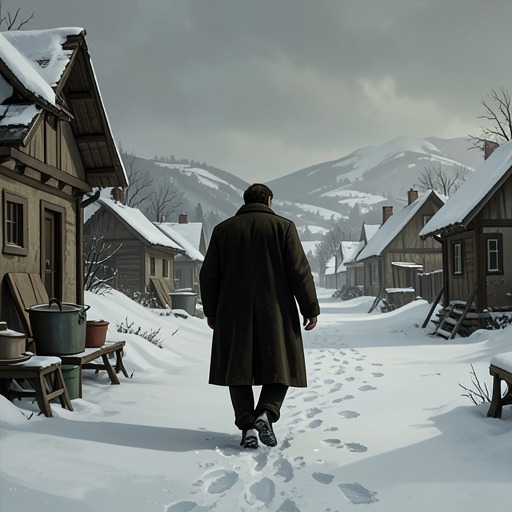
Augustine Shoots the Polar Wolf
Good Morning, MidnightAugustine Shoots the Polar Wolf is a turning point in Augustine’s care for Iris: an attempt to protect her ends with the death of an animal she had approached without fear. The event exposes the gap between his protective intention and his unthinking use of violence. Iris’s grief, and Augustine’s recognition that fear and loneliness helped drive his action, make the encounter consequential beyond the immediate danger he believed he faced.
The Encounter on the Runway
The episode unfolds beside a hangar near the observatory, as Augustine has started one of the snowmobiles and considers whether they might ride back. His attention shifts when he notices a four-legged figure against the snow. Iris has already become absorbed in it, moving toward it along the metal poles of a fallen staircase and making the low, distinctive sounds Augustine has grown accustomed to hearing from her. The figure is a wolf.
The scene first presents an encounter rather than an attack. The wolf turns its attention toward Augustine and growls, then comes a step nearer the hangar. Iris continues toward it, reaching out. The animal sits and watches her, responding to her voice. Its behavior gives Augustine a moment in which to observe the situation, but he instead reaches for the rifle he has brought with him.
The rifle carries a personal association: Augustine has not fired a gun since hunting with his father in the woods near their home in Michigan, an activity he remembers hating. That memory makes the weapon more than a practical tool in the scene. It links his present response to an old, unwanted experience, even as he prepares to repeat the act of aiming and firing.
The Shot and Iris’s Grief
As Iris draws nearer, she removes her mittens and extends her hands toward the wolf. Augustine sights the animal through the rifle. It howls and steps toward her; when it rises on its hind legs and reaches its snout toward her palm, Augustine fires. The narration emphasizes the speed of his decision: the threat he perceives becomes a target before he has stopped to think through what is happening.
The shot brings the encounter to an abrupt end. Augustine watches the wolf fall, and Iris screams. He hurries toward her, leaving the flashlight on the stalled snowmobile. She has fallen from the staircase onto the runway and then throws herself against the wolf. When Augustine reaches her, the animal is still alive but dying. He tries to draw Iris away; instead, he sees the wolf licking the snow and tears from her face. The moment complicates the division Augustine had made between a dangerous animal and a child needing protection: the wolf’s final response to Iris is gentle.
Iris does not release the animal as it dies. She remains beside it, her hands in its fur, while Augustine places a hand on her back. She allows that contact but continues to hold on and to mourn. The aftermath gives Iris’s attachment its own weight: she is not simply frightened by the gunshot, but grieving the creature she had approached and tried to touch.
Augustine’s Recognition
Augustine attempts to apologize, but cannot complete his explanation. The narrative makes the failure significant: he cannot honestly present the shooting as the result of careful judgment. He recognizes that he had identified a target before thinking at all. He also believes he would do the same again, a recognition that unsettles any simple account of the incident as a single mistake that remorse has already corrected.
He tells himself that he acted to protect Iris from danger, and the possibility that the wolf could have been dangerous remains part of his reasoning. But that explanation does not account for the whole of his response. He senses fear and loneliness beneath it. The event therefore does not resolve into a choice between a wholly justified protector and a wholly malicious aggressor: Augustine’s stated concern for Iris coexists with a reflex he recognizes as premature and with feelings he has difficulty controlling.
Augustine looks toward the stars, which have often helped him feel the immensity of the world around him. Here, their distance offers no relief. Rather than diminishing his emotions, the stars seem cold and remote while he experiences helplessness, loneliness, and fear. The contrast marks a change in the way he meets the familiar vastness: for once, looking outward does not let him escape what he feels.
The Burial and Return
After the shooting, Augustine and Iris cover the wolf’s body with snow and pack it down into a grave. Iris pushes the snow over the body with her mittens. Her purposeful work might resemble a child’s play, but her shaken expression and continued distress make clear that the burial is an act of grief, not a game. The snow-covered mound, marked by the events of the shooting, preserves the consequence of Augustine’s decision in the landscape they must leave behind.
They return to the observatory in darkness, following the outline of its dome against the sky. The flashlight has been lost in the hangar, and Augustine has also lost his ski pole, so the walk is slow and difficult. He carries the rifle back and wishes he had left it on the runway—or never brought it at all. Iris resumes her usual low song as they walk. Augustine is grateful for the sound, which helps drown out the memory of her screams. Their return does not undo the encounter: the rifle remains with him, Iris’s grief remains audible, and the event leaves Augustine newly aware of the loneliness and fear his protective role has not kept at bay.