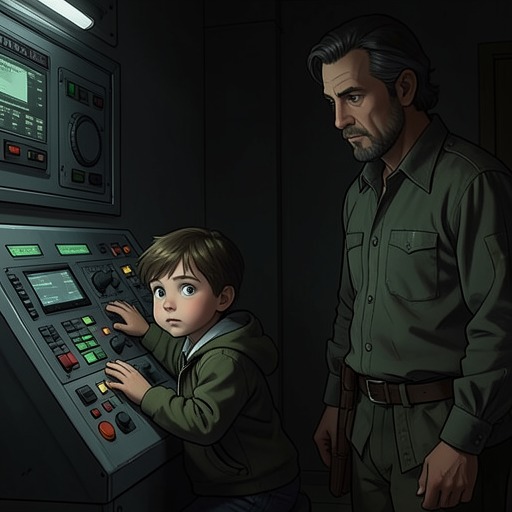
Augustine Shoots the Polar Wolf Dead
Good Morning, MidnightAugustine Shoots the Polar Wolf Dead is a decisive encounter between Augustine, Iris, and a wolf on the runway near the observatory. Augustine fires as Iris reaches toward the animal, believing himself to be protecting her, but the aftermath exposes how little reflection preceded his choice. The wolf dies, Iris mourns it, and Augustine is left confronting both his fear and the possibility that regret will not keep him from repeating the act.
The Encounter on the Runway
After starting one of the snowmobiles, Augustine turns his attention to Iris and barely registers the engine sputtering out. A wolf stands on the runway, its grayish-white coat difficult to distinguish from the snow. Iris is absorbed by the animal. She moves along the fallen staircase toward it, making the guttural sounds Augustine has grown accustomed to hearing from her. The wolf cocks its head; Iris’s calm approach, rather than any deliberate plan to engage it, brings her closer.
Augustine takes the rifle from his back when the wolf turns toward him and growls. It steps toward the hangar, while Iris continues along the staircase and reaches out as if to touch its fur. The animal sits and watches her. Augustine removes his mittens and prepares to shoot, but his response is not entirely detached from memory: he recalls hunting with his father in the woods near their home in Michigan. Those trips required father and son to wait silently and fire when an animal entered their sights. Augustine had hated them. The old experience does not stop him from taking aim now, but it shadows the action with an earlier association between a gun, a target, and a decision made in silence.
The Shot and Its Consequences
Augustine sights the wolf through the rifle as Iris removes her mittens and extends her hands toward it. The wolf howls and moves closer to her. When it rises on its hind legs and lifts its snout toward Iris’s palm, Augustine fires. The timing is central to the scene: the wolf is approaching the child, but Iris is also the one drawing near to the animal, and the narration does not establish that it is about to attack. Augustine acts under uncertainty, at the instant when his interpretation of danger becomes irreversible.
The shot brings the encounter to a close for Augustine, but not for Iris. She falls from the staircase onto the runway, then goes to the wolf and holds its fur. Augustine reaches her and finds the animal still alive, though only briefly. As it dies, it licks the snow and tears from Iris’s face, an act the narration compares to a mother tending her cubs. The gesture complicates the scene’s stark division between a dangerous animal and a child in need of protection: Iris is distressed, yet the wolf’s final contact with her is gentle. Its death leaves her crying and unwilling to let go.
Iris’s Grief and Augustine’s Recognition
The wolf’s death is not presented as a clean resolution to a threat. Iris keeps her hands in its coat and makes a low, keening sound while Augustine rests a hand on her back. She allows that contact, but does not release the animal. Her grief is conveyed through what she does rather than through an explanation: she stays beside the dead wolf, still holding its fur, as the wind and snow surround them. Augustine can remain with her, but he cannot undo the shot or make her stop mourning.
He apologizes, beginning to explain what he thought, but cannot complete the explanation. His unfinished words give way to a more troubling recognition: he had not thought before identifying the wolf as a target, and he believes he would do the same again. He tells himself that the shooting was necessary to protect Iris from danger. Yet he also recognizes fear or loneliness beneath that justification. The scene therefore distinguishes the reason he can give for acting from the less settled impulse he senses in himself. His remorse is real, but it does not amount to a promise that he would choose differently next time.
The Return and the Event’s Significance
Augustine looks toward the stars in the hope that their distance and scale will diminish what he feels. They do not. Instead, he experiences himself as helpless, lonely, and afraid, emotions he has not felt so plainly for years. The familiar contrast between human distress and the vastness overhead fails to console him. The wolf’s death has made that scale feel less like perspective than indifference: the stars remain distant while Iris’s grief and Augustine’s responsibility are immediate.
The pair make their way back toward the observatory in darkness. Augustine has lost the flashlight and his ski pole, and he carries the rifle he wishes he had left behind. Its weight and the recoil have left him sore as he walks without the support of the pole. These practical losses and discomforts extend the encounter beyond the instant of firing: he must carry the weapon and the memory of what he did back to the place where he and Iris are staying. The event marks a change in the emotional balance between them. Augustine has acted in the name of keeping Iris safe, but the scene leaves him beside her in shared exposure to the cold and in the knowledge that his protection has cost her the animal she approached. Its force lies in that unresolved contradiction: he remains responsible for Iris, yet his attempt to control danger has produced a loss he cannot explain away.