Augustine and Iris Travel to Lake Hazen
Good Morning, MidnightAugustine and Iris Travel to Lake Hazen is a difficult passage from the observatory toward a possible new home, and a turning point in Augustine’s care for Iris. Their journey is shaped by a stark contrast: the observatory offers shelter but is no longer a secure future, while the route to Lake Hazen exposes them to the cold, uncertain tundra. The trip tests their ability to continue together and ends with the discovery of a small weather station beside the frozen lake.
Departure from the Observatory
Augustine begins the departure alone, walking down to the hangar while Iris stays behind to pack. The journey to the hangar is difficult for him, and he experiences that effort as a kind of penance. Inside, the scene preserves traces of their earlier trip: snow has drifted through the open bay doors, ratchet heads remain scattered on the oil-stained floor, and the flashlight he carried before lies where he left it. The snowmobile he had previously made run will not start; he discovers that its key was left in the On position during the commotion, draining its battery. He coaxes the second machine to life instead.
Before leaving, Augustine gathers full fuel canisters and lashes them to the snowmobile’s luggage rack with a bungee cord. He cannot depart without looking toward the nearby grave, where the fallen staircase and blood-marked snow remain visible. The moment makes the journey more than a change of location: he leaves behind a place marked by loss, while carrying the practical supplies needed to make another attempt at survival.
They shut down the observatory but leave enough heat running to protect its pipes and telescope. Augustine wonders who might benefit from that last measure: they may have to return, or Lake Hazen may prove a more hospitable home. He also recognizes that the shelter is temporary. When the furnace runs out of fuel, the pipes will freeze and the telescope lens may crack; the winter will eventually reclaim the control room and the rest of the outpost. Their departure therefore carries both a hope of finding a better refuge and the knowledge that the place they leave behind cannot remain safe indefinitely.
The First Breakdown
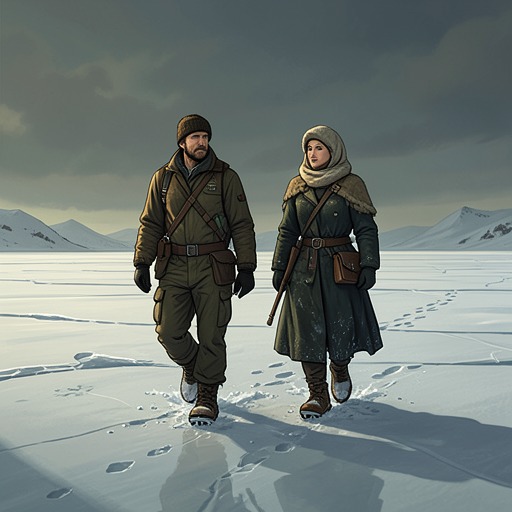
Iris rides with her arms around Augustine’s waist as they head toward the tundra, turning east before the hangar comes into view. The snowmobile jolts over buried rocks. Her helmet is too large, so Augustine pads it with three hats; her goggles are also oversized, and he uses a safety pin to tighten their elastic around her head. Once they reach level ground, the ride smooths out and Iris loosens her grip. After four or five hours across the white expanse, Augustine stops the machine.
They drink water and eat crackers. Iris appears delighted by the adventure, while Augustine looks back toward the observatory and sees that it has disappeared behind the shifting veil of snow. He has been resisting the urge to turn around, holding instead to a faint hope that the journey is right. When they climb back onto the snowmobile, however, the starter produces no response. Augustine tries again, checks the key and throttle, and steps away to inspect the machine, but cannot identify what is wrong. With the observatory and the weather station both many miles away, there is no shelter between them. He fears that walking in either direction could leave them exposed to the cold.
Augustine collapses beside the snowmobile, overwhelmed by the thought that he has taken Iris away from their only sanctuary. As the wind erases their tracks, he imagines the danger the cold poses to her and blames himself for bringing them into the wilderness. He reaches for Iris’s boot and holds it against his cheek. His apology is carried off by the wind. The episode reveals the responsibility he feels for her not as an abstract duty but as a fear sharpened by their immediate dependence on one another.
Crossing the Tundra and Mountains
The journey continues through further days and nights on the tundra. On one night, Augustine and Iris sit at the entrance of their tent with the lantern off, watching a long green aurora fade. Augustine is struck by Iris’s wonder and, for once, attends to the experience around him rather than concentrating only on the sky as an object of observation. As they settle into their sleeping bags, he notices the sounds and sensations of their immediate surroundings and feels, briefly, alive and content. The encounter offers a quieter counterpoint to the journey’s danger: their shared attention becomes part of what makes the exposed nights bearable.
On the morning of the fourth day, they reach the mountains. Dark Paleozoic rock breaks through the snow in jagged outcrops, and the terrain makes it difficult to find a route. Augustine has never crossed this range and is unsure whether a pass or easier way exists. They proceed cautiously, the snowmobile’s studs gripping the snow and ice. When the ground briefly levels into a gentle slope, he lets the machine gather speed, but the smoother passage is short-lived. Blowing snow obscures their view, and a concealed boulder throws both riders from the snowmobile.
Augustine checks that he can move his limbs and sees Iris on her feet, examining the snow angel she made when she fell. The snowmobile is beyond use: one ski has shattered, and the engine only croaks when he rights it and tries the starter. He remembers the words “There will be no return trip.” With the machine destroyed, they collect what gear they can carry and leave the rest behind. They continue on foot over exposed rock and sheer ice, carrying heavy loads with sore limbs. The failed vehicle makes the journey one-way in practical terms; reaching the station, rather than returning to the observatory, becomes the only route forward described in the account.
Arrival at Lake Hazen
They hike for hours, climbing toward one of the lower peaks as the day ends. From the top, they see Lake Hazen below: an immense sheet of ice, with the weather station at the foot of the mountain. The sight of the huts and antenna array encourages them, though they still have to camp once more before descending. In the morning they begin the descent, and after hours crossing the plateau they reach the camp as the light starts to fade.
The station is modest: a low green canvas tent and two larger white tents with stovepipes stand on a flat, snow-covered terrace beside the lake. A cluster of tall antennae and a small radio shelter rise beside the huts. The shoreline remains snowbound, but rocky ground is beginning to show. On a small island in the lake, Arctic hares leap across the ice. The lake itself creaks and chimes, a new sound after the wind that had swept across the tundra. Augustine feels a mild breeze against his frozen beard and recognizes that spring is beginning; the thaw has started.
The destination is not a developed refuge, but it gives them shelter, equipment, and a landscape distinct from the exposed route they have crossed. Its arrival changes the emotional register of the journey: the observatory had represented a sanctuary they feared losing, while the weather station offers the possibility of making a home elsewhere. Reaching it does not erase the dangers of the trip or the losses left behind. It does, however, bring Augustine and Iris to a place where the season itself is changing, and where their onward life can begin.