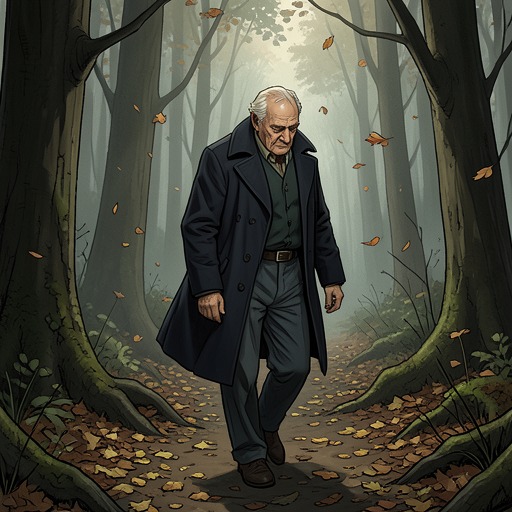
Augustine’s declining health
Good Morning, MidnightAugustine’s declining health is a steady, seasonal deterioration that no change of surroundings can reverse. At Lake Hazen, warmth and quiet briefly make him feel stronger, but the returning cold exposes the limits of that comfort: his movement narrows, the radio vigil becomes harder to sustain, and fever eventually unsettles his sense of time and consciousness. The illness unfolds alongside his growing attachment to Iris and his effort to remain available for a voice from beyond the lake.
A reprieve mistaken for recovery
When Augustine and Iris first settle at Lake Hazen, the calm of the lake, relative warmth, and stillness of the wind seem to improve his condition. He comes to understand, however, that feeling better is not the same as recovering. Age continues to advance beneath the summer’s ease. He expects the coming polar night to bring severe cold, aching joints, and a mind that works less nimbly. He fears that this may be his last year, yet also hopes it will be; the thought holds both dread and a measure of acceptance. The landscape may offer gentler days, but it cannot make him young again.
His awareness of that limit sits beside the renewed happiness he has built with Iris. He has not yet entered the radio control building, though he is curious about its equipment and what signals it might receive. Part of him avoids disturbing their tranquil life by testing whether there is anything to hear. But the search for another voice has ceased to be only a matter of his own curiosity or contentment. His concern has shifted beyond himself, even as his strength remains finite.
Cold reduces his world
As summer fades, cold returns to the valley and frost forms along the lake’s muddy shores. Augustine bundles himself in wool layers and stays by his Adirondack chair, watching the sun’s descent and the season’s change. He no longer leaves the camp to wander. Iris explores the tundra and mountains alone, while their shared fishing trips continue only as long as the lake permits. Rowing grows difficult in the cold, and increasingly heavy frosts make each outing less practicable. The change is gradual: their familiar routine persists, but Augustine can do less of it.
He continues to scan the radio bands once a day in the shelter. The silence remains complete, and the daily listening becomes a task he performs for work and purpose rather than for any reliable prospect of a reply. The short walk between his chair and the shelter grows from a pleasant outing into a challenge. He saves his energy for it, unwilling to relinquish the routine, even after he can no longer row the dinghy any distance. When a thin rim of ice forms at the lake’s edges, the end of boating confirms how much the season has taken from him.
Time itself becomes legible through changes he can observe from camp. The sun reaches the horizon and dips beneath it before rising again, producing a long sequence of sunset and sunrise that bathes the mountains in orange and sends violet clouds across the sky before the light returns to blue. These adjoining transitions become a recurring marker of the days passing. Later, the lake freezes, melts, and freezes again. Snow covers the brown landscape and restores the Arctic winter scene, a seasonal return that contrasts with Augustine’s inability to regain his former strength.
The vigil through polar night
After the last sunlight, autumn gives way to polar night and extreme temperatures. Augustine stays inside the main tent with the oil stove burning, but the short walks to the radio shed become progressively harder. Breathing the subzero air strains him; exertion makes breathing harder, which in turn worsens his condition. Even so, he keeps watch by the microphone whenever he can. The vigil persists as his capacity to carry it out declines.
While waiting in the shed, Augustine drifts in and out of dreams that grow more vivid until he can no longer reliably distinguish sleep from waking. Fever accompanies this confusion. When the woman’s voice returns over the radio, he has been away from full awareness for an uncertain interval, perhaps hours or days. Repeated calls to his station eventually rouse him enough to answer. The contact brings a brief return to purposeful action, but it does not restore his health: after the exchange, he struggles back to the tent and collapses on his cot, still dressed. He remains there for hours before he can remove his outdoor clothes.
The fever then traps him in a repeating dream of trying to return to the shed and turn on the generator and transceivers, only to find himself still on the cot and unable to move. Real wakefulness is brief and painful; much of the time his thoughts circle through layers of imagined waking. Iris appears beside him, though he cannot always tell whether she is there in reality or in his dreams. She tends him with cool cloths on his forehead and warm ones on his chest, and sings while distant wolves howl. His confusion also makes him mistake her at times for Jean or for his mother, folding present care into memories of earlier attachments.
Care and uncertain recovery
Eventually Augustine becomes conscious in a dark, cold tent, with the lamp extinguished and the stove out. He cannot tell how long he has been ill or where Iris is. Despite his weakness, he finds enough strength to replace the oil drum and relight the stove, then collapses again. When Iris returns, she relights a kerosene lamp, brings it to his bedside, checks his forehead, and sits beside him. Her quiet presence gives the scene its clearest sign of care, but the episode does not establish that his illness has passed.
Later, Augustine struggles to sit up beside the low-burning lamp and calls for Iris. He cannot measure the time since his radio conversation, because the fever’s waking dreams have blurred the days. He wants to speak again with the woman aboard Aether, learn about her family and life, tell her about his achievements and failures, and seek forgiveness. The desire to speak is expansive, but his strength is not: raising his head makes him dizzy, and he must wait for his balance to return. When he opens his eyes, Iris is in the chair where she has kept watch throughout his illness. The narrative leaves his health unresolved at that moment. Its emphasis is on the distance between what he still wants to say and what his failing body can manage, and on Iris’s continuing presence beside him.