Callisto
Good Morning, MidnightCallisto is one of Jupiter’s four Galilean moons, but in the novel it is more than one object of the Aether crew’s survey. Its ancient, pockmarked surface becomes a remembered vantage point from which Sully watches Jupiter turn, linking the mission’s scientific achievement to a lasting sense of wonder and altered perspective.
A Moon in the Jovian Survey
During the crew’s survey of Jupiter and its moons, Callisto appears within a system of strikingly different worlds. The narration describes its ancient, pockmarked skin alongside Ganymede’s icy crust, Europa’s rusty cracks above subterranean oceans, and Io’s volcanoes, where magma leaps from the surface. Callisto is not given a detailed account of its geology or a separate scientific finding; its distinctive image is its scarred, ancient surface, set among the varied Galilean moons.
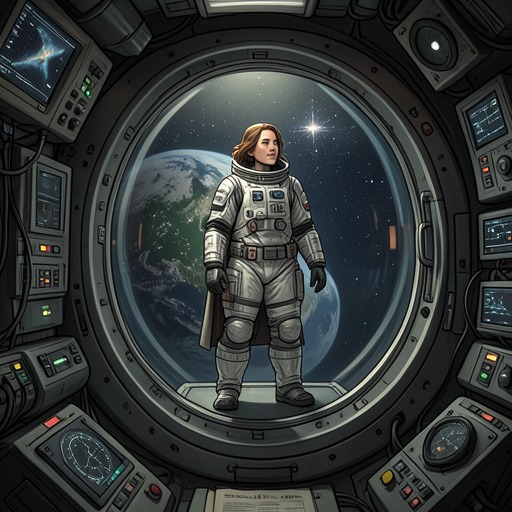
Jupiter dominates the view from Callisto. In Sully’s dream of standing on the moon, the planet’s fawn-colored stripes whirl above her and the Great Red Spot churns. The perspective joins two scales at once: the solid, marked ground beneath her and the vast, moving planet filling the sky. Callisto is thus presented not merely as a destination in the survey, but as a place from which the scale and activity of the Jovian system can be experienced directly.
The Crew’s Encounter with Jupiter
The survey’s view of the moons changes the crew’s state of mind. As the six members of Aether contemplate the four Galilean moons, their earlier anxiety about failing in deep space and never being heard from again gives way to a quiet reverence. The mission is complete, and the crew recognize that they have traveled farther into space than human beings before them. The narration presents Jupiter and its moons as having soothed and changed them: in the presence of that immense system, the crew feel their own lives and histories shrink in scale, while the worlds before them seem exquisite.
Callisto belongs to this collective transformation, even though the text does not isolate it as the cause. Its pockmarked surface is one part of the moons’ plurality, and Sully’s later memory of standing there makes the survey’s shared encounter personal. The contrast matters: the mission’s achievement can be stated as a record of human exploration, yet the crew’s response is not triumph alone. Their experience unsettles the familiar importance of earthly concerns and opens onto a larger scale of existence.
A Place Revisited in Memory
After the survey, Sully’s sleep repeatedly returns to Jupiter. In one dream, she stands again on Callisto, watching the planet’s fawn-colored stripes and the churning Great Red Spot. The recollection is anchored in a specific viewpoint: she is not simply thinking about data collected in the Jovian system, but imagining herself back on the moon’s surface beneath the planet she had seen there.
The dream continues to shape the morning that follows. Although the compartment lights gradually imitate an Earth-like dawn, Sully does not get up to watch them. She lets the artificial sunrise go unobserved and returns to sleep, back to Callisto. The ordinary shipboard simulation of daybreak cannot compete with the remembered scene. This moment gives the moon a role beyond the earlier survey: it becomes a setting Sully can mentally re-enter, and a measure against which the small comforts designed to recall Earth feel diminished.
A Shared Reference and a Private Landmark
Callisto also enters the crew’s life before the mission begins. During the final weeks of training in Houston, after a day of lunar-landing simulations, the crew go out for drinks. Tal proposes four shots apiece, one for each Galilean moon. When Sully arrives late, Harper slides her a shot designated for Callisto; she drinks it and declines the lime. The exchange turns the moon into part of a group ritual, a name the crew can attach to a shared celebration as launch approaches.
That casual toast and Sully’s later dream give Callisto two different human associations: it is both one item in the crew’s playful countdown to departure and a place of extraordinary visual memory. The book does not supply a separate account of Callisto’s environment or make it the site of a distinct plot crisis. Instead, it lets a few sharply placed details carry its significance: an ancient, pockmarked surface, Jupiter turning overhead, a crew quieted by the moons, and Sully choosing the remembered view over a simulated sunrise. Callisto becomes a durable landmark in the narrative because it holds together the mission’s concrete destination and the change in perspective the crew bring away from it.