Devi
Good Morning, MidnightDevi, Aether’s youngest crewmember and an exceptionally gifted engineer, is shaped by a stark tension between technical brilliance and growing emotional isolation. The silence from Earth gradually loosens her connection to the ship and its crew; even when she returns to urgent work, the failure of a life-support component during a spacewalk kills her. Her death leaves Sully not only grieving but uncertain whether Devi recognized the danger in time to speak up.
Identity and First Impressions
Devi is introduced through Sully’s recollection of their underwater training in Houston. While they waited for their turn to be lowered into the pool, Devi stood beneath an overhead crane used to lift astronauts in and out of the water. She studied the hoist pensively, then laughed and turned her attention back to the pool. The moment offers no explanation of what she saw in the machinery, but it places her habit of close observation within the practical world of training and equipment.
Sully remembers being drawn to Devi almost as soon as they met. Devi’s small stature and large, dark eyes could make her seem young, innocent, or uncertain; beneath that appearance, however, was a deeply analytical mind. The contrast matters aboard Aether: the engineer who can detect how a machine works is also someone whose own distress can remain difficult for others to read.
Awe and Withdrawal Aboard Aether
After the crew’s encounter with Jupiter and its moons, Devi and Thebes spend long stretches in the cupola, looking out through its clear dome. They sometimes neglect their maintenance work in order to watch the surrounding depths together, sharing the view in companionable silence. Thebes calls these sessions big-picture moments. In the wake of the mission’s achievement, the crew’s attention has been altered by the scale of what they have seen; Devi’s quiet stargazing is one expression of that pause.
The silence from Earth changes the character of her quietness. As the weeks pass, Tal and Ivanov seem to fill the ship with increasingly forceful emotions, while Devi appears to shrink. She had always been more engaged with machines than with colleagues, a preference that had helped make her an outstanding engineer. Now she disengages from both. Nothing seems able to hold her interest, and she drifts away from the crew and from the mechanics of the ship itself.
The change becomes dangerous through its practical consequences. Thebes notices that Devi misses obvious problems in her repairs: she fails to hear troubling sounds and passes over malfunctioning components, as if moving through her work in a sleepwalking state. He brings his concern to Sully, who already recognizes that the crew is coming apart gradually. Rather than leave Devi to manage alone, Thebes works beside her, taking on the extra labor, and tells her stories about his recruitment into South Africa’s young space program. Sully tries to keep her company off duty and to make sure she exercises, eats, and sleeps regularly. They ask about her family and childhood. Their care is sustained and concrete, but it cannot cancel the widening distance between Aether and Earth.
Family, Grief, and Sully’s Care
During the asteroid-belt crossing, Devi comes to Sully’s bunk at night. The two lie side by side, using each other’s warmth against the strain that returns when the lights go out and there is nothing to distract them from an unknown future or painful memories. Sully can feel Devi suppressing a sob. She wants to comfort her, but cannot promise that everything will be all right, and is unsure how to reach someone who has become so withdrawn. She lets her foot rest gently against Devi’s instead.
Devi tells Sully about a recurring dream of her family’s kitchen in Kolkata. In the dream, her brothers sit across from her, eating rice and dal with their fingers, while her parents sip chai and watch them. The scene lasts for hours and returns repeatedly, but its warmth gives way to the knowledge that her family is gone and she is alone. The dream makes her separation from home intimate rather than abstract: an ordinary shared meal becomes a temporary return, and waking restores the loss. Sully listens beside her. Later, remembering how Lucy once came to her after nightmares, Sully tries to recover the words she used to offer her daughter, but cannot. She moves closer to Devi, and the two women weep together.
Their closeness is expressed through limited gestures rather than reassurance. They lie with their limbs overlapping, and Sully allows physical contact to stand where a comforting promise would be dishonest. The scene also shows the limits of Sully’s caregiving: she wants to reach Devi, but cannot undo either her isolation or the separation from the family the dream brings back.
Repair Work and Renewed Purpose
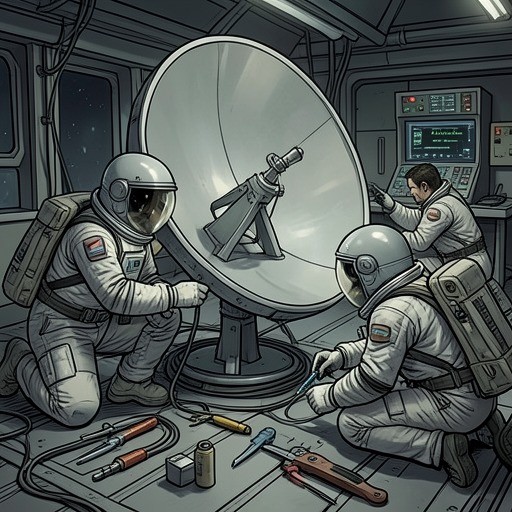
When Aether’s main communications dish breaks away, the crew’s crisis gives Devi a demanding task. Harper assigns Sully, Devi, and Thebes to work on a replacement, while other crewmembers assess damage and investigate the incident. Devi has been silent during the meeting, leaving Sully unsure whether she is paying attention. On the way to inspect equipment in the lunar module, however, Devi begins talking rapidly about ideas for the replacement. Sully feels relief: the work has caught her attention again, and she believes Devi is the person most able to make the plan succeed.
The repair draws on equipment already aboard Aether. Sully, Devi, and Thebes salvage components from the ship, including the dish from the lunar landing module, and raid redundancies in the communications pod. They use the table in Little Earth as a staging area so their tools will not float away. The improvised work reorders the crew’s attention: after months without a shared task of comparable urgency, they are tired but invigorated by a problem that demands concentration in the present. Devi’s return to animated technical thinking is a brief but significant counterpoint to her earlier disengagement.
Death During the Spacewalk
During the spacewalk associated with the repair, Devi becomes dazed and struggles to stay alert. She identifies the problem as a failed lithium hydroxide cartridge in her suit’s scrubber and says she did not notice it. She tries to draw a deep breath, but cannot get enough oxygen. Harper orders her back to the airlock; Devi replies that she does not think there is time. Her arms begin to convulse, and the tool in her padded fingers slips free and spins away. Sully, holding the mast of the new communications dish, watches Devi lose consciousness and sway against her tether.
The death brings Devi’s earlier lapses into painful focus without resolving their cause. When signals return through the rebuilt system, Sully remembers Devi’s struggle to remain conscious and wonders whether she had seen her suit’s oxygen levels falling or sensed the trouble without saying anything. She knows she will never find out. The uncertainty is part of the loss: the crew has an identifiable equipment failure, but Sully cannot know what Devi perceived before the cartridge failed to protect her.
Afterward, Sully and Thebes continue calibrating the communications system, adjusting its gain and squelch settings until its reception is as good as they can make it. Their work extends the possibility of contact with anyone calling them home, but it cannot restore the person who helped make the replacement possible. Devi’s trajectory therefore binds two kinds of dependence together: Aether’s survival depends on systems that require attentive maintenance, and that work depends on a crew trying to care for one another across the widening silence. Devi’s brilliance makes her vital to the repair; her death exposes how little technical competence can protect anyone when a critical failure goes unnoticed.