Global Communications Blackout
Good Morning, MidnightThe Global Communications Blackout is the unexplained collapse of contact between Earth and those beyond it, leaving both the remote Barbeau Observatory and the spacecraft Aether without a dependable link to the world. Its force lies not in a confirmed account of what happened on Earth, but in the failure of every expected route to news and response: the observatory finds only static, and Aether’s crew can hear the wider universe while Earth remains silent. The outage makes communication infrastructure visible precisely when it stops working, and turns uncertainty into a condition the characters must live and work inside.
Warning Signs at Barbeau
The blackout reaches Augustine Lofthouse in an already thinning world. The Barbeau Observatory had been built for a dozen researchers and stocked with fuel, food, purified water, medical supplies, guns, and fishing gear. Its airstrip and hangar, about a kilometer south of the outpost, were now neglected; the lights along the runway no longer worked. The last planes had come to collect researchers, and the last news from civilization, more than a year earlier, had been of war. The evacuation established that something catastrophic was happening beyond the observatory, but did not explain it. Augustine refused to leave with the other researchers, remaining at the remote outpost with Iris after the civilian staff had gone.
The following day, Augustine tried to reach the Alert military base, the northernmost year-round settlement on Ellesmere Island. There was no answer. He searched other frequencies, finding the amateur bands silent, the emergency communication satellites empty, and even the military aviation channels mute. He considered a glitch or a storm and planned to try again, but the breadth of the silence suggested that the failure could not be reduced to one unanswered call. The observatory’s isolation sharpened the uncertainty: a message could not establish whether the problem was local, whether anyone remained able to respond, or what had happened elsewhere.
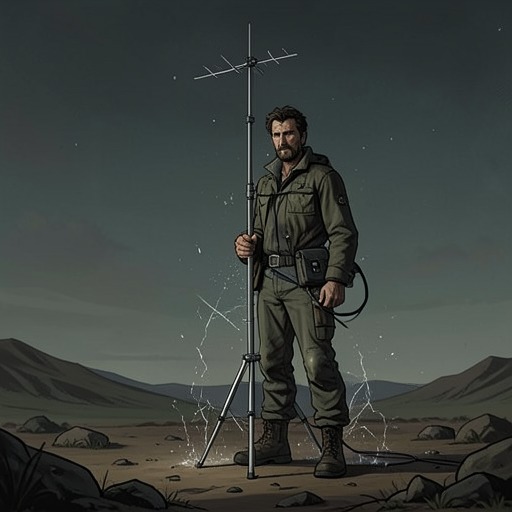
The equipment available to Augustine offered little redundancy. The outpost had relied mainly on satellite connections, but its satellite phone and broadband were not working. Ham radio was the remaining option, and the equipment was only a backup: its weak power supply and insensitive antenna were barely adequate for the nearby military base or passing aircraft. A distant transmission would need to be close and powerful, or arrive by a fortunate sky-wave; even then, someone had to be listening. The blackout thus exposed the difference between having communication equipment on hand and having a functioning communications network.
Aether Loses Contact with Earth
Aether’s crew encountered the same silence far from the planet. Mission Control fell silent just before the spacecraft began its weeklong survey of the Jovian system. There was no sign-off and no warning that contact was about to be interrupted. At first, the crew continued working, with little reason to treat a break in contact as proof of disaster. The Deep Space Network depended on three sites around the globe, arranged to account for Earth’s rotation: if the Goldstone Deep Space Network facility in the Mojave Desert was unavailable, Spain or Australia should have been able to take over. But a full day passed without a response, then another, and eventually nearly two weeks.
The silence altered the meaning of the mission. The survey was successful, and the probes left among Jupiter’s moons continued to send telemetry, but the crew had no audience for what they were discovering. They had undertaken the journey for more than their own achievement; the work was meant to matter to the world. As contact failed to return and the prospect of going home drew closer, that purpose became difficult to separate from the hope that there was still a world waiting to receive their findings. Their training had taught them to compartmentalize threats to their work, but Sully finally allowed the blackout to occupy her attention. The crew had checked the ship’s equipment, and Sully had examined the communications pod. Its receivers could detect signals from celestial sources millions of light-years away. It was Earth, specifically, that was not speaking.
The crew could identify the scale of the failure more readily than its cause. Harper judged that the three Deep Space Network telescopes were down and that the problem was worldwide, involving equipment, personnel, or both. Sully considered atmospheric interference, radio-frequency pollution, or a geomagnetic storm. Such a storm would have to be extraordinary to cause an outage of this extent, and comparable historical interruptions had been brief and associated with solar activity. These possibilities remained hypotheses, not explanations. The evidence established a global failure of contact without revealing whether the system had failed, its operators were unavailable, or some larger event had silenced both.
Silence as an Infrastructure Crisis
The blackout is not simply an absence of conversation. At Barbeau, Augustine has to fall back on an underpowered ham-radio system after satellite phone and broadband fail; aboard Aether, the crew can receive data from probes but cannot reach Mission Control. In both settings, the difference between local equipment and a working network becomes decisive. Radios, antennas, satellites, operators, and power supplies form a chain, and an apparently available device is of little use if the rest of that chain has gone dark. The characters can test and maintain the equipment near them, but those efforts cannot establish that anyone elsewhere can answer.
The later loss of Aether’s main communications dish compounds the crew’s existing isolation, but it is a separate equipment failure, not an established cause of the worldwide blackout. After a bang, Sully sees the dish drift away from the spacecraft. The crew’s attempt to replace it makes communications repair a dangerous physical task: during the spacewalk, Devi realizes that her suit’s lithium hydroxide cartridge has failed. She has been suffocating without noticing the falling oxygen levels, and dies before Sully can help. The incident shows how the effort to restore a communications link can carry immediate human stakes, even though it does not explain why Earth has gone silent.
After the replacement work, Sully and Thebes receive telemetry again from their probe on Europa. They check the machines, adjust the gain and squelch, and calibrate the new system as well as they can. This is a restored connection to a probe, not proof that contact with Earth or Mission Control has returned. Sully stays to listen, having done what she can to make the ship able to hear an external caller. Her work gives the crew a prepared channel, but not an answer.
Unresolved Consequences
Across the two storylines, the blackout remains an unanswered question rather than a solved technical puzzle. At Barbeau, the silence follows an evacuation and fragmentary news of war; on Aether, it persists despite the Deep Space Network’s multiple sites and the spacecraft’s functioning receivers. Neither setting supplies a confirmed cause or a reliable account of Earth’s condition. The characters must distinguish what they know—their systems cannot reach anyone—from what they fear or speculate about the people and infrastructure beyond their reach.
That uncertainty changes the practical and emotional value of communication. Augustine’s repeated scans cannot tell him whether the world is empty or merely unreachable. Aether’s crew can keep collecting scientific data, yet the loss of contact deprives that work of its intended audience and makes the return to Earth uncertain in meaning as well as logistics. The blackout also reveals the limits of technical self-sufficiency: careful checks, alternate channels, and repaired equipment can preserve some links, but they cannot recreate a network or guarantee a listener. Silence is therefore both a material condition and a narrative pressure, binding distant characters through a shared absence while leaving the event that caused it unresolved.