Home
Good Morning, MidnightHome in the novel is not simply a building, a planet, or a family role. It is a fragile sense of safety and belonging that can arise in an abandoned hut, remain elusive inside a family, or be unsettled by the return to a home planet transformed into a mystery. Augustine and Iris’s move to Lake Hazen gives that idea a physical refuge; Sully’s reflections reveal how far refuge and belonging can diverge.
Leaving one refuge for another
The journey from the observatory to Lake Hazen begins with a choice about what counts as necessary. Augustine and Iris pack a tent, subzero sleeping bags, food, water, fuel, warm clothing, helmets, goggles, a stove, a map, a compass, and flashlights. Iris’s books, spare clothes, extra batteries, and a second fuel canister are luxuries, to be taken only if there is room. Their snowmobile can carry the heavy load, but its practical promise does not make the destination certain: they know little about the weather station and cannot know what they will find there.
Before they leave, Augustine shuts down the observatory while keeping the furnace on just enough to protect its pipes and telescope from freezing. He cannot tell whether he is preserving the building for their return or leaving heat for nobody. In time, the fuel will run out, the cold will enter, and frost will take the windows and control room. The observatory has been a sanctuary, but it is not a permanent home; the prospect of its slow return to winter accompanies the decision to leave it behind.
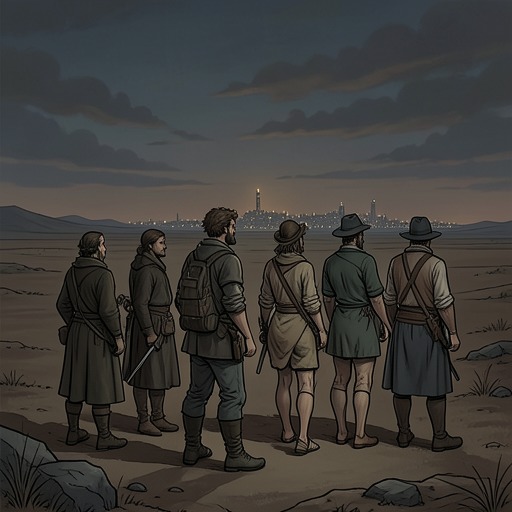
On the snowmobile, Iris clings to Augustine as they jolt over snow-covered rocks. Her helmet is too large, padded by three hats, and the oversized goggles are tightened with a safety pin. After four or five hours, the observatory has vanished behind a curtain of snow. Augustine wants to turn back, yet the hope of what lies ahead keeps the journey moving. The scene makes belonging inseparable from risk: safety is something they have left, while the place that might shelter them is still unseen.
A refuge at Lake Hazen
At the weather station, material traces of earlier lives give the hut a warmth the Barbeau Observatory lacked. Ragged carpets cover its plywood floor; crates hold mostly romance novels, a few mysteries, and basic cookbooks. Augustine unwraps a cot mattress, shakes out a sheet, and arranges wool blankets and a pillow. These ordinary acts of preparation turn an abandoned interior into a place where two people might live, rather than merely endure.
The decisive change comes when Augustine sits outside with Iris. She draws figure eights in the snow with a rock, while he looks out over the lake and feels that the journey has been worth making. There will be no return trip, but he feels safe. Without the evacuation’s shadow or the hangar and runway’s emptiness, Lake Hazen seems less like exile than an oasis. Its security is not founded on certainty about the future; it comes from the relief of having arrived together.
Their first evening makes that refuge intimate without making it comfortable or permanent. As darkness gathers, they listen to ice, hear wolves answering across the lake, and watch a snowy owl settle on an antenna pole beneath the emerging stars. Augustine leaves the hut door unfastened so Iris can come in after sitting beside the water. He lights kerosene lamps, starts the oil stove, and makes corned beef hash, powdered eggs, and coffee from the station’s stores. Against the prospect of an empty, abandoned outpost, the lamps and shared meal create a small, active home.
The frozen lake also changes Augustine’s attention. He imagines the midnight sun returning, spring water trickling through the land, grass appearing, and the lake surface becoming liquid. Since the evacuation and Iris’s arrival, he has felt more earthbound; for once, the ground and its coming life matter more to him than the sky. The landscape is no longer only an environment to resist. Imagining its seasonal renewal lets him rest, briefly, in the possibility of belonging to the place.
Family, memory, and the limits of belonging
Sully’s account of her family complicates the idea that home can be recovered by returning to familiar domestic details. In the dark, she imagines the life she might have had: staying in Canada, never going to Houston for the space program, keeping the raspberry-red door in Vancouver, the copper pans above the stove, and the task of folding Lucy’s miniature shirts. The image is vivid, but she recognizes it as an unrealized alternative, not a home she can simply reclaim.
Her memories resist the comforting explanation that separation alone ruined an otherwise secure family. Sully believes she was never the woman Jack wanted or needed and that she never loved Lucy in the right way, though she cannot define what the right way would have been. Having a family, she realizes, had been harder than losing one. Something had always been missing: warmth, openness, and the roots of a connection that never had the chance to grow. Home, in this passage, is neither proof of successful motherhood nor a guarantee that family members belong naturally to one another. The domestic objects survive in memory, but they cannot erase the emotional distance she describes.
That recognition does not make Sully’s loss less painful. She imagines Lucy as possibly dead and regrets having left her family, yet the alternative life she pictures remains impossible and, by her own judgment, unsuited to who she was. The tension is central to the novel’s treatment of belonging: longing for home can coexist with the knowledge that the life associated with it was not one a person could inhabit without difficulty.
Little Earth and the distant home planet
During the return journey, the spacecraft’s centrifuge offers a contained, familiar world. Its routines and surroundings are predictable, so the crew feels safe there even as the actual Earth fills the cupola view. Earth should be home, but time away has made it mysterious; returning from the unknown has brought the crew back to more uncertainty. The contrast turns Little Earth into more than a miniature habitat: it is the place they know how to live in, while the planet below is familiar in name and appearance but no longer in its circumstances.
Sully’s radio listening links that distance to the possibility of human connection. She keeps scanning for Augustine in the Arctic, though the frequency has been empty for days. Their contact has softened a part of her that had felt icebound since launch, perhaps even since she understood that she had lost her family. The exchange was tenuous and separated by an immense distance, but it had shown her that even fleeting things could matter enough to be worth their sadness. When the receivers yield only atmospheric disturbance and white noise, she eventually shuts them down and returns to Little Earth. Home is thus also a relationship briefly sustained across separation: not a replacement for family or a promise of rescue, but a reminder that a few words can create a meaningful point of connection.