Human connection
Good Morning, MidnightHuman connection is the need that outlasts certainty about survival in these passages. For Augustine, its meaning shifts from an incidental comfort to a reason to search for another voice, even when he expects no rescue. Aboard the spacecraft, Thebes and Sully encounter another form of it: attention to another person, practiced in ordinary tasks and offered without any guarantee that grief or fear can be overcome. Together, these moments treat connection not as a solution to isolation but as a way of remaining present within it.
Presence in the Arctic
At the outpost, companionship first arrives without explanation or ceremony. During a long night, Augustine and Iris walk the perimeter through fresh snow. Iris stops, points toward the North Star, and identifies it as Polaris. She does not wait for an answer; Augustine follows her gaze and then her as she moves on. The exchange is brief, but its effect on him is decisive: for the first time, he is truly glad of her company. Connection here does not depend on a conversation about their losses. Iris directs their attention outward, to a fixed point in the sky, and Augustine is able to share the moment.
Her presence also changes the conditions under which Augustine endures the silence after the evacuation. Telescope maintenance, data archives, and his work observing the universe give him structure, but Iris is described as a calm, indifferent anchor. She seems absorbed by books, meals, and the landscape, while Augustine is overwhelmed by the possibility that civilization has ended and his work has been erased. Her apparent immunity to his panic does not mean she resolves it; rather, her steadiness helps him continue until he becomes calmer and accepts the futility of his old expectations.
Their shared life becomes practical as well as companionable. Augustine moves the essentials from the dormitories to the control building’s upper floor, carrying mattresses, food, water, fuel, and batteries. Iris follows with a crate of cooking utensils. She carries it well, and he recognizes her strength and toughness. She pockets a deck of cards; he salvages a globe. These objects do not prove that the two have become a family, but their movement together and the things they choose to keep give their isolation a small, workable human scale.
Care as a limited practice
Thebes offers a contrasting picture of connection aboard the spacecraft as the crew drifts through the asteroid belt, still months from home. The others are increasingly strained, but he continues to attend to them individually. He guides Devi through her work as she sleeps less and loses focus, coaxes Tal away from the gaming console to harvest vegetables, and visits Ivanov in the laboratory to ask attentive questions about his work. He sets aside leftovers for Ivanov. After talking quietly with Harper, he leaves Harper looking softer and standing a little taller.
Sully watches these efforts closely. Thebes is strong and hopeful, but he is only one member of a six-person crew; he cannot save the others from themselves. His care is limited in outcome, yet it makes things easier for those around him. That limit matters: connection is not presented as a power to prevent every crisis, but as a repeated choice to notice what another person needs and respond in a concrete way.
Learning to inhabit the present
Sully seeks to understand how Thebes has endured his family’s death in a car accident. She already knows what happened; she wants to understand how he kept going without falling apart. Thebes tells her that he is in pieces too, but keeps those pieces separate, one at a time. His explanation does not offer a universal method or promise that she will learn to cope in the same way. He says that people handle these things differently, and that she may learn or may not.
What he can describe is a practice of attention. When he brushes his teeth, he thinks about brushing his teeth; when he replaces an air filter, he thinks about that task. When loneliness comes, he starts a conversation with someone else, and the conversation helps both of them. The exchange makes connection part of living in the present: not a way to undo loss or solve the fate of people on Earth, but a way to meet the person beside him in the moment they share. Sully’s questions themselves mark a movement toward that presence. Thebes observes that she can seem far away and then suddenly return, asking him how he continues.
From observation to address
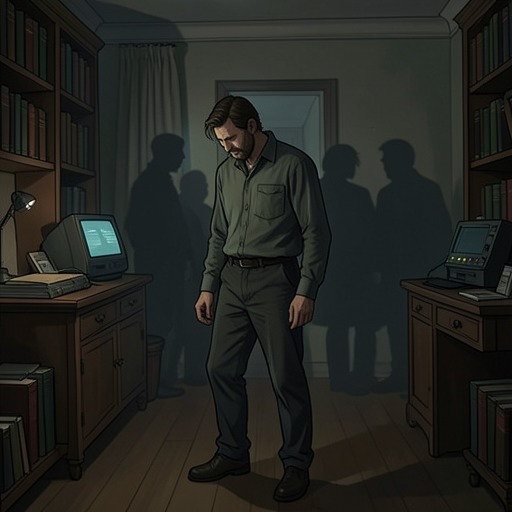
Augustine’s relationship to connection changes after he begins thinking beyond his own life and toward Iris’s future. Earlier, he had made halfhearted attempts to contact possible survivors, then stopped when satellites fell silent and commercial radio stations went off the air. He became comfortable with the belief that nobody remained to contact. Being physically marooned did not trouble him; he had expected to stay at the observatory. What alters his purpose is the prospect that Iris might need connection, love, and community beyond what he can give her.
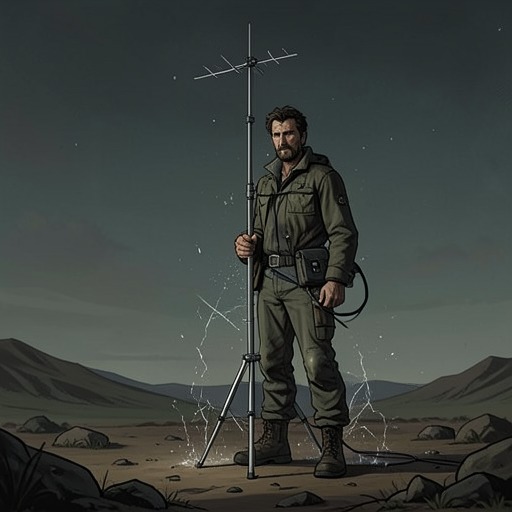
He now wants to find another voice, despite understanding that his search will probably yield nothing and will not bring rescue. The significance lies in the change of motive: contact matters in itself, not because it can deliver him somewhere or restore a functioning world. He turns from the telescope to radio waves. That decision reaches back to his boyhood, when he built radios and transmitted calls from his basement. In those early exchanges, he was thrilled by the fact that someone had answered, even if he never met the person and did not continue chatting after the initial contact. A response across distance was enough to establish that another person existed at the other end.
Signals without certainty
Sully repeats this reaching outward in the comm. pod. She checks receivers and probe uplinks, sends commands to the Jovian system, and scans for remnants of Earth’s radio noise. The work is tedious and unrewarding, but stopping would mean surrendering to the bleak possibilities she has kept at the edge of her thoughts. She also transmits quietly, without wanting the rest of the crew to hear her. As the spacecraft draws nearer to Earth, she believes the odds of contact may improve, and hope grows despite the empty airwaves and the accumulating, unprocessed probe data.
Augustine’s calls and Sully’s listening share a refusal to treat silence as proof that reaching out has no value. Neither practice guarantees an answer. The radio can establish contact only if someone is there to receive it, just as Thebes’s care cannot determine how the crew will fare. Across the observatory and the spacecraft, connection therefore remains both fragile and chosen: a walk shared beneath the stars, a meal saved for a colleague, a conversation begun against loneliness, or a signal sent into the dark.