Lake Hazen
Good Morning, MidnightLake Hazen is both a physical refuge and a turning point in Augustine and Iris’s life at the edge of civilization. Roughly fifty miles east of Barbeau Observatory, it draws them away from the mountain’s year-round snow and the futile routine of listening for signals: a place where a stronger radio station, milder conditions, and the beginnings of spring make another kind of life seem possible.
Setting and earlier use
Augustine finds Lake Hazen on a well-worn map in an Arctic atlas while listening to radio static at Barbeau Observatory. Researchers had organized fishing trips there, and he remembers being invited to several, though he never went. He had preferred imagining distant galaxies or more exotic holidays to paying attention to the landscapes around him. Now, after a long period of transmitting into silence, the lake’s location and remembered human use give it a different appeal: it is a reachable destination, not merely a mark on a map.
The setting is described in contrast to the observatory’s mountain environment. Lake Hazen lies lower, where the year-round snow and ice are expected to yield to wildflowers and warm breezes. Some of the archipelago’s warmest temperatures had reportedly been recorded there, reaching the low seventies in high summer. The lake is still frozen when Augustine and Iris arrive, but the land and weather already signal a change. Rather than offering escape from the Arctic, it presents a different, more hospitable experience of it.
The journey to the lake
Augustine decides that the trip might benefit them both and that Lake Hazen’s weather station could offer a practical advantage as well as a change of scenery. Photographs had shown him the station’s large aerial array, which he expected to outperform the antenna at Barbeau Observatory; its transmitting equipment, he reasons, should also be more powerful. He begins making plans and supply lists before telling Iris they will go. A snowmobile seems a viable way to travel while the snow cover lasts.
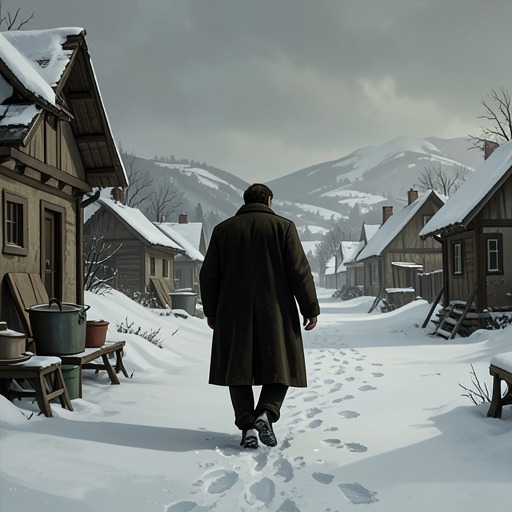
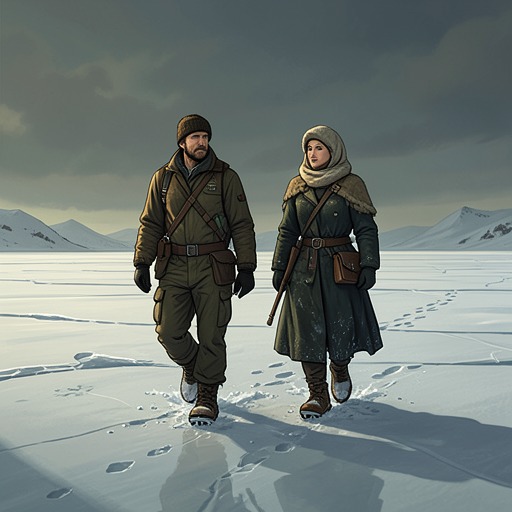
The approach proves harder than that plan suggests. On the fourth morning, Augustine and Iris reach the mountain range, where dark Paleozoic rock breaks through the snow and the route grows rough and difficult to find. A hidden boulder throws them from the snowmobile. Both survive the fall, but one ski is shattered and the machine will not restart. With only the gear they can carry, they continue on foot across exposed rock and ice, exhausted and sore. From a lower peak, they finally see the frozen lake below and the weather station at the mountain’s foot. The destination is no longer simply a promising alternative: the wrecked vehicle makes turning back impossible.
The weather station and its shelter
The camp consists of a low green half-cylinder tent and two larger white tents with stovepipe chimneys, set on a flat, snow-covered terrace beside the lake. A cluster of tall, slender antennas and a small radio shed stand nearby. The shore remains snowbound, though rocky ground is beginning to show. An island interrupts the broad sheet of ice, where Arctic hares leap and look back toward the newcomers. The frozen lake creaks and chimes, a markedly different sound from the wind that had swept across the tundra. A gentle breeze reaches Augustine’s frozen beard; in the scene, the thaw is both a change in weather and a sign of a new beginning.
After reaching camp at dusk, Augustine and Iris take shelter in a tent furnished with four canvas-sprung camping beds, an oil-burning stove, a gas range, folding chairs, a card table, meteorological maps, weather records, a generator, and crates of books. A dozen kerosene lamps sit on the table, and ragged carpets cover the plywood floor. The room feels more personal and comfortable to Augustine than Barbeau Observatory because it bears traces of lives already lived there: meals prepared, novels read, and games played. The books are mostly romance paperbacks, with some mysteries and basic cookbooks. Beneath the protective plastic around a mattress, he finds wool blankets, a sheet, and a pillow, and makes up the bed. The abandoned station offers not just shelter from the cold but the material signs of ordinary domestic life.
Communications and significance
The radio shed gives Lake Hazen a purpose beyond refuge. Inside, Augustine finds a complete base station with HF, VHF, and UHF transceivers, headsets, speakers, a tabletop microphone, and a generator. A satellite phone and several handheld radios are also there. Unlike the setup at Barbeau Observatory, which depended on satellite communications and used radio mainly as a backup or for local transmissions, this station is built around radio frequencies. Emergency supplies—bottled water, rations, and sleeping bags—are stored beneath the desk, making the shed the camp’s emergency shelter as well as its communications hub.
Augustine starts the generator, powers the equipment, and scans the bands, transmitting repeatedly without receiving an answer. The silence has not ended, but Lake Hazen gives his search a more capable instrument and a new setting. Its meaning rests in this double promise: the radio array may extend his reach toward other people, while the camp’s warmth, surviving books, and approaching spring let him and Iris inhabit the present more fully. The journey is therefore not simply a move between two Arctic outposts. It carries Augustine from a place associated with isolation and the sky he habitually watched toward a lakeside shelter where landscape, companionship, and practical hope demand his attention.