Polar Night
Good Morning, MidnightPolar Night is the recurring Arctic darkness that organizes some of the most consequential changes in Augustine Lofthouse’s life: Iris speaks during its first long stretch, its passing brings a return of light and shared routines, and its arrival again tests Augustine’s failing strength as he keeps watch by the radio. More than an absence of sunlight, it becomes a measure of time and companionship in a landscape where ordinary human schedules and assurances have fallen away.
Seasonal Darkness and the Arctic Landscape
At Barbeau Observatory, a remote outpost stocked for a dozen researchers over nine months, Augustine has stayed far longer than the usual fellowship. By the time he watches the sun return, it is nearly three years since the evacuation. The surrounding tundra makes the changing light especially stark: unlike winter in Michigan, which he remembers as soft snow followed by a thaw, this is a landscape of permanent ice and ground that never freezes free. A polar bear crossing a mountain ridge offers him a momentary fantasy of existence without guilt, hope, love, or reflection—only hunger and sleep. The thought belongs to the same severe world as Polar Night: survival stripped, in imagination, of the burdens Augustine associates with being human.
In late March, he sees the sinking sun through thick cloud, its outline divided by the jagged Cordillera Mountains. The day is only a little past noon, but the sun still hangs near the horizon. Polar Night has finally passed over this desolate place, and daylight will return gradually, a few hours at a time. Later, the Midnight Sun will rise and the stars will fade. The passage is not a clean switch from darkness to light but a long transition between seasonal extremes, one Augustine watches with an attention that makes the sky itself a calendar.
Iris Speaks in the Long Night
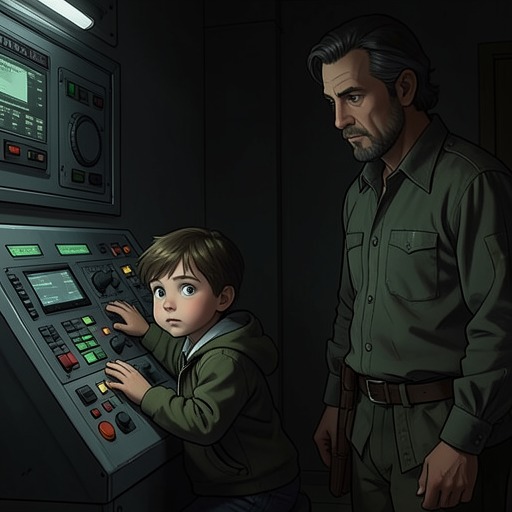
During the long Polar Night, after several weeks of total darkness and nearly two months after the evacuation, Iris breaks her silence to ask, “How long till morning?” It is the first time Augustine has heard her speak, apart from the eerie, wordless humming he has grown used to hearing as she looks out from the control tower. Her question gives the darkness a human measure: not an astronomical phenomenon but a wait whose end a child needs to know.
Augustine tells her they are about halfway there, without making a show of the fact that she has spoken. They eat jerky; she grips the strip in both hands and tears off a mouthful, and he passes her water. He asks her name, then asks who her parents are, but she does not answer those questions or speak again that day or the next. The exchange does not solve the mystery of her presence at the outpost. Instead, it leaves Augustine with a more immediate point of connection: the question of how long the darkness will last.
As time passes, he stops treating Iris’s silence only as an obstacle. He recognizes that she is intelligent and that, even when he was still hoping someone would return for her, she had begun adapting to the circumstances rather than dwelling on their causes. His irritation gives way to admiration, and he lets the unanswered questions go. Toward the end of the long night, they walk together around the outpost beneath a low moon, bundled in parkas against the cold. When Iris points out Polaris and names it, Augustine follows her gaze. She moves on without turning the observation into a question, and for the first time he is truly glad of her company. In the darkness, their relationship advances not through explanation but through shared attention.
Light Returns, and Time Finds New Markers
The seasonal change later appears beside a lake where Augustine and Iris fish together and take a dinghy out on the water. As warmth drains from the valley, frost rims the muddy shore and Augustine’s strength diminishes. The lake freezes, melts, and freezes again. At one point, sunset and sunrise draw together into a continuous display lasting several hours: orange light on the mountains, violet clouds, then vivid blue. These prolonged transitions become a regular marker of time passing, taking over the work that a normal day-night cycle might do.
The return of the stars signals another change. Augustine tests the lake ice with his boot and finds enormous polar bear tracks leading across it. At the radio shelter, winter has brought still air, departed birds, and a hush punctuated by the distant howl of a wolf. The radio’s static is a relief because it breaks into that quiet. Its sound does not end the isolation, but it makes the silence less absolute—and, as Augustine scans the bands, becomes the medium through which an unfamiliar human voice may reach him.
Polar Night Returns with the Radio Vigil
After Augustine makes radio contact with Sully, he sees the last of the sun and autumn begins. Polar Night returns along with extreme temperatures. The walk from his shelter to the radio shed becomes harder; breathing the subzero air hurts his lungs, and exertion worsens his illness. Still, he keeps watch as often as he can, waiting by the microphone through stretches of sleep and fever in which he can no longer reliably distinguish dreams from waking.
When Sully speaks to him again, she asks him to describe the sky, the animals, or even the dirt. Augustine tells her that the sky is dark all day and guesses that it is late October: there will be no sun until spring, only stars. He describes the cold, the birds that have mostly gone, wolves that remain, and Arctic hares moving across the ice. He also tells her about the bear whose tracks he saw and says he thinks it has been following him. The description gives Sully access, through his words, to a landscape she cannot see; at the same time, it confirms how completely Augustine’s own days are now organized around darkness, the weather, and waiting for a voice on the radio.
Narrative Significance
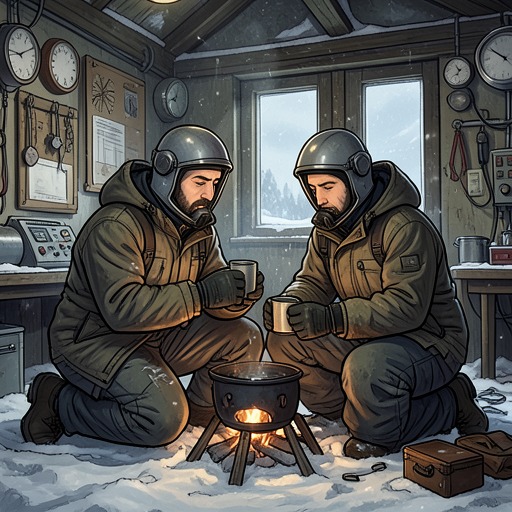
Polar Night links two forms of waiting. For Iris, it first becomes the duration behind a simple question about morning; for Augustine, it is a recurrent season measured through the return of stars, the freezing lake, difficult walks, and radio vigils. The sun’s eventual return gives the narrative a cycle rather than a single passage out of darkness, while the next autumn shows that light has not permanently restored Augustine’s health or ended his isolation. Against this repetition, small acts acquire weight: Iris naming Polaris, two companions watching snow cover the land, and Augustine continuing to listen. The season makes the Arctic’s scale palpable, but its most intimate measure is the fragile human connection that persists within it.