Sully
Good Morning, MidnightSully is a mission specialist aboard Aether whose search for signals from Earth becomes both a practical duty and a way of resisting despair. The mission gives meaning to sacrifices she has made for spaceflight, but it also carries her far from her daughter and into a silence she cannot repair by technical skill alone. As contact with Earth fails and Devi dies, Sully’s attention shifts from the work that once steadied her toward grief, memory, and a final movement toward Gordon Harper.
Identity and Family
Sully’s life in space is marked by small, repeated acts that keep Earth present. At 0700 GMT, five hours ahead of Houston and four behind Moscow, she wakes to the regimen Mission Control prescribed for Aether’s crew. Though Mission Control is no longer there to enforce it, the astronauts mostly keep to the schedule. Sully touches the single photograph pinned to the upholstered wall of her sleeping compartment, then sits up and braids her dark hair, which has gone uncut during the journey of more than a year. The familiar portrait and practiced morning routine make a modest domestic counterweight to the ship’s hum and the centrifuge’s whir.
The photograph shows Lucy, her daughter, at five or six, dressed as a firefly for Halloween. Jack made the costume from googly eyes, antennae, a stuffed glow-in-the-dark abdomen, and wings of sheer black pantyhose and wire. Lucy would be nine by the time Sully reflects on the picture, but Sully had left without finding a newer one to take; Jack had always been the family photographer. The old image preserves a particular childhood moment while exposing how much of Lucy’s growing up has happened beyond Sully’s reach.
Sully’s own childhood memory of family centers on her mother, Jean Sullivan. When Sully was about eight, the two lived in the Mojave Desert while Jean worked long hours at the Goldstone Deep Space Network facility. On a hot afternoon, Jean borrowed a deck of cards from an intern and brought Sully into her small office between signal-processing meetings, teaching her solitaire. Sully already knew the game from a babysitter, but pretended to learn because the lesson meant five extra minutes with her mother. She was accustomed to being at Jean’s workplace and did not question the absence of a father; as she understood it, the family had always been the two of them. The childhood card game returns years later as a reminder that time and attention, not the lesson itself, were what Sully wanted.
Aether and the Work of Listening
After the crew’s survey of Jupiter and its moons, Sully turns intensely toward the communications pod and the telemetry from probes left behind in the Jovian system. She works so persistently that she has to pull herself away to eat or use the stationary bike, impatient to return to the instruments. For the first time in years, the sacrifices involved in joining the space program seem settled rather than doubtful: the question of whether she chose correctly recedes, replaced by a conviction that she belongs in this work and is part of something larger than herself.
That conviction is tested by the absence of an audience. Mission Control falls silent just before the Jovian survey begins. The crew waits through the weeklong survey without a sign-off or warning, and the Deep Space Network’s other sites do not take over when the Goldstone facility is unavailable. One day passes, then another, and nearly two weeks go by without contact. Sully and her crewmates initially have no reason to assume the worst, but the longer the silence continues, the more the successful mission feels detached from the world it was meant to serve. The discoveries matter to her, yet the crew has no one with whom to share them.
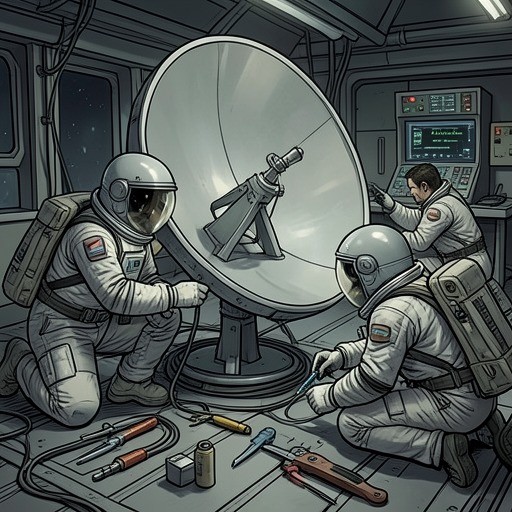
Sully continues to search rather than accept that silence. In the communications pod she checks receiver memory, reviews probe uplinks, sends commands toward the Jovian system, and scans the airwaves for traces of Earth’s transmissions. She sometimes uses a handheld microphone to transmit quietly, away from her colleagues. The work is tedious and unrewarding, but stopping would mean surrendering to the bleak possibilities she has tried to keep at the edge of thought. As Aether approaches Earth, her hope of making contact grows along with their decreasing distance. Then a cacophonous bang cuts off the sound; the equipment checks out, but the ship’s main communications dish has broken away and drifts past the cupola. The loss turns a long-running absence into a visible, immediate obstacle.
Care, Grief, and the Crew
Sully’s attachment to Devi is expressed less through easy reassurance than through attention to another person’s distress. She remembers loving Devi almost immediately after they met in Houston. In the later crisis aboard Aether, Devi grows increasingly quiet and describes recurring dreams of her family’s kitchen in Kolkata: her brothers eating with their parents at the head of the table, before the dream gives way to the knowledge that they are gone and she is alone. Sully lies beside her in the dark. When Devi’s tears run silently onto the pillow, Sully thinks of Lucy climbing into her bed after a nightmare, but cannot remember how she used to comfort her. Jack had been the one to take Lucy back to her own bed. Unable to offer certainty about what will happen, Sully moves closer, and the two women weep together.
The scene binds Sully’s losses and limitations. She can offer Devi warmth and physical closeness, but not the assurance that everything will be all right. Her recollection of Lucy does not give her a ready script for care; instead, it makes the distance from her daughter more palpable. When Devi dies during the work around the communications dish, Sully remains with her, holding the dish as her crewmate dies beside her. For a time afterward, she withdraws from the others and answers their visits with a single postponement: tomorrow. The word is not indifference to Harper, Thebes, or the rest of the crew. It is the narrow interval she needs to get through a day made full by grief.
Sully’s capacity to recognize other people’s attachments also appears in her exchange with Ivanov. While looking at the many pictures of his smiling family, she says she wishes she had brought more things from home and admits she had not expected to want them so much. Ivanov identifies that she has a daughter and asks whether her husband understood her choices. His perception surprises her, particularly because he has barely spoken to her in weeks. She recalls seeing him with his family in Houston, attentive to his wife and tenderly cutting food for his daughter. The encounter gives Sully a moment of recognition: the family she misses is not an abstract idea but a bond she has seen embodied in another crew member’s care.
Purpose, Loss, and Release
The external repair work makes the vastness around Sully newly concrete. When she leaves the airlock with Devi, Aether appears enormous from outside, built up from storage tanks, radiation shields, solar panels, and propulsion systems that the crew rarely sees from within. The centrifuge where all six have lived seems small beside the ship. Sully passes the greenhouse, life-support areas, and research pods, then reaches the cupola and waves to the four crewmates watching through the glass. The scene places her within a tightly shared human habitat surrounded by a scale of space that the interior normally conceals.
After Devi’s death, Sully gets up from a sleepless night because the crew still has work to do and a mission to complete. She must configure the new communications dish. As she traces the initial on her uniform’s monogram, she thinks of Devi’s name stitched into her burgundy Aether clothing: NTD. She says Nisha Devi’s full name repeatedly, like a chant or prayer. The act of naming restores the person behind the loss at the moment Sully is preparing to return to the task whose failure preceded it.
A radio exchange with Augustine Lofthouse brings Sully into contact with someone on Earth after more than a year of silence. Gordon Harper identifies her to Augustine as Specialist Sullivan, whom Augustine already knows; Augustine welcomes the crew home while acknowledging that he has heard nothing over the airwaves since the evacuation. The exchange offers contact but not a simple restoration of the world Sully left. Later, as she watches continents pass beneath Aether, she thinks of Lucy, Jack, and Jean. Through several sunrises and sunsets, she lets go of memories and plans for the future, imagining them falling toward a planet she does not expect to return to. She considers that perhaps staying in space is best and that she may no longer belong on the surface.
That night, after the others have turned in, Sully hears Harper moving restlessly in his bunk. Earlier, the connection between them had unsettled her and kept her at a distance. Now, after releasing her plans for the future, she changes direction and climbs in beside him before she can reconsider. Harper makes room for her. Her choice does not undo her grief or restore her family life; it makes closeness possible in the present, when she believes this may be her last chance to be near him. Sully’s arc thus turns on a difficult contrast: the work that once made her feel certain of her place in the universe cannot bring back what she has lost, but she can still choose a human connection within the uncertain life that remains.