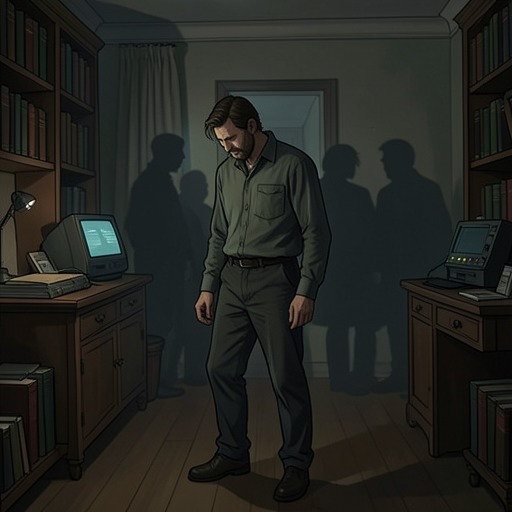
Sully’s grief and trauma after Devi’s death
Good Morning, MidnightSully’s grief and trauma after Devi’s death shape the aftermath of the fatal spacewalk and unsettle Sully’s assumptions about safety, work, and connection. Her response moves between involuntary replay of Devi’s death, memories of earlier family losses, and the practical demands of Aether’s mission. Returning to work helps her rejoin the crew, but it does not erase the loss or immediately restore her closeness with Harper.
The Bond Before the Loss
Before Devi’s death, Sully already understood that her crewmate was carrying grief of her own. In the dark, Devi described a recurring dream of her family’s kitchen in Kolkata: her brothers eating rice and dal, and her parents sitting at the head of the table with chai. The familiar scene lasted for hours in the dream, then gave way to the knowledge that her family was gone and she was alone. Sully could not promise that everything would be all right. Instead, she lay beside Devi and let a foot touch hers, offering contact without pretending to have an answer.
The intimacy of that quiet exchange gives the later loss a particular weight. Sully had wanted to comfort Devi but was unsure how to reach someone who had grown increasingly withdrawn. After Devi died, Sully’s memories of her were not limited to the spacewalk: the earlier image of them lying side by side also remains part of the relationship being mourned. Sully’s grief unfolds against the knowledge that she had seen Devi’s isolation and tried, in a small way, to meet it.
The Spacewalk in Memory
After Devi’s death, Sully wakes screaming and repeatedly sees her crewmate drift away in the darkness. She tries to imagine different outcomes, including returning Devi to the airlock in time or recognizing the failing carbon-dioxide scrubber earlier. These imagined alternatives offer no relief. Sully knows Devi is gone, while she herself remains aboard Aether, and the mind’s repeated revisions cannot change that fact.
The work of the spacewalk continues even as its memory overtakes her. Sully follows Harper’s instruction to install the bolts one by one, then returns through the airlock to the ship, where the other four crewmembers wait in silence. She passes them without speaking and withdraws behind the curtain in her compartment. Sleep and wakefulness blur together; the remembered vacuum seems to extend beyond the event and into the environment surrounding the crew. Sully comes to feel that they are not safe there and that she will never again feel entirely safe.
Her response is not a clean progression from shock to acceptance. She first tries to escape the terror, then allows its recurring ache to settle into her daily experience. The memory continues to return whether she is awake or asleep. Its repetition makes the death feel less like an event left behind than an experience that keeps intruding on the present.
Earlier Losses Return
Devi’s death draws older wounds into the same field of memory. Sully recalls leaving Lucy and Jack for Houston, including the departure before her first spaceflight, when Lucy was growing up and the family’s separation had become more definite. She remembers returning to find Lucy at ease with Jack’s new wife, Kristen, and feeling that she had been replaced in a family that was loved and secure without her. The pain of Devi’s death thus joins a history in which Sully has repeatedly been physically or emotionally separated from people she loves.
A later panic attack follows a visit from Harper. When he asks how she is doing, Sully answers that she is fine apart from the obvious circumstances. She is irritated by his effort to make room for her feelings, then ashamed of her brusque response when he leaves. Alone in the communications pod, memories of Devi, Lucy, Jack, and her mother, Jean, crowd together until Sully cannot easily distinguish one loss from another. As she drifts among the equipment, her body’s movement in weightlessness intensifies her sense that the stable logic she has relied on has broken down: hard work and intelligence cannot ensure that anyone will be safe.
Sully remembers another panic attack, after her stepfather told her that Jean had died. For years, she had imagined that she and her mother would find their way back to one another and share the desert and the night sky again. The news ended that hope. In the memory that follows, Sully sits on the floor of her apartment, fixed on the pattern of pink tile and white grout, and eventually makes her way outside to look at the sky. Remembering that she once found a way through that loss gives her a modest basis for believing she can endure the present one; it does not make the losses equivalent or cancel the new fear.
Work, Crew, and Mourning
For a time Sully withdraws from her crewmates. When Harper and Thebes visit, she sends them away with a promise to face the next day instead. She feels ashamed of dismissing friends who are also grieving, but cannot manage more than getting through the day of the spacewalk and reaching the one after it. Her isolation is therefore not indifference to the crew; it is a response to the scale of what she cannot yet articulate.
The return to work begins with ordinary, necessary actions. The morning after her withdrawal, Sully gets dressed, traces the initial on her monogram, and thinks of the initials on Devi’s uniform: NTD, for Nisha Devi. She repeats her friend’s full name quietly. At breakfast, Tal places his hands on Sully’s shoulders and tells her that the death was not her fault. Sully keeps eating despite feeling ill and decides she will do what the day requires because she owes Devi that much.
In the communications pod, Thebes works beside her without asking her to discuss the spacewalk. Sully values the silence and concentrates on bringing the replacement communications system online. When she recognizes that Thebes, too, seems diminished by the loss, she understands that the event belongs to the whole crew: the others watched Devi drift away through the helmet cameras. At lunch, the surviving crewmates share their remaining shepherd’s pie in silence. Ivanov takes Tal’s and Harper’s hands, and the others join them. Thebes’s simple recognition that Devi was loved gives Sully a way to see the crew not only as fellow survivors but as the family she has had aboard Aether.
Reconnection Without Resolution
That afternoon, the repaired system receives the first signal since the main communications dish broke away a week earlier. Sully and Thebes hear telemetry from their probe on Europa and check that the equipment is receiving and saving data. The successful signal means the spacewalks achieved their practical objective, though Sully’s memory of being unable to help Devi remains bound to the work’s cost. She wonders whether Devi noticed her suit’s oxygen problem and chose not to say anything, but knows she will never find out.
Sully and Thebes calibrate the new system as well as they can, adjusting its settings until the reception is as good as it will be. Sully stays afterward to listen. She does not mistake the faint signal for a response from someone calling them home; rather, the work leaves her less alone and allows her to feel that she and the crew have done what they could. Her attention shifts, cautiously, from the turbulence of loss toward whatever may come next.
That movement remains incomplete. Later, when Harper tries to check on her, Sully cannot tell him what she is feeling and reacts sharply to his concern. She recognizes that she has hurt him and apologizes, but his detached reply makes the cost of their exchange newly immediate: she can feel the possibility of losing someone who is still there. Her grief therefore changes more than her memories of Devi. It alters how she approaches the people who remain, while her work, her crew, and the act of naming Devi keep a connection to the lost crewmate present.