Tal
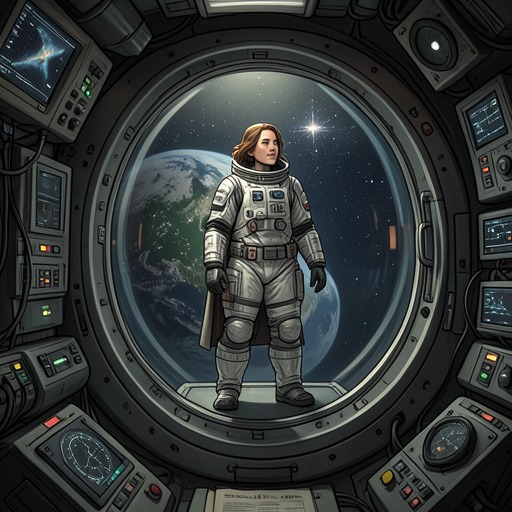
Good Morning, MidnightTal is Aether’s pilot and physics specialist, a lively presence whose delight in the precision of spaceflight gives way to distress when contact with Earth and his family becomes uncertain. His trajectory links the mission’s exhilaration to its isolation: the same man who performs zero-gravity acrobatics and fills the centrifuge with jokes later retreats into video games, then returns to the work of the crew and pilots the Soyuz reentry capsule on the journey down toward Earth.
Identity and the mission
Tal’s technical responsibilities combine piloting with physics. He helps set the landing modules down on Callisto and Ganymede and pilots Aether’s slingshot around Jupiter, challenges that reward the precision he enjoys. After the crew surveys Jupiter and its moons, the astronauts experience a collective change in perspective: their anxiety about the mission and its isolation recedes, replaced by a sense of having encountered a scale beyond ordinary life. Tal responds with movement and exuberance. He spends extra time on the exercise equipment, performs zero-gravity acrobatics for anyone willing to watch, and tells jokes without pause. His joy becomes infectious, giving the ship a buoyant social energy even as each crewmember absorbs the experience differently.
The contrast in Tal’s response matters. Ivanov turns toward rock samples and research, while Harper fills notebooks with drawings of Jupiter. Tal expresses his transformation physically and socially: through exercise, tumbling, and comic performance. His enthusiasm is not simply a stable temperament, however. As the return trajectory levels out and the mission’s immediate challenges recede, the silence from Mission Control changes his mood. The excitement that had been sustained by demanding tasks proves more difficult to maintain when the crew must endure a long, uncertain passage home.
Family and the loss of contact
Before the communications silence, Tal spends hours speaking with his wife and sons. His boys are eight and eleven when Aether launches; their birthdays fall a week apart, and they celebrate with a small party at a training facility in Houston before the launch. The family’s shared life includes video games. Tal keeps his high scores aboard Aether so that, during video calls, he and his sons can compare them. Even after communication delays make conversation one-sided, the game competition continues through messages.
That connection gives the games a meaning beyond recreation. Tal’s sons play the same racing games back in Texas, and beating their record offers him a moment of triumph that immediately turns painful. After he surpasses one of their scores, he raises a fist, then loses composure; the controller slips from his hands. Sully sits beside him and places a cautious hand on his back. Tal presses his face against her shoulder, a degree of vulnerability she has not seen from him before. He explains that he is winning, while the game’s victory music continues to repeat. The scene makes the paradox of his achievement plain: he can still compete with his sons, but cannot share the victory with them as he once did.
As periodic uplinks from his young family in Houston disappear, Tal becomes despondent and irritable. He channels that distress into the ship’s games, using an assortment of joysticks, gamepads, guns, steering wheels, and flight simulators. His outbursts can send plastic equipment across Little Earth, followed by curses in Hebrew and English. The contrast with his earlier joking is stark: a pursuit once shared with his children becomes a private, repetitive outlet for frustration in the enclosed centrifuge.
Withdrawal and the crew’s strain
After a particularly forceful outburst, Tal sits slumped before the console, his earlier buoyancy gone. He retrieves the steering wheel he has thrown against a wall and spends the rest of the day trying to repair it, fitting plastic pieces together, working on wires, and testing buttons. The repair is futile, but the task gives him something to do. Thebes eventually lays a hand on his back and redirects him to work on the control deck. Tal accepts the interruption, yet returns to the console the following day. Sully cannot tell whether the games’ repeated sounds and graphics soothe him or whether their cycles of winning and losing provide a brief release. In either case, the console becomes a recurring refuge rather than a solution to his isolation.
The deteriorating atmosphere reaches a confrontation with Ivanov. After Ivanov charges at him and seizes his jumpsuit, Tal breaks free, and Thebes intervenes to separate them. Harper arrives as Tal kicks his controller away; the centrifuge falls quiet while Harper and Thebes confer. The episode shows how private distress has become a shared problem for the crew. Their earlier harmony, strengthened by the moon survey, has given way to separate routines and strained relations. Tal is not isolated in that breakdown, but his dependence on games makes his withdrawal conspicuous, and the conflict with Ivanov brings the tension into the open.
Tal’s work nevertheless continues alongside his retreat. As Aether crosses the asteroid belt, he monitors a radar tablet and is responsible for making sure the ship avoids a collision. The belt is widely dispersed, and the passage is scheduled for a relatively inactive Kirkwood gap, making impact exceedingly unlikely; Tal still has to watch for hazards. When Sully checks in, he reports that the view is clear, with only dust and pebbles for thousands of miles, and estimates that they are about two weeks from Mars’s orbit. His brief exchange with her combines professional vigilance with a small return to easy companionship: he reassures her that he will keep watch.
Renewed teamwork and the return
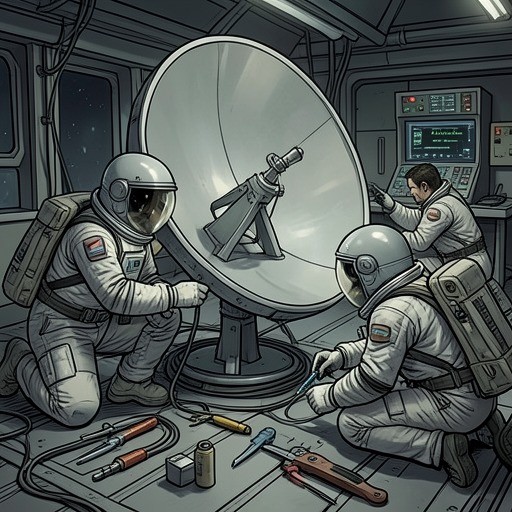
Preparations to restore Aether’s communications bring the crew back into a more collaborative rhythm. Tal remains glued to the radar system while Sully and Devi review the plan with Harper and Thebes checks the suits. Ivanov tests the plan and identifies possible weaknesses. As the work proceeds, Tal begins joking again, and the crew’s old camaraderie reappears. The change is not proof that the strain has vanished: Harper remains apprehensive, and the hope that repaired communications will carry more than silence is still uncertain. But a concrete shared task draws Tal back into conversation and collective effort.
On the final leg, Tal briefs the crew on their trajectory past Mars and how they will use the planet’s gravity. He explains that they will pass near Mars and that the coming days offer an opportunity to see it more closely. Sully drifts away from the discussion, but Harper takes over the crew’s assignments as Aether draws nearer to Earth. At the International Space Station, Tal prepares the docking controls while Ivanov watches the station through the cupola. Tal monitors the docking port through the camera as the station’s solar arrays and Earth’s blue oceans come into view. The spacecraft align and lock together, ending Aether’s long passage through deep space.
The crew’s decision about who will leave the station is made by drawing straws: short straws mean remaining in space, while long ones mean an uncertain descent. Tal draws a full-length straw and releases a held breath. His draw places him on the descent side of the choice, but the procedure offers no certainty about what awaits on Earth. When the Soyuz reentry capsule departs, Tal takes charge of the flight. He performs a short burn to move it away from the station, then a longer burn to carry it around the planet and lower its orbit toward the atmosphere. He follows the reentry sequence, sheds the orbital module and instrument components, and keeps the descent pod on target as it enters the atmosphere.
During the descent, the heat darkens the window and gravity steadily intensifies. Tal remains focused on piloting while Sully and Harper experience the frightening entry and the opening of the parachutes. The last glimpse through the mostly blackened window is a patch of clear blue sky. Tal’s ending thus brings his technical competence and his family-centered longing into the same uncertain passage: he has helped leave Earth, endured the loss of contact with the people there, and now pilots toward a world whose condition the returning crew does not yet know.