The last man on earth
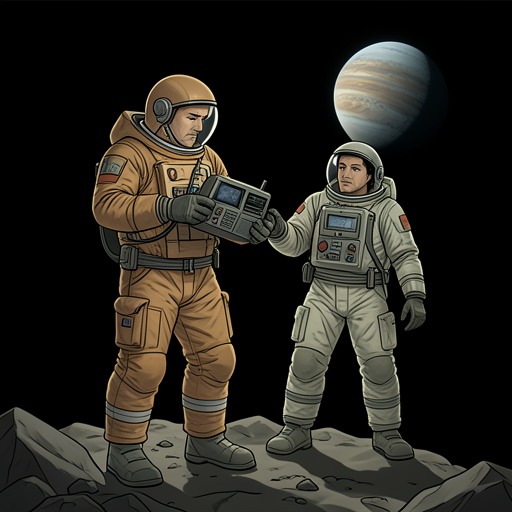
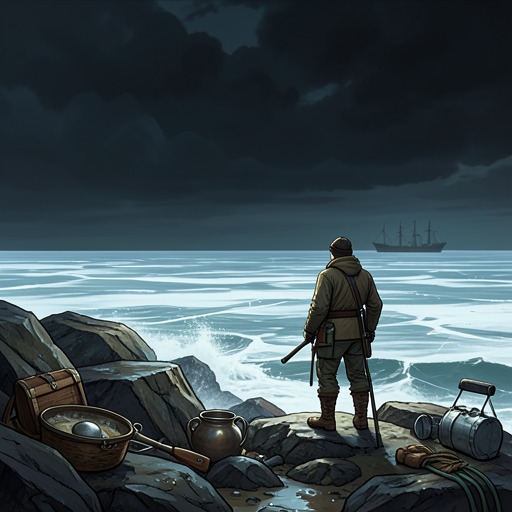
Good Morning, MidnightThe last man on earth names a possibility, not a fact: an isolated Arctic survivor may be the only human left, but neither his silence nor his sparse knowledge proves it. The phrase moves from the crew’s anxious speculation into Sully’s private vigil, where it comes to signify both the scale of the catastrophe they fear and the fragile connection she finds in a distant voice.
Naming a Possibility
The idea enters the crew’s conversation in Tal’s indignant question: “So then, this guy is what, like the last person on earth? Is that what we’re getting at here?” Ivanov admonishes him not to joke. Tal replies that he wishes he were joking, then offers a reason for taking the possibility seriously: if a catastrophe had occurred, the poles might have been among the safest places, and the man’s location fits that conjecture. The phrase is therefore not an announcement of survival’s end but a bleak inference drawn from geography and a failed attempt at contact.
That distinction matters. Tal’s reasoning depends on what the crew cannot learn: the survivor has been trying to make contact, but until now no one has answered, and he knows only rumors about why people were evacuated. The crew has no confirmation that he is alone, no account of what happened elsewhere, and no reliable explanation for the silence. “The last person on earth” gives their uncertainty a human shape, but the words outrun the evidence even as they make its stakes imaginable.
From Conjecture to Vigil
The crew’s second conversation with the survivor supplies little explanation. After the signal fails, the astronauts return to the limited facts, while Sully tries to reconnect because she has questions beyond the practical mystery. She wants to hear about Earth itself: its sunsets, weather, animals, ocean, trees, and the feel of ground beneath her feet. The possibility embodied in the phrase begins to matter to her not only as a threat to humanity, but as a way of thinking about everything she has lost access to while in orbit.
When contact resumes, the man tells Sully about the Arctic’s dark days and frozen tundra. His account of finding polar bear tracks gives her a way to recognize a loneliness she believes they share. The tracks are slight evidence of another presence, yet, in her reading of him, they have become a kind of company. She suspects that his isolation is not merely the result of catastrophe or wilderness: even among crowds, in cities, or with a lover, he might have felt alone. Sully recognizes that condition because she feels it in herself. The phrase thus shifts from a count of surviving people to an intimate question of what it means to be unconnected, even before anyone knows whether the survivor is literally alone.
A Voice Without a Body
Sully’s growing attachment to the possibility is shaped by the limits of their communication. Their connection breaks before she is ready to end the conversation; afterward, she remains in the comm. pod, listening to the ship and the faint sounds of her crewmates. The man is present to her through a voice and the details he supplies, but she cannot see him. She imagines his age from the gravel in his voice, pictures his long hair and beard, and gives his unseen eyes an icy blue color. These are her imaginings, not information the conversation confirms.
She also imagines rescuing him by landing the return capsule on Ellesmere Island and finding his camp. But the fantasy stops at the danger of getting there and surviving: the crew could end up in freezing water or on the tundra without finding him. They will instead land in a more forgiving region where they have a better chance of survival. In Sully’s view, the man she has come to think of as the last man on earth will remain trapped in the Arctic, and she will never know what he looks like. The phrase now carries a personal consequence: not just the fear that he is the last, but the likelihood that she cannot reach him.
An Unresolved Claim
Sully wonders whether she has found the last man on earth, but the narrative does not establish that she has. Her conclusion that he will die alone belongs to her fearful expectation, not to a confirmed account of his fate. The phrase gathers force precisely because it remains unverified: a radio signal has connected two isolated lives, but it cannot show Sully who else may have survived or what awaits the man below.
The wording also changes as it passes between speakers and contexts. Tal’s “last person on earth” is an exasperated formulation of the crew’s public fear; Sully’s later “last man on earth” is quieter and more personal, attached to the voice she waits for and the rescue she cannot attempt. The movement from a question to a private designation does not resolve the uncertainty. Instead, it makes the survivor’s possible solitude feel specific, while preserving the gap between what the crew knows and what Sully fears.