Flying with the cormorants
Good Morning, Midnight (Reginald Hill Edition)Hat Bowler’s memory of flying with the Cormorants turns a childhood attempt at imaginative identification into a lasting way of understanding life. Recounted to Lavinia Maciver, it links the bodily danger of flight above a rough sea with both his adult knowledge of birds and his sense of what it means to be alive.
The childhood vision
Hat places the beginning of the experience when he was six, on holiday on the Pembrokeshire coast. Sitting on the beach, he watched a pair of Cormorants hurtle just above the waves. The sea below them was surging and breaking; from the birds’ imagined point of view, each wave seemed ready to reach up and pull them under, while spray struck cold against the belly. The scene’s force lies in its closeness to danger: Hat does not merely see the birds against a landscape but tries to imagine the sea as they encounter it in flight.
He recalls trying to become them in imagination, testing what it might feel like to move so quickly through the air. Asked whether he succeeded, Hat distinguishes between the child’s effort to picture the sensation and the adult’s later recognition: “I think I just about imagined it physically,” he says, before concluding, “It’s like living.” The short phrase recasts the remembered flight as an analogy for life, with exhilaration and exposure inseparable.
From imitation to attention
The vision did not end with that day. Hat supposes that he went paddling with his brothers or bought an ice cream, ordinary holiday activities that sit beside the memory without displacing it. Afterwards, whenever he saw a bird, he tried to see through its eyes. Over time, that imaginative exercise developed into attention to what birds were actually doing, rather than what he preferred to pretend they were doing. His fascination thus moves from projection toward observation: imagining another creature becomes a route into learning about it.
Even as his knowledge grew, the first flight remained distinct. Hat insists that he never forgot the Cormorants and describes the childhood moment as having flown with them for a little while. The expression preserves the imaginative claim without confusing it with literal flight; its importance is the felt access it gave him to another creature’s physical experience.
A conversation held in the present
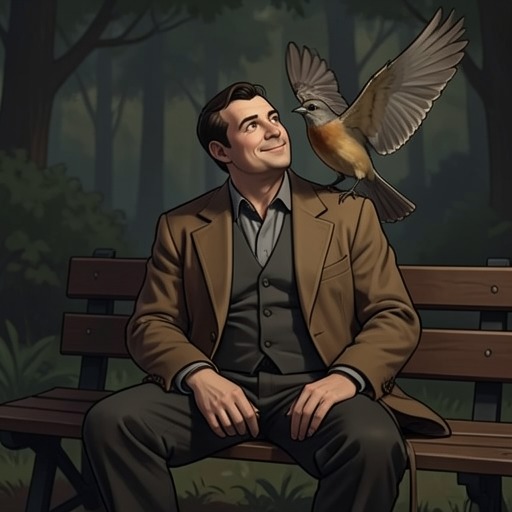
Hat tells the story to Lavinia Maciver in a domestic scene where two blue tits, Impy and Lopside, settle on his shoulders and seem to listen. Their presence quietly joins the remembered birds to the present conversation, while their expectation of food keeps the encounter grounded in ordinary life. When Lavinia asks what followed the childhood moment, Hat answers with the development of his lifelong interest; when he asks whether the account makes sense, she says it makes more sense than almost anything she has heard in the last few days.
Her compassionate response recognizes the memory as more than a charming explanation of a hobby. The phrase “Like living” gives it its wider significance: flight is imagined as vulnerable movement through forces that might overwhelm the body, yet it is also a way of inhabiting the world with attention. The childhood image remains vivid because adult understanding has not replaced it; instead, experience has made its physical feeling legible.