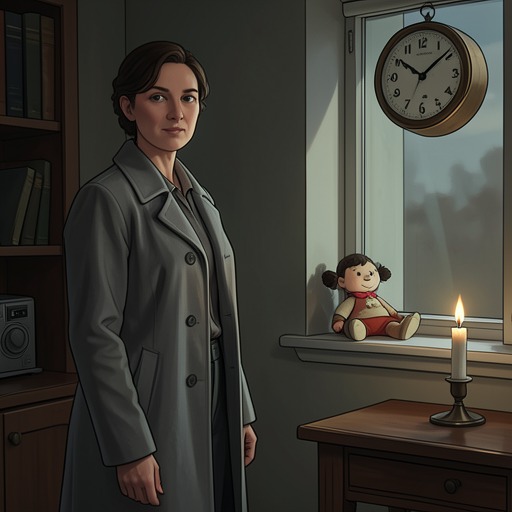
Helen Dunn
Good Morning, Midnight (Reginald Hill Edition)Helen Dunn is Kay Kafka’s stepdaughter, the expectant mother of twins, and Palinurus Maciver Junior’s sister. In the scenes surrounding the search for her brother, she moves from the familiar warmth of her Wednesday evenings with Kay into a moment when pregnancy, family loyalty, and childbirth abruptly become immediate realities. Her insistence that she is not an invalid, and that Pal is her brother, gives kinship a direct claim on her choices; the birth that follows turns that claim into a new family beginning.
Identity and Background
Helen’s connection with Kay is close without depending on blood or shared opinions. Their regular Wednesday visits are relaxed and affectionate: they talk about films, fashions, and local gossip, keeping difficult realities at a distance. The pleasure Kay finds in Helen’s company comes, the narration stresses, from the certainty of their love rather than from an especially close match in taste or outlook. Their ease is therefore a chosen intimacy, not simply a family role performed by habit.
The approach of Helen’s delivery has begun to change the subjects of those visits. Her pregnancy has so far been comparatively easy, and she appears to be enjoying the preparations: baby clothes, pushchairs, and the nursery. She refuses to learn whether the twins are boys or girls, but has decided that a daughter will be named Kay. She also insists that both children will call Kay their grandmother. These plans make the future vivid in the present, extending Helen and Kay’s bond into the next generation before the babies have arrived.
Helen and Kay: Intimacy and Independence
The impending birth unsettles the usual rhythm of one Wednesday evening. A phone call from Jason Dunn and a delayed pizza interrupt the comfortable visit, but the deeper disturbance is Helen’s dawning recognition that the twins will bring a permanent change to her life, not merely a single occasion for celebration. Kay tries to reassure her; Helen cannot be made cheerful by reassurance. Her anxiety is not presented as rejection of the babies, but as an awareness of the scale of what is about to happen.
Helen interprets Kay’s refusal to let her use the name Mum as a refusal of a more binding role: she suggests that accepting the name would have made Kay her prisoner. Kay is taken aback by the idea. The exchange exposes a strain inside their affection without cancelling it. Helen can regard closeness as something that might impose a claim, while Kay experiences their relationship as a delight precisely because it is freely shared. Their difference is not resolved in the moment, but the earlier plans for the babies show that tenderness and uncertainty coexist between them.
Family Loyalty and the Search for Pal
When Jason arrives, he asks whether there has been word from Pal and whether Pal failed to appear at the club. The conversation shifts from the future Helen is preparing for to the immediate uncertainty surrounding her brother. Once the group discusses going, Jason objects because of her condition. Helen answers that pregnancy does not make her an invalid and that Pal is her brother. Her response establishes a clear priority: physical vulnerability does not erase her right to act, and family connection gives her a reason to take part.
Kay recognizes the force of Helen’s appeal to blood. The moment contrasts with the affection between stepmother and stepdaughter, which has been described as deep despite not being founded on blood ties. Helen’s chosen closeness with Kay is real, but when Pal may be missing, biological kinship presses forward with its own urgency. Kay then tries to steady the situation by suggesting that the police may be seeking Pal only because he is the keyholder, rather than because the matter concerns him directly. Her attempt to reassure Helen underscores how little the group yet knows about what has happened.
The Birth and Its Significance
The search is interrupted when Helen, having reached the Volvo, sinks back into the car. Jason calls for help because the baby is coming, and Kay runs toward her with the other women. The change is sudden: Helen has been discussing whether to join an effort to find her brother, but the immediate event is now the arrival of her children. Her pregnancy, until then expressed through preparations and apprehension, becomes the central action of the scene.
Ellie Pascoe soon announces that Helen has delivered twins, a boy and a girl. The outcome gives a concrete shape to the plans made during the Wednesday visits: Helen had refused to know the babies’ sexes in advance, and now both possibilities arrive together. Her earlier intention to name a girl Kay acquires particular resonance, as does her promise that the children will call Kay grandmother. The episode does not resolve the uncertainty about Pal in these moments; instead, it places the family’s search beside a birth that reorganizes its immediate attention. Helen’s role as sister and daughter is joined by motherhood, while the bond between her and Kay is projected forward into the lives of the twins.