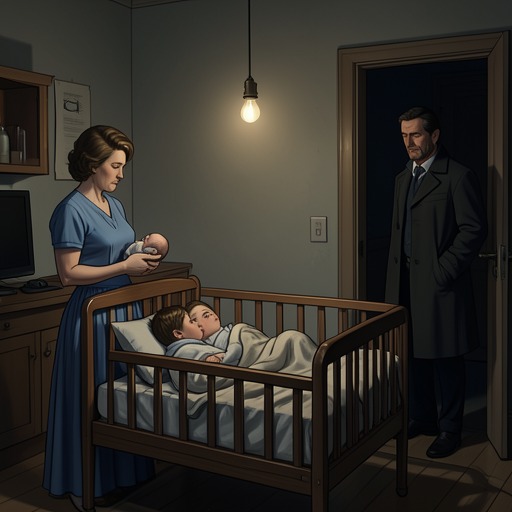
Jason Dunn and Helen Dunn’s marriage
Good Morning, Midnight (Reginald Hill Edition)Jason Dunn and Helen Dunn’s marriage is defined in the novel by affection expressed through practical care, candid disagreement, and a shared pull toward family. A sudden journey to Moscow House brings those qualities into focus: Jason worries about Helen’s pregnancy, Helen refuses to be treated as an invalid, and when labour begins he calls urgently for help while she is still in the car.
Identity and Everyday Partnership
Jason is Helen’s husband, and their exchanges suggest a relationship comfortable enough to accommodate both endearment and blunt challenge. He enters the room looking for news of Palinurus Maciver Junior, addresses Helen affectionately as sweetie, and asks whether there has been any word from her brother. His concern for Palinurus soon becomes a reason to leave again, but it is also the immediate circumstance that draws the couple into the same unfolding crisis.
The scene’s description of Jason comes through Kay Kafka’s point of view. She notices his height, blondness, muscular build, and striking looks, then imagines that his and Helen’s genes might produce extraordinary-looking twins. That thought connects the couple’s physical presence to their impending family without turning the narration into a report of their private feelings: the anticipation belongs to Kay, who smiles a welcome as Jason arrives.
A Family Emergency and a Disagreement
Jason says he must go out again after hearing news that changes the mood in the house. He intends to go to Moscow House because Sue-Lynn Maciver has said she is heading there and sounded upset. Helen immediately challenges the apparent concern, asking when he began to care how Sue-Lynn sounded. The brief exchange makes their familiarity visible: Helen can question Jason directly, and his stated reason is not accepted without scrutiny.
Kay agrees that the concern may amount to nothing but decides to accompany him in case it does not. Helen rises more slowly and insists on coming too. Jason protests on the grounds of her condition, but Helen answers that she is pregnant, not an invalid, and that Palinurus is her brother. Her reply establishes both the physical circumstance shaping their choices and the family bond she will not subordinate to it. Jason accepts that further argument would be useless, and they set off together.
The journey also gives the pregnancy a practical presence. Helen is eased into a large Volvo estate, a vehicle that can accommodate her more readily than Jason’s much-loved MR2. He had given up the MR2 during the fourth month of her pregnancy after acknowledging that it was impractical for his expanding wife and the family they were expecting. The change in car is a small but concrete sign of their preparations: affection appears not only in how Jason addresses Helen, but in an adjustment to the demands of their shared future.
Labour at Moscow House
At Moscow House, Helen suddenly sinks back into the Volvo. Jason’s alarm breaks through his attempt at composure, and he cries out for help, explaining that the baby is coming. His immediate response is to seek assistance for his wife; he does not remain a detached observer as the situation changes from a family visit to an urgent birth.
The arrival of help confirms that Helen is having twins. The news gives Kay’s earlier thought about the children’s appearance a sharp narrative echo, but the scene’s immediate emphasis is physical and practical: Helen’s waters have broken, and an ambulance is on its way. The imagined future of the twins becomes an urgent present, while Jason’s role shifts from accompanying Helen on a journey to calling for help as she goes into labour.
Character and Narrative Significance
The marriage is drawn through a compact sequence of actions rather than a history of the couple. Jason’s affectionate greeting, his concern about Helen’s pregnancy, and the earlier loss of the unsuitable sports car sit beside Helen’s pointed challenge and refusal to be protected out of a family emergency. Neither care nor independence cancels the other. Jason’s caution does not prevent Helen from deciding for herself, and her forcefulness does not make him withdraw when the crisis arrives.
Their journey also binds the couple’s relationship to two overlapping family responsibilities: Helen’s concern for her brother and the imminent birth of her children. The scene moves from uncertainty about Palinurus to Helen’s labour without separating those obligations into neat stages. By the time Jason calls for help, the marriage has been shown in action—negotiating risk, accommodating pregnancy, and responding together as the expected twins arrive.