Laurence Waverley
Good Morning, Midnight (Reginald Hill Edition)Laurence Waverley is a retired Value Added Tax investigator whose established professional persona conceals a covert assignment connected to Ash-Mac’s. He enters the story as a composed, observant visitor and an old friend to Lavinia Maciver; later, he emerges as a crucial intermediary between the Maciver family’s private history and Peter Pascoe’s murder inquiry. His defining tension is between access to the truth and the decision to keep some of it beyond a police officer’s reach.
Identity and Presentation
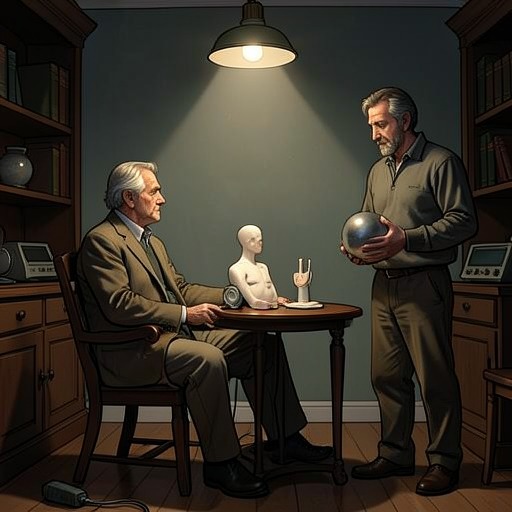
Waverley is in his early sixties, of medium height and slim build, with a long, narrow face, carefully kept silvery hair, alert blue-green eyes, and a sympathetic expression. His polished appearance is reinforced by a well-cut grey mohair overcoat and a black trilby. He carries an ebony walking stick topped with a silver hawk’s head; a slight drag in his left leg makes clear that the stick is practical rather than decorative. His gentle, well-modulated voice, with a faint Scottish accent, matches the measured manner with which he meets strangers and handles tense situations.
His first appearance is filtered through Hat Bowler’s uncertain perception. At Blacklow Cottage, Hat initially experiences the morning as though it were still a dream, but the taste of food and the chill of the weather have already begun to unsettle that explanation. Waverley arrives at the door, greets Lavinia with familiarity, and finds Hat unexpectedly in her kitchen. He does not press the stranger for an explanation; instead, he asks whether Hat lives locally and listens to the reply that he became lost in the forest. This quiet exchange establishes his composure and courtesy before the larger crisis comes into view.
Friendship with Lavinia Maciver
Waverley comes to Blacklow Cottage to bring Lavinia news of the death that has shaken the Maciver family. He knows that she avoids telephones and broadcast media, so she has heard nothing. When the news reaches her, she falls silent before asking whether she is needed and seeking his advice. Waverley recommends that she go with him, speak to the people involved, and learn what there is to find out before deciding what role she can play. His response is practical but attentive: he does not claim to know what she should do after arriving, and instead helps her reach the place where she can judge for herself.
Their friendship is older than the crisis. At the family home, Lavinia recalls an earlier meeting when the two heard a green woodpecker and she led him to its nest in an old beech tree. She wonders whether the birds still use it, and Waverley accepts her invitation to look. The recollection gives their relationship a private history rooted in shared attention to the landscape, sharply distinct from the household’s present grief. Lavinia also describes him as an old friend and regards his visit with the news as an act of genuine friendship. He helps her travel into town in his maroon Jaguar S-type, offering a lift to Hat as well. The car, conspicuously grander than Hat would have guessed, adds a note of wry contrast to the restrained figure who steps out of it.
Professional Cover and the Maciver Inquiry
Waverley’s connection with Palinurus Maciver Senior began professionally, not socially. He explains to Pascoe that he knew Maciver Senior only in his capacity as a tax investigator, a role that made friendship unlikely. By the time he appears at the family home, however, Waverley has also brought Lavinia and Cressida Maciver there. Pascoe challenges his presence in a crime scene. Waverley apologizes for entering without authority and recognizes that the study should remain under police control until the death has been established as suicide. His response combines deference to procedure with a steady bearing that makes him seem accustomed to authority rather than cowed by it.
The later account to Pascoe reveals that the tax-investigator identity was also an unusually effective cover. Waverley says that Ash-Mac’s American management had assured his superiors that allegations of sanction-busting and other illegal trading were under control. His superiors nevertheless sent him to Yorkshire to make an independent assessment. He used the familiar role of a Value Added Tax investigator, supported by a detailed career record in Customs and Excise personnel files. The cover worked because a tax investigator naturally attracts suspicion, making others less likely to suspect a more covert purpose.
Under that identity, Waverley approached Maciver Senior on the pretext of comparing the company’s current record-keeping with the systems used before the takeover. Once Maciver Senior understood that Waverley was dissatisfied with the new regime, he began confiding his concerns about the firm. Waverley learned that Maciver Senior had employed Jake Gallipot to obtain hard evidence. The arrangement placed Waverley close to the allegations without making him their public face: he was able to gather information by allowing Maciver Senior to believe that his professional interests aligned with the older man’s concerns.
At the Crime Scene
When Pascoe finds Waverley near the old record player associated with Maciver Senior’s farewell music, Waverley is on one knee. He explains that he brought Lavinia and Cressida to the house. Pascoe insists that the study is a crime scene and asks what Waverley is doing there without authorization. Waverley acknowledges the trespass and the unfinished status of the inquiry. He does not claim investigative authority, even as his manner suggests that he understands the importance of the scene and the limits Pascoe is enforcing.
Waverley’s composure also coexists with a personal response to death. When Lavinia sees him again, she remembers the green woodpeckers and the old beech; Waverley meets the invitation to go outside with a wry glance toward Pascoe. The scene sets a remembered encounter with living birds against the present investigation, without suggesting that grief can be resolved by a single gesture. Pascoe prevents Waverley from using the back entrance, and the older man leaves by the front. His respect for Lavinia’s friendship therefore does not erase the police boundary, even if his arrival has brought family members into a space under investigation.
In his subsequent account, Waverley describes going to the house after learning that Gallipot was there with Kay Kafka. He found Maciver Senior dead in the study, with an ice axe nearby, and read a letter on the desk. The letter, written by Maciver Senior’s son, accused Kay Kafka of a history of unwanted advances, including a recent incident during a visit home. Waverley’s discovery connects the business investigation to the family conflict, but the evidence available in his account does not by itself resolve every question about the death or the allegation.
Disclosure to Peter Pascoe
Waverley later reappears at the cottage where Pascoe is staying. Pascoe recognizes his maroon Jaguar and is unsure whether its presence should reassure him. When Pascoe questions whether Waverley’s judgment should decide what happens next, Waverley answers with an assessment of the detective’s abilities: he presents Pascoe as clever, perceptive, sensitive, discreet, articulate, and capable of authority without bullying. He also says that Pascoe listens to others, can make difficult decisions, and does not repeat mistakes.
The appraisal leads to a warning. Waverley argues that some mistakes are fatal even when made only once, and that a successful investigator must recognize matters of which he should not make himself the judge. He has a telephone number through which Pascoe could seek confirmation, but cautions that making the call would be unnecessary and professionally unhelpful. The exchange leaves the truth deliberately bounded: Waverley signals that more could be confirmed, yet refuses to make disclosure a simple test of Pascoe’s persistence.
He then invites Pascoe into the Jaguar and sets explicit terms for a final account: he will speak briefly, will not be interrupted, will answer no questions, and will allow no further interviews or record. Pascoe agrees, but secretly switches on a miniature cassette recorder. Waverley’s effort to control the conditions of disclosure thus meets Pascoe’s independent effort to preserve it. The account that follows explains the covert assignment and Waverley’s route to Maciver Senior, while Waverley himself remains careful about what he will tell the police.
Narrative Role and Significance
Waverley links several kinds of knowledge that the investigation cannot easily bring together: Lavinia’s personal trust, Maciver Senior’s business suspicions, and the concealed work behind the Ash-Mac inquiry. His tax-investigator cover is not merely a disguise; it gives him a credible way to approach Maciver Senior and hear concerns that might otherwise have remained inaccessible. At the same time, his guarded dealings with Pascoe show that possessing information and making it available are separate acts.
His appearances move from the small domestic courtesy of a morning visit to the controlled disclosure inside the Jaguar. Across both settings, Waverley is helpful without becoming fully transparent. He drives Lavinia toward the information she needs, respects Pascoe’s authority at the crime scene, and later warns Pascoe against pursuing a truth that Waverley considers improper or damaging for him to judge. The narrative leaves the boundaries of Waverley’s institutional role undisclosed, but makes his importance clear: he is both a witness to the events around Maciver Senior’s death and a gatekeeper who decides how much of their larger context reaches the investigator.