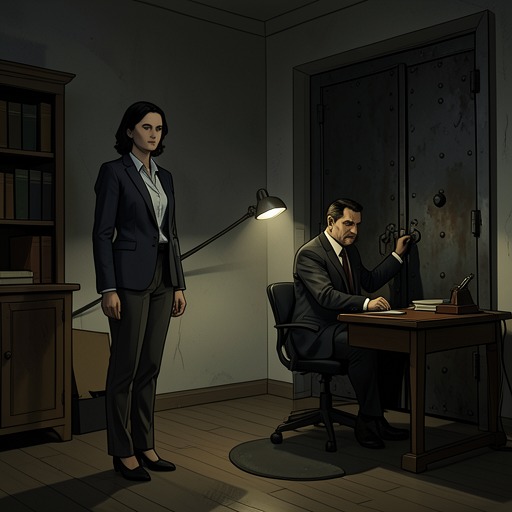
Mary Lockridge
Good Morning, Midnight (Reginald Hill Edition)Mary Lockridge enters the story through a brief but consequential confrontation with Sue-Lynn Maciver. Peter Pascoe identifies the woman who attacks Sue-Lynn as probably Mrs Tom Lockridge, then finds a photograph of Sue-Lynn with Dr Tom Lockridge, Mary’s husband. The image is dated to the same night, shortly before Palinurus Maciver Junior’s suicide, linking Mary’s intervention to a private discovery at a moment already marked by death.
Identification and Evidence
Mary is not introduced by name during the confrontation. Peter Pascoe first sees a woman emerge from a BMW and move toward Sue-Lynn, shouting as she runs and thrusting a sheet of paper toward her. The woman’s words are indistinct to him, so the scene gives no direct account of what she says or what she believes has happened. Her actions establish hostility, but the reason for it is initially withheld.
After the woman leaves, Peter joins the torn pieces of paper. They form a photograph showing Sue-Lynn and Dr Tom Lockridge in a bedroom. The picture supplies the connection that makes Peter identify the BMW’s departing driver as probably Mrs Tom Lockridge. The identification is presented as a detective’s conclusion rather than a spoken confirmation from Mary herself; the narrative does not give her name in the encounter or show her acknowledging the photograph.
The Confrontation with Sue-Lynn Maciver
The encounter unfolds in a compressed sequence. Sue-Lynn reaches her front door and tries to put it between herself and the approaching woman. The visitor nevertheless comes alongside her, continues shouting, and presses the paper toward her. Sue-Lynn looks at it and replies, but Peter cannot report what she says. The woman then strikes her, leaving Sue-Lynn against the door, before tearing the paper and scattering its pieces beside her.
Peter intervenes verbally and moves toward the scene, but the woman pushes past him and returns to the BMW. His brief hesitation matters: he recognizes that, as a senior police officer witnessing an assault, he ought to arrest her, yet by the time he has reached the point of action she is already leaving. The car accelerates away, and the immediate confrontation ends without Peter establishing Mary’s account or questioning her about the image.
The paper’s two roles sharpen the scene. It is first presented as something Mary thrusts at Sue-Lynn, then becomes evidence Peter can reconstruct after it has been torn. Its destruction does not erase what it depicts; instead, the fragments lead him to the relationship behind the confrontation. The narrative makes the photograph, rather than Mary’s unreported explanation, the means by which the reader can understand why the encounter may have occurred.
Marriage, Discovery, and Inference
The photograph identifies Sue-Lynn and Dr Tom Lockridge together, while Peter’s inference identifies the woman in the BMW as Tom’s wife. Taken together, those details strongly suggest that Mary has confronted Sue-Lynn over her relationship with Tom. The scene does not explicitly state what Mary knew beforehand, how she obtained the picture, or whether the photograph itself was the only cause of her anger. Her motive is therefore legible through the arrangement of events, but not independently confirmed by her testimony.
This distinction keeps Mary partly outside the reader’s reach. Peter sees her conduct and later interprets her identity; he does not hear her words clearly, and the account does not enter her thoughts. The reader can connect the assault, the torn photograph, and the apparent marital discovery, but cannot turn that connection into a fuller account of Mary’s feelings or circumstances. Her presence is defined by what she does and by what the evidence allows Peter to infer.
Chronology and Narrative Role
A date and time printed on the photograph place the pictured encounter on the same night as, and not long before, Palinurus Maciver Junior’s suicide. That timing gives the confrontation a wider significance than a private dispute: Mary’s apparent discovery belongs to the immediate chronology surrounding the death. The evidence does not establish that the confrontation caused or contributed to the suicide, and the two events should not be treated as causally connected on this basis alone.
Mary’s role is consequently narrow but important. She appears at the edge of Peter’s investigation, first as an unidentified woman whose actions disrupt his attempt to follow events, then as the likely wife of the man in the photograph. Her departure prevents an immediate explanation, while the recovered image supplies a concrete link between the confrontation and the affair. The scene turns Mary’s anonymity into a controlled uncertainty: enough is revealed to make her probable purpose understandable, but not enough to replace inference with her own account.