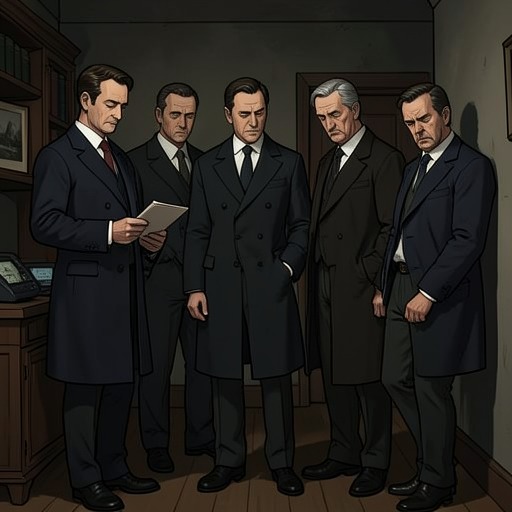
Mid-Yorkshire CID
Good Morning, Midnight (Reginald Hill Edition)Mid-Yorkshire CID is the local investigative unit at the centre of the novel’s police work, especially the shifting inquiry into the Maciver deaths. Its role is practical and institutional: officers review old files, order searches and forensic examination, pursue leads across financial and personal records, and decide who is entitled to handle the case. Under Andy Dalziel’s forceful command, the department becomes a place where evidence is gathered but also where competing judgments about duty, uncertainty, and jurisdiction collide.
Identity and investigative remit
The department is identified in the address on an envelope sent to the Maciver murder enquiry: it is directed to Police CID, Mid-Yorkshire. That formal label matters because the investigation does not remain a settled matter of classifying a death as suicide. A communication addressed to a murder enquiry arrives within the same institutional setting where officers are handling the case, giving the department a visible point of contact between an accusation and the police process required to assess it.
The department’s remit in the narrative is shown through its work rather than through an account of its organization chart. Peter Pascoe and Shirley Novello examine the files on Pal Senior’s suicide from ten years earlier. Later, when new information changes the investigative picture, Pascoe sends the scene-of-crime team back to Moscow House and orders a thorough examination of the house, with moveable items from the study taken to the laboratory. He also directs inquiries into bank and telephone records, credit history, business dealings, a private investigator, and possible witnesses among working women on The Avenue. The range of these instructions shows a local investigation extending from physical evidence to financial history and the movements and knowledge of people connected to the case.
Command, colleagues, and control of the case
Andy Dalziel is the department’s dominant authority in the scenes presented. He learns that Pascoe has been reviewing the earlier Maciver files with Novello and challenges him for not explaining what has prompted the renewed work. His reaction establishes both the chain of command and its friction: Pascoe has acted with an investigative purpose, but Dalziel expects to know what is happening within his unit.
That authority has direct procedural consequences. After hearing Pascoe’s account, Dalziel orders him to hand everything over to Paddy Ireland and return to his regular work. The instruction is not merely an expression of impatience. It redirects the inquiry and sets a boundary around Pascoe’s continued involvement, leaving him resentful even as he understands the need to withdraw. The exchange presents the CID as a workplace where a detective’s interpretation of a case must contend with managerial decisions about responsibility and priority.
The department’s working group includes Edgar Wield and Novello, who appear in Pascoe’s investigative activity and in Dalziel’s office. Constable Jennison also brings information to the inquiry, while Hat Bowler is present in a later gathering with Dalziel, Wield, and Novello. These appearances suggest a collective investigative environment, but the evidence does not make every participant’s formal responsibilities equal or interchangeable. What it does show is that information reaches the department through colleagues at different levels and that Dalziel’s office is a central site for receiving, weighing, and responding to it.
Methods and evidentiary pressure
The department’s methods are presented as concrete tasks rather than as a claim that any single clue settles the case. Pascoe orders a second, more thorough examination of Moscow House and has material from the study sent for laboratory work. He broadens the inquiry beyond the scene by commissioning checks of Pal Junior’s financial and communications records and business dealings. He also directs officers to investigate Jake Gallipot, a private investigator, and asks that possible witnesses be located and spoken to. The sequence shows an inquiry expanding in response to uncertainty: physical examination, documentary checks, and witness work are pursued together rather than treated as substitutes for one another.
That work has a psychological cost for Pascoe. He distinguishes the reconstruction of a murderer’s state of mind, which he experiences as an intellectual task, from trying to comprehend a person for whom death seemed like the only escape. The distinction does not provide an answer about the Maciver death; it explains why the classification of the case matters to the investigator. The CID’s ordinary tools remain available, but a suicide inquiry also confronts the limits of what an officer can reconstruct about another person’s mental state.
The department’s information flow is imperfect. In Dalziel’s office, a phone rings and goes unanswered; another phone rings in the main CID room, where Dalziel finds no one in view except a person by the fax machine. The moment briefly contrasts the commanding image Dalziel has of his staff, ready to act at his direction, with the untidy reality of a working unit. It does not establish a lasting failure of operations, but it makes clear that the department is not an abstract machine: its work depends on people being present, communicating, and carrying out instructions.
Narrative significance
Mid-Yorkshire CID serves as both the machinery of the investigation and the arena in which its limits become personal. Pascoe’s renewed attention to the old suicide files brings him into conflict with Dalziel’s demand for control of the case. His reflections also expose a distinction that police procedure cannot erase: homicide may invite a search for a perpetrator, while suicide forces attention toward the distress and unknowability of the person who died. The department’s actions can gather evidence and test competing accounts, but the officers’ authority does not make uncertainty disappear.
The department’s importance therefore lies not simply in its searches and record checks, but in the tension between investigation and judgment. An envelope naming a murder enquiry, a renewed examination of the study, and Dalziel’s order to transfer Pascoe’s material all belong to the same institutional story: the status of a death can be challenged, evidence can prompt new work, and command can determine who pursues it. Mid-Yorkshire CID gives those changes their procedural setting while leaving the moral and psychological questions unsettled.