The Maciver family's estrangement
Good Morning, Midnight (Reginald Hill Edition)The Maciver family's estrangement is not a single quarrel but a division formed after the death of Palinurus Maciver Senior and sustained by the siblings' sharply different relationships with their stepmother, Kay Kafka. Cressida Maciver and Palinurus Maciver Junior regard Kay with hostility, while Helen Dunn, still a child when Kay entered the family, remains close to her. The split shapes how the siblings understand one another, who counts as family, and whether reconciliation can be approached directly or only from the side.
Origins in a Divided Household
Cressida describes the difference as a matter of age and protection. When their father remarried, she and Palinurus Maciver Junior were older, and she believed they had become guarded against Kay's influence. Helen Dunn, by contrast, was nine. Cressida says that she and her brother tried to separate Helen from Kay, but Helen became distressed at the prospect and would not leave her stepmother. The same household therefore produced opposing accounts of loyalty: to Cressida, Kay had drawn Helen into her orbit; to Helen, Kay was the adult to whom she was attached.
The father's death made that difference more than a matter of feeling. Palinurus Maciver Junior was already of age, while Cressida was seventeen and still officially needed an adult responsible for her care. She refused to have Kay take that role, even though doing so meant going to her aunt, Lavinia Maciver, whom Cressida regarded as eccentric, until she turned eighteen. Her choice placed a clear boundary between herself and Kay. Helen, only nine, did not make the same choice, and the siblings' different responses left Cressida and her brother estranged from the sister who remained with their stepmother.
The Siblings' Unequal Distances
Cressida speaks of her brother's hostility to Kay as shared ground: she says he hated Kay, while presenting herself as equally resistant. Her account of Helen is more complicated. She describes the younger girl dismissively and suspects Kay preferred her dependent, but the underlying fracture is that Cressida and Palinurus Maciver Junior could not persuade Helen to break from the person she trusted. Cressida treats Helen's decision as settled, saying she had made her choice. The phrasing turns a childhood attachment into a lasting family verdict.
Helen's own view, as reported by Kay, allows for a different reading of Palinurus Maciver Junior. Kay regrets making a sarcastic remark about him and recognizes that family relationships are a subject she has chosen to avoid. In speaking to Tony Kafka, she has explained that the siblings are blood relatives and she is not; she believes that this difference cannot be changed. Her self-exclusion helps explain why she has not readily joined Helen in criticizing her siblings, even when their behavior has hurt them both.
Helen later tells Kay that Palinurus Maciver Junior has been trying to repair relations. She points to his squash games with her husband, Jason Dunn, as a kind of rapprochement that would have been unlikely a year earlier. Helen interprets the games as his indirect way of proposing a fresh start: rather than speak plainly, he approaches from an angle. Kay recognizes the sideways quality of his manner, but her response remains guarded. She acknowledges that the games matter to Jason and adds that no one likes being stood up. The exchange shows a possible movement toward reconciliation without suggesting that the old injuries have been resolved.
Conflict at the Family Home
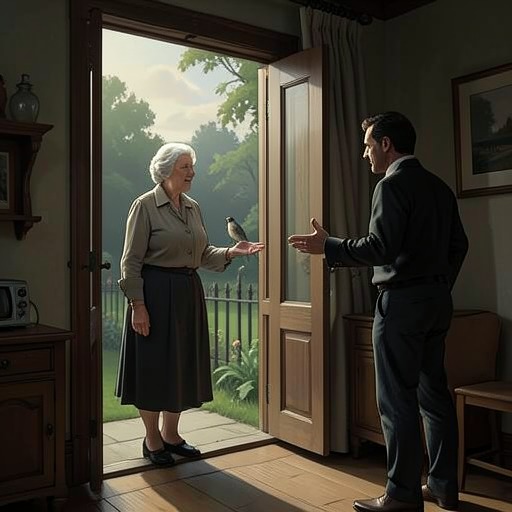
The estrangement becomes explicit when Cressida encounters Helen and Kay at the family home after an emergency involving Palinurus Maciver Junior. Cressida challenges Helen's presence and claims that her interest in the household ended ten years earlier, treating her as a trespasser. Helen counters that the property is as much hers as Cressida's and objects to being excluded, particularly as Kay has come with her. The dispute over who has a right to be there makes the family's emotional division concrete: a shared home and a shared crisis do not produce a shared sense of belonging.
The sisters' argument briefly gives way to a common demand that they stop quarrelling and attend to Palinurus Maciver Junior, their brother and Helen's husband. That appeal does not erase their hostility. The women remain united, at most, by their dislike of the person making the reproach, while the immediate emergency exposes how little agreement exists beneath the family name. Cressida's resistance to Kay and Helen's defense of both Kay and her own claim to the property turn a moment of crisis into another confrontation over the boundaries of kinship.
Loss and the Limits of Repair
The news that Palinurus Maciver Junior has died by suicide in Moscow House reaches Lavinia Maciver after a night spent outdoors by the same tree where she and Laurence Waverley once shared coffee and an unusually intimate conversation. Waverley tells her that the death is like her brother's. The comparison brings the earlier family loss into the present: the death that divided the siblings is recalled through a second death in the next generation. Lavinia's first response is shock and uncertainty about whether she is needed; Waverley urges her to come with him and find out what there is to learn. The family rupture thus persists, but death reopens questions of responsibility and connection that estrangement had left unanswered.
Kay's own experience of bereavement offers a separate measure of how loss can alter a person's relation to life without repairing family ties. After Alba's death, Kay could barely endure other people's consoling formulas. Tony Kafka's blunt words gave her a form of support she could accept; much later, being given responsibility at work helped her become aware again of who she was and what she was doing. This recovery does not reconcile Kay with Cressida or Palinurus Maciver Junior. Instead, set beside the Maciver divisions, it clarifies the distinction between surviving loss and restoring a family bond. The siblings' estrangement remains defined by unequal memories, competing claims of belonging, and a reconciliation that Palinurus Maciver Junior may have begun but did not live to complete.