Timothy Gedye
Good Morning, Midnight (Reginald Hill Edition)Timothy Gedye is a government operator who turns the language of routine administration into cover for covert influence. His investigation of Ashur-Proffitt and Maciver’s begins as an ostensibly neutral assessment of the company, but it leads him to recruit Jake Gallipot and recommend undermining Palinurus Maciver Senior’s credibility. In his other principal setting, the Mastaba Club, Gedye and Victor Warlove discuss political risk over lunch with the cool assurance of men accustomed to working behind the visible machinery of government.
Identity and public appearance
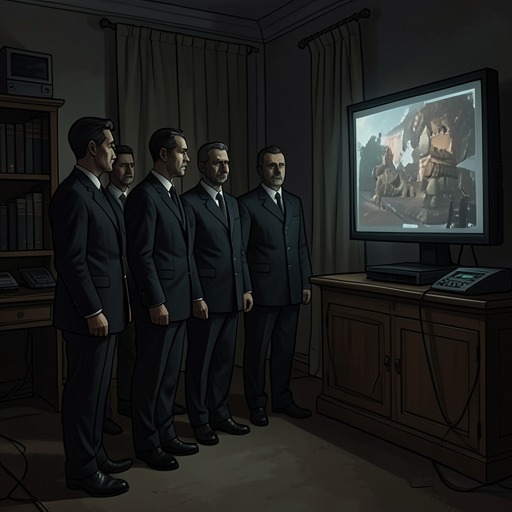
At the Mastaba Club, Gedye is introduced as a striking contrast to his host, Victor Warlove: very tall and thin, with a notably smooth appearance. One of his passports identifies him as a civil servant, but his actual work is difficult to place. The description establishes a useful division between his official papers and his real function: Gedye has a recognizable bureaucratic identity, but not one that explains what he does.
His manner is restrained and dry. He speaks in measured assessments, while Warlove supplies more theatrical remarks and wry reflections on political change. Gedye can still be playful: he answers Warlove’s familiar complaint about the wine trade with a suggestion that Warlove change professions. Their exchanges present him as a man who can participate in the club’s rituals without mistaking them for the substance of his work.
Gedye also follows the political and personal histories of people around Ashur-Proffitt. He tells Warlove that Tony Kafka has embraced the American ideal with particular fervor, and that, despite apparently lacking the religion associated with his inherited name, the idea of kafala—care for homeless and parentless children—seems to remain important to him. Gedye’s account is watchful rather than intimate: he treats a person’s history and relationships as information relevant to how that person may act.
The Yorkshire investigation
The narrative’s later account of Gedye’s work in Yorkshire clarifies the purpose behind his inconspicuous credentials. After Maciver’s business was taken over, its activities and security became a matter of concern to officials in Whitehall and Westminster, with observers in Washington. Palinurus Maciver Senior, relegated to what he believed was a meaningless advisory directorship, began accusing the company of breaking sanctions and engaging in other illegal trading. The danger, from the government’s perspective, was not simply that he was making accusations, but that he might produce hard evidence and create a public scandal.
Gedye was sent to Yorkshire to assess the situation. His cover was that of a Value Added Tax investigator, supported by a detailed curriculum vitae in Customs and Excise records. The role gave him a plausible reason to examine possible VAT irregularities and compare the company’s current record-keeping with the systems used before the takeover. It also allowed him to approach Maciver as someone dissatisfied with the new regime. Maciver then shared his concerns, including his effort to obtain evidence through Jake Gallipot.
Gedye’s investigation of Gallipot found a capable but venal man with a dubious past. Gedye brought him onto the government’s side through a combination of threats and bribery. Maciver, by contrast, was isolated from legitimate access to the company’s sensitive areas and could not readily obtain the evidence he wanted without Gallipot. Gedye concluded that Maciver’s unsupported complaints could be made to look like the resentment of a former owner who had lost power. His recommendation was to undermine Maciver’s credibility and allow events to proceed, a consequential choice that turns an inquiry presented as impartial into an effort to manage the accuser.
Private suspicions and political exposure
Gedye’s account identifies Maciver’s marriage as the factor that changed the situation. As Maciver’s suspicions about the company grew, his relationship with Kay Kafka cooled. He had warned Gallipot to keep Kay uninformed because she remained an employee of the company and had a close relationship with Tony Kafka. Maciver also appears to have wondered whether his marriage and Kay’s connection to Tony had helped facilitate the takeover. These suspicions complicated the business dispute with questions of loyalty and personal trust.
Gallipot’s inquiries at the Golden Fleece Hotel added another troubling report. The company kept a suite there for distinguished visitors, and Gallipot obtained information about its use from a chambermaid. She reported that Kay had used it for private assignations on at least two occasions. Gedye presents the discovery as part of the circumstances surrounding Maciver’s growing mistrust, not as proof that Kay took part in the takeover. The distinction matters: the suspicions widen the conflict, but the account does not establish the explanation Maciver feared.
The Mastaba Club and institutional pressure
In the Mastaba Club conversations, Gedye’s attention shifts from the Yorkshire inquiry to the risks facing Ashur-Proffitt and those connected to it. He says the company may soon attract scrutiny from the Securities and Exchange Commission, whose investigators have begun examining corporate conduct more closely after Enron. On a later lunch visit, he tells Warlove that an investigation is expected to begin shortly before the close of business in the United States, around eleven o’clock in Britain. Warlove asks about Joe Proffitt’s reaction; Gedye says he did not consider it worth giving him advance warning, so he would not have to feign surprise.
Gedye also anticipates consequences for the company’s personnel. He expects Ashur-Proffitt executives to disappear in large numbers over the coming weeks, explaining that police are bound by their experience and do not ignore what appears obvious. The remark links corporate exposure with the likelihood of police attention, while his calm delivery keeps the discussion within the club’s composed surface. The institution’s repeated lunches, familiar service, and recurring wine discussion provide a setting in which impending disruption can be discussed as another item of business.
Gedye’s dealings with the police make that overlap more concrete. An inquiry reaches a contact at the Yard asking unofficially whether Constable Bowler is involved in covert surveillance. The inquiry is attributed to a man named Gedye, working from the Home Office. The contact is told to create no ripples, and the response is that Bowler is on sick leave and no operation is known. Later, Andrew Dalziel recognizes Gedye’s name as the one connected to the question about Bowler. The episode shows Gedye testing the boundaries of police knowledge while leaving the inquiry unofficial and deniable.
Narrative role and significance
Gedye’s importance lies partly in the gap between the role he claims and the work he performs. The VAT-investigator cover grants him access to Maciver; the civil-service identity at the Mastaba Club leaves his actual duties indistinct. Across both settings, information is gathered, assessed, and directed: Gallipot is turned, Maciver’s credibility is targeted, and questions about police surveillance are quietly raised. Gedye is therefore not merely an observer of institutional power. He helps shape what others can know and how their actions will be interpreted.
That role also gives the story’s apparently separate pressures a common structure. Maciver’s allegations, the threatened American investigation, and the covert inquiry about Bowler all concern the management of facts before they become public or actionable. Gedye’s actions expose the moral ambiguity of that management: officials who fear illegal trading and scandal do not simply wait for evidence to emerge, but intervene to control the credibility and access of the people involved. His cool discretion makes that intervention seem routine, even as its consequences reach into a family conflict, a corporate takeover, and police work.