Tony Kafka
Good Morning, Midnight (Reginald Hill Edition)Tony Kafka is a senior executive for Ashur-Proffitt Corporation whose life in Britain is shaped by a growing conflict between corporate loyalty and his sense of American identity. He stays in Mid-Yorkshire to manage the company’s acquisition of Maciver’s business, builds a home with Kay Kafka, and becomes involved in concealing Palinurus Maciver Senior’s death. His commitment to protecting Kay is clear; whether that commitment can be separated from his business interests, or where his final departure leads, remains unresolved.
Identity and Corporate Career
Tony first appears in Kay’s account of her early work for Ashur-Proffitt Corporation. The company’s head, Joe Proffitt, was rarely seen by canteen staff, while Tony, still young, served as the executive on the spot. His arrival could quiet a room. Kay initially found him too ready to joke about her appearance, and he seemed to regard her as a temporary waitress rather than as a person in her own right. That impression changed when she became pregnant. Tony appeared to take responsibility after learning that one of the company’s employees had left her in difficulty, and he authorized maternity leave through the company welfare scheme even though her casual position did not entitle her to it. Kay later understood his practical support as a sign that he had begun to see her as more than an employee passing through.
Tony’s authority grew with the company’s acquisition of Maciver’s business. Afterward, he remained in Mid-Yorkshire to oversee the transition, eventually settling into the role of head of Ash-Mac’s operations and acquiring a country house at Cothersley. Kay continued to work as his personal assistant after their marriage, but made clear that caring for Helen Dunn came first. Tony accepted that condition without resistance. The arrangement joined their domestic life to his corporate responsibilities: Kay was close to the work, while the former head of Maciver’s increasingly felt excluded from its decisions.
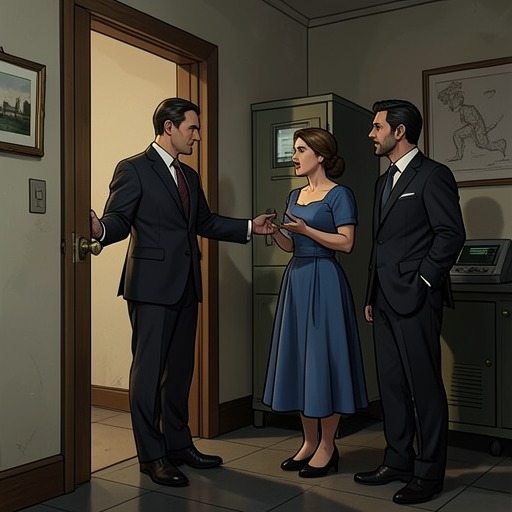
Tony’s executive position is also visible in his own workplace. When Sergeant Edgar Wield comes looking for another employee, Tony receives him directly and offers to handle the inquiry himself. The scene presents him as accessible but unmistakably in command: a senior figure able to put a visitor on a fast track to the person running the operation. At Cothersley Hall, meanwhile, the modern glass-sided extension, indoor pool, computer, and breakfast tray place him within a life of corporate comfort. Yet that polished setting does not settle the question of whether he feels at home.
Marriage, Home, and American Identity
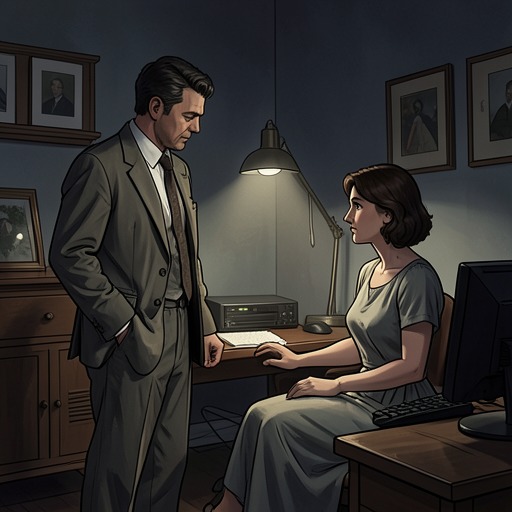
Kay and Tony’s marriage is marked by affection and by an unusually direct awareness of his unease. At home, she brings him breakfast and asks after his work; he turns to her by phone from the Mastaba Club and again while she is at Cothersley Hall. Their exchanges show habitual care rather than grand declarations. Kay is willing to ask whether he is worried, and Tony does not always conceal his anxiety from her.
The home he has made with Kay is not the same as a settled sense of belonging. Tony describes a recurring dream in which he hears fire bells, knows he must get home, but cannot find the way. Kay reassures him that he is already home with her. He distinguishes his attachment to her from his discomfort in Britain: the country itself can make him feel more foreign than anywhere else. He wonders whether good Americans ought to be in America, especially in the changed atmosphere after the September 11 attacks. His uncertainty is not simply a complaint about distance. It exposes a split between the security and intimacy of his private life and the national identity he feels called to honor.
That conflict had already shaped his choices. After the September 11 attacks, Tony’s instinct was to return permanently to the United States. With Helen three months pregnant, however, he understood how strongly she would feel about such a move and stayed in Britain. Later, his complaint that travel to the United States could seem as easy as getting to London by train makes the distance sound at once manageable and intolerable. He is physically able to cross it; what holds him in place is his marriage and its responsibilities.
Business, Politics, and Moral Unease
Tony’s relationship with Joe Proffitt brings his private concern into collision with corporate power. Kay dislikes Joe but does not feel free to oppose him too openly. Tony insists that Joe has strong feelings and that they have talked about everything, resisting Kay’s suspicion that business will simply continue as usual. His defense does not resolve her concern: she believes Joe’s priorities remain profit, while Tony hopes that their conversations have made a difference.
The tension becomes more pointed in Tony’s dealings with Victor Warlove and Timothy Gedye at the Mastaba Club. In conversation with Kay, Tony says that events have changed in the United States but that business in Britain continues much as before. He objects to a political arrangement in which British figures make the decisions yet American businesses may be blamed when matters go wrong. He has already spoken to Joe on an open telephone line and agrees with him to bring forward a strategy meeting, planning to return to the United States within a day or so. The episode shows Tony trying to act inside the system even as he distrusts the loyalties and evasions sustaining it.
His disagreement with Kay over Joe later becomes an argument about patriotism. Tony says Joe has accepted that the issue is no longer only political but concerns patriotism; Kay counters that she expects profit to remain Joe’s real concern. Tony’s response is not to dismiss her outright, but to insist that he will manage the coming meeting. If Joe refuses to listen, Tony says, he will leave the company and make the break forcefully. The threat marks a limit to his accommodation: he has served Ashur-Proffitt, but does not regard service as unconditional. His conviction that a time may come when more will be demanded of good Americans gives that limit a larger, unsettled significance.
The Cover-Up and Final Departure
Tony’s most consequential actions follow the discovery of Palinurus Maciver Senior’s death. The account of the cover-up is given by a participant who says that he telephoned Tony, explained the situation, and found that Tony shared his assessment of the danger. Kay knew about the company’s unofficial dealings, and the possibility that the circumstances of her husband’s death would connect her to a damaging story threatened both the company and her relationship with Helen. Tony and the narrator therefore helped devise a false explanation intended to protect the interests involved.
The plan required Kay to leave before the death was staged. Her cases and Helen’s were already packed. She was to collect Helen from school, give a practical explanation for leaving that night, and stay at an airport hotel before travelling to the United States. Tony and the narrator agreed to put as much time as possible between Kay’s departure and Palinurus Maciver Senior’s death; they selected March 20. Tony undertook to provide evidence that the dead man had made increasingly agitated attempts to contact him during the intervening period. The staged narrative of mounting distress would help make the later false account of suicide seem plausible. Tony was not merely a concerned husband offering Kay comfort: he knowingly contributed to the concealment and to the construction of misleading evidence.
Kay’s final farewell to Tony is remembered by Peter Pascoe as she runs out of Cothersley Hall to embrace him. She clings to him, and Pascoe experiences the intensity of the moment as private enough to make him feel like a voyeur. Later, Kay explains that Tony wants to be a good American, describing that aspiration as difficult and dangerous. The police ask whether he is on the run, but the novel supplies no definite answer. His departure thus ends neither in a confirmed escape nor in a settled return home. It leaves him suspended between the wife he has tried to protect, the company he has served, and the national identity that increasingly draws him away.