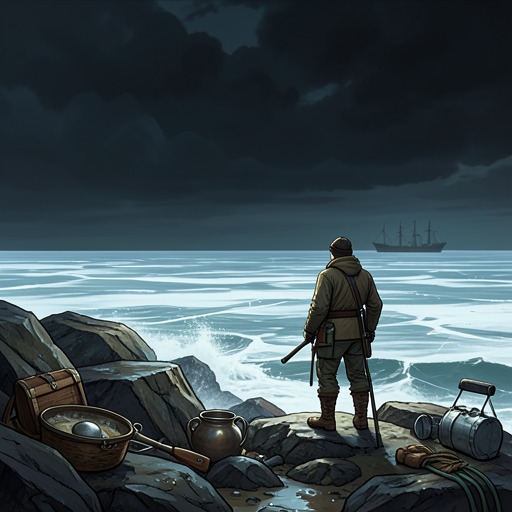
Aether and Augustine Make First Radio Contact
Good Morning, MidnightThe first radio contact between Aether and Augustine joins two isolated listeners across nearly two hundred thousand miles, but it offers no immediate explanation of Earth’s silence. For Sully aboard the returning spacecraft and Augustine at an Arctic research outpost, the faint exchange confirms that someone else is still listening; its brief duration and interrupted follow-up leave the catastrophe itself largely unknown.
Background: Two Searches Across the Silence
At the outpost, Augustine had already encountered a world in which ordinary channels of communication seemed to have vanished. After an evacuation he chose not to join, he tried the Alert military base and scanned amateur, emergency satellite, and military aviation frequencies. None answered. He told himself that the silence might be a temporary glitch, but repeated attempts yielded only static. His isolation was not merely geographical: the radio had become his only means of testing whether anyone beyond the island remained reachable.
The equipment available to him was poorly suited to that task. Satellite phones and broadband at the observatory had failed, leaving ham radio as the remaining option. The outpost’s backup system had weak power and limited antenna sensitivity, and had generally served nearby aircraft or the military base rather than long-distance communication. Augustine nevertheless returned to the familiar practice of scanning frequencies and calling out, an activity that had once brought replies from other operators. Now the same routine confronted him with the possibility that there might be no one left to answer.
Sully’s search aboard Aether developed under different but related conditions. As the spacecraft drew closer to Earth, she spent long hours in the communications pod listening for remnants of terrestrial broadcasts while also tracking the probes sent to Jupiter’s moons. Her expectation that reception would improve as the distance shrank kept her listening through repeated stretches of silence. After the main communications dish broke away, she and Thebes worked to restore reception with a replacement system. They calibrated it as well as they could, adjusting its settings until they believed that, if anyone was trying to call, Aether could hear.
The First Reply
Augustine’s breakthrough came while he scanned from the radio shed. The Arctic’s winter stillness made the receiver’s static a welcome background, and he had fallen asleep with the equipment operating when a faint voice reached him. At first he could not tell whether he had truly heard anything. The signal returned as fragments of sound rather than intelligible words. Excitement disrupted the familiar amateur-radio codes he might ordinarily have used, so he simply called out and waited. His first attempts brought no reply; on the third, he heard a woman’s voice clearly.
For Sully, the contact arrived after Aether had passed the Moon. In the early morning, Greenwich Mean Time, she had been transmitting almost without realizing that she was speaking. The faint, distorted sound initially seemed like atmospheric interference. She tried again, cautiously, and heard a response. As the voice became clearer, the possibility that the signal was real displaced the long habit of expecting nothing. The exchange was a connection, but not yet an explanation: hearing another person answered the immediate question of whether anyone could respond without telling Sully what had happened on Earth.
The initial conversation lasted less than two minutes. Sully identified herself as being aboard Aether, a deep-space exploration spacecraft, and explained that the crew was heading home after losing contact with its Mission Control team more than a year earlier. They were a little less than two hundred thousand miles from Earth, and Augustine was the first person they had reached by radio since that loss. The reply gave him his first direct information about the spacecraft and the people approaching his world, while making clear how long their own isolation had lasted.
Information Exchanged, Questions Unanswered
Augustine told Sully that he was at a research facility at 81 degrees north in the Canadian Arctic archipelago. He had little information about events beyond the icebound island. He described rumors of war, the evacuation he had chosen to forgo, and the silence that followed. The exchange thus set two partial accounts beside each other: Aether had been cut off from Mission Control, while Augustine had been cut off from almost every radio service he tried. Neither account could establish what had happened across the rest of the world.
Augustine wanted to say much more than the brief connection allowed. He wanted to describe leaving the observatory, making a home beside the lake, and caring for Iris; he also wanted to ask what Earth looked like from space and how it felt to live among the stars rather than observe them from the ground. The words he hoped to share included a changed awareness of attachment and care, feelings that had become vivid through his life with Iris. Yet the signal faltered and disappeared. Distance, Earth’s rotation, and atmospheric fluctuation all made a reliable link uncertain. Augustine saved the frequency and intended to keep monitoring it rather than treating the brief reply as a completed conversation.
Afterward, he told Iris what had happened and invited her to return with him to the radio shed. She continued reading and showed little interest in the spacecraft or its crew. Her reaction contrasts with Augustine’s excitement, but the scene does not establish that she understood the encounter’s significance. He went back to the receiver alone, waiting for the signal to return.
A Fragile Continuation
A later exchange brought Gordon Harper, Aether’s commander, onto the frequency with Sully. Harper identified himself and introduced Sully as Specialist Sullivan, whom Augustine had already spoken with. He understood that Augustine was as confused as the crew about what had happened and asked him to confirm it. Augustine confirmed, welcomed them home, and explained that he had heard nothing over the airwaves since the evacuation more than a year earlier. The exchange widened the contact from a brief reply between two radio operators to a conversation involving the spacecraft’s commander, but it did not supply the missing account of events on Earth.
The renewed conversation also failed to hold. Sully began to warn that the signal was about to be lost, and the transmission cut out. Augustine announced that he was standing by, but the words could not make the connection continuous. The first contact therefore ends not with a resolution or a secure communication channel, but with a frequency to monitor and a promise of readiness that depends on conditions beyond either party’s control.
Significance
The contact reverses the meaning of the static that has surrounded both searches. For months, silence could suggest either failed equipment or an empty world; a human voice proves that at least one distant party is listening, without proving how many others survive or what has happened to civilization. Its limited information matters as much as its emotional force: Aether is coming home, its Mission Control link has been absent for more than a year, and Augustine’s account of the evacuation is all he can offer about events on Earth.
The scene also makes communication dependent on material work rather than hope alone. Augustine has to use an underpowered backup radio, while Sully’s opportunity to hear him follows the crew’s efforts to restore Aether’s damaged communications system. The equipment can carry a voice across enormous distance, but it cannot guarantee a reply or preserve one once atmospheric conditions and distance disrupt the signal. Their first contact is thus both a breakthrough and a limit: it connects two isolated lives, opens the possibility of further exchange, and leaves the central uncertainty intact.