Aether’s Return Lottery and Decision to Stay
Good Morning, MidnightAether’s Return Lottery and Decision to Stay turns the crew’s return from a shared destination into a choice about who will risk landing on Earth and who will remain in orbit. With only three seats in the last Soyuz reentry capsule, the five astronauts cannot all descend; neither the planet’s condition nor the safety of landing is known. A lottery gives the uncertainty a procedure, but Thebes and Ivanov’s subsequent decisions to stay overturn its first assignments and define the crew’s final division.
An uncertain return
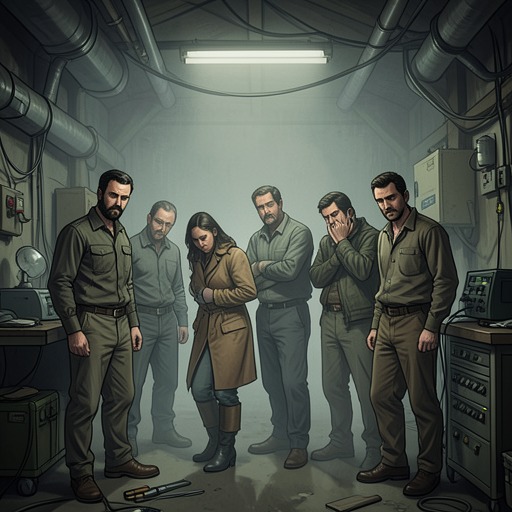
The choice emerges after Aether’s crew reaches the International Space Station and finds it apparently abandoned. Its machines are still running and food packets remain in the kitchen area, but two of its three Soyuz reentry capsules are gone. The crew searches for inhabitants and clues without finding either. At the remaining capsule, they face a limit they cannot negotiate: it has three seats, while two people will have to stay on the station and circle Earth indefinitely if the others descend.
Neither option offers safety. Without a ground team to recover a landing party, the capsule could come down in an ocean or desert. The crew cannot know whether the air, water, and soil are poisoned, or whether anyone survived below. Staying also carries risk: supplies in orbit are finite, and the crew cannot tell how long they will last. They postpone the question of who goes, concentrating instead on docking, equipment, and provisions. The practical discussion gives them something to do while the consequential decision remains unspoken.
That night, the astronauts return to Aether for dinner and attempt small talk. Their two-year journey through the solar system has brought them close to home, but not to certainty: some will make the last leg and some will not. The next morning, Earth fills the view from the cupola, while the familiar centrifuge offers a reassuringly predictable environment. The planet they are approaching has become a mystery. With reentry now unavoidable as a subject, Harper proposes a random method rather than a choice made by one crew member over another. The others agree.
Drawing straws
Harper sets out five straws, matching the crew of five. Thebes shortens two with his utility knife; a short straw means remaining in space, while a full-length one means an uncertain descent. The simple distinction cannot make either outcome less consequential, but it gives the crew a rule they can accept. Harper asks the astronauts to draw in turn.
Tal selects a full-length straw and lays it down. Thebes draws next and also gets a long one, which he examines without making his reaction clear. Ivanov draws a short straw. The crew tenses as they wait for him to respond, but after a pause he smiles and says he feels relieved. Thebes puts a hand on Ivanov’s shoulder. Harper then offers the remaining pair to Sully, who draws the other short straw. The draw has begun assigning people to the two futures, but it has not settled what they will do with those assignments.
The crew schedules reentry for two days later. Tal needs time to calculate the capsule’s trajectory, its angle of entry, and the intended landing coordinates, work made especially difficult without assistance from the ground. They choose the Great Plains of Texas as their target because they expect temperate weather and open space, and hope they may be able to get an answer from Houston. It is a best available plan, not assurance that anyone will meet them or that the planet is safe.
The decision to stay
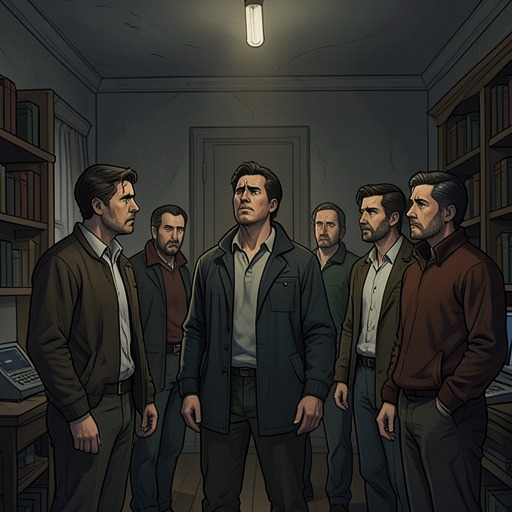
When Sully comes to the table the following morning, the other four are already assembled. Thebes tells her that he will stay on Aether and remain at the space station. The others appear to have known about his decision. Sully asks whether this means she is expected to go instead and raises Ivanov’s place in the decision. Ivanov then tells her that he, too, has decided to stay.
Their choices do not follow the lottery’s first outcome. Thebes drew a long straw, which had marked him for descent, while Ivanov drew a short one and had seemed relieved by the prospect of remaining. Now each makes staying a personal decision rather than simply accepting the result of chance. Together, their choices leave the capsule’s three seats available for the rest of the crew. What had been framed as a fair allocation becomes a parting shaped by the astronauts’ own judgments about what they can accept.
Ivanov explains that he wants the past restored, but believes the world below is not the one the crew left behind. He refuses the comfort of assuming his family is waiting for him. He and Thebes, the oldest crew members, are tired and identify themselves as old dogs. His explanation makes the decision more than a matter of logistics: going home cannot guarantee the recovery of the life they remember. The unknown Earth may contain people, but it cannot simply be treated as a return to what was.
Sully is unable to answer at first, and Thebes puts an arm around her. Harper moves the group back toward work: Thebes is to check the capsule’s seal; Ivanov is to help Tal with the course calculations; Tal is to plot the course and run landing simulations; Harper will inspect the survival gear; and Sully is asked to make one last attempt on the communications systems. The division of labor makes the decision operational. The crew does not resolve what awaits them, but it begins preparing for departure under the new arrangement.
Consequences and significance
The lottery and the later decisions separate the crew’s future without resolving the central danger. The descent party has a target and a schedule, but no ground team, no reliable knowledge of the planet, and no certainty of contact with Houston. Those staying face the station’s finite resources and an indefinite orbit. The decision changes who will take each risk; it does not turn either risk into a safe option.
Sully’s short straw gives the encounter particular force. The previous night, awake in her bunk, she touches a photograph of her daughter, Lucy, and considers the distance between herself and the family she has lost. At the cupola afterward, she watches Earth pass beneath the station and thinks of Lucy, Jack, and Jean. Her reflections do not decide the lottery or explain the others’ choices, but they place the abstract question of return beside the specific family ties that make going back matter. Thebes and Ivanov’s decision means that Sully’s place among those who may descend is no longer determined by the short straw alone.
The event’s lasting turn is from a random assignment to a chosen separation. The straws briefly seem capable of settling an impossible question by chance; the two men’s decisions show that the crew must still confront what return means to them. A capsule with three seats, a proposed landing across the Great Plains of Texas, and a pair of astronauts committed to staying mark the transition from a crew that has traveled together to people whose paths will divide just before Earth comes within reach.