Augie and Iris’s journey to Lake Hazen
Good Morning, MidnightAugustine and Iris’s journey to Lake Hazen is a difficult, several-day passage away from Barbeau Observatory and toward an uncertain refuge. A dead battery, a breakdown on the open tundra, and a crash in the mountains successively strip away the possibility of an easy return. The journey ends not with a fully known future but with the sight of a small weather station beside a vast frozen lake—and the first signs that the season is changing.
Departure from Barbeau Observatory
Augustine sets out for the hangar alone while Iris stays behind to pack. The walk is difficult, and he accepts that difficulty as a kind of penance. Inside the hangar, the remnants of their previous outing remain: snow has drifted through the open doors, ratchet heads lie scattered across the oil-stained concrete, and the flashlight he carried on their last journey is still where he left it. The snowmobile he had repaired before will not start. During the earlier commotion, he had left its key in the On position, and the battery has since run down. He coaxes the second machine to life and gathers the full fuel canisters for the trip.
Before riding away, Augustine looks toward the nearby grave, marked by a fallen staircase and blood-stained snow. The staircase’s unlocked wheel turns in the wind. He then turns from the grave, climbs onto the snowmobile, and heads back up the mountain. The departure is practical, but it is also shadowed by what he leaves behind: a damaged landscape, the observatory’s uncertain future, and the loss for which the grave stands.
Iris joins him with an excitement he has not seen from her before. Her delight makes him recognize her as a little girl, and that recognition brings both tenderness and fear: he is responsible for her safety, and he is unsure whether he has considered the risks carefully enough. In the control room, they sort what they can carry. Their necessities include a tent, subzero sleeping bags, food and water, fuel, warm clothes, helmets and goggles, a stove, a map, a compass, and two flashlights. Iris’s books, spare clothes, extra batteries, and a second fuel canister are luxuries to take only if there is room. The snowmobile is built for rough ground and heavy loads, but with passenger and gear aboard it may not handle perfectly.
They leave the observatory with just enough heat running to protect the pipes and telescope. Augustine wonders who, if anyone, will benefit from keeping it warm. If they turn back, it may still shelter them; if the weather station proves more hospitable, the observatory will eventually cool, its pipes will freeze, and its lens will crack. He cannot know which future awaits the building—or them.
The tundra and the first breakdown
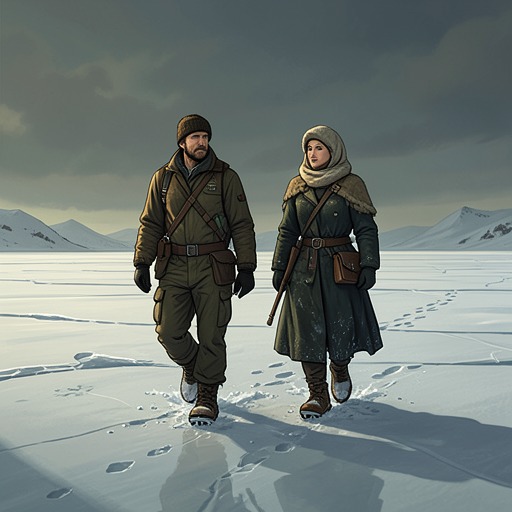
Iris wraps her arms around Augustine as they ride down toward the tundra, taking an eastern route before the hangar can come into view. Her helmet is too large, padded with three hats; her goggles engulf most of her face, their elastic tightened with a safety pin. The rocky ground jolts them, then gives way to a smoother ride across the level tundra. After four or five hours, Augustine stops so they can drink water and eat crackers. The observatory has disappeared behind a shifting curtain of snow, and the opaque air makes it impossible to see far ahead. He has been counting the miles and resisting the urge to return, relying on the hope that the weather station may offer them a better home.
After their break, the snowmobile will not start. Augustine checks the starter, key, and throttle, but the machine remains silent. They are stranded miles from the observatory and farther still from the weather station, with no shelter between them. He collapses beside the vehicle, convinced that leaving the observatory has brought them to a fatal dead end. Iris waits on the passenger seat as the wind begins to erase their tracks. In his despair, he takes her boot in his mittened hand and apologizes.
The explanation is small and mechanical: the fuel valve beside the right footwell is caught halfway between Off and On. Augustine realizes that Iris may have kicked it while climbing down. He turns the valve fully to On, and the snowmobile starts. Relief steadies him enough to continue, although the landscape now seems more threatening than before. The episode makes the journey’s danger immediate without making it mysterious: survival depends on finding a switch hidden beside the footwell, while the surrounding tundra offers no alternative shelter.
As the light fades, they pitch their orange tent beside the snowmobile because there is no boulder, tree, or snowdrift to block the wind. They heat baked beans on a kerosene stove and use the can as a hammer to drive the tent pegs into the packed snow. Iris keeps her green cap and yellow goggles on during dinner. Later, they sit at the tent entrance with the lantern off and watch a long green aurora. Augustine is struck by Iris’s wonder. For a while, he stops measuring the distance already covered and the distance still ahead; what occupies him instead is the sound of her breathing, the wind, the cold, and the unfamiliar feeling of being alive and content.
The mountain crossing
After another full day on the tundra and another night outdoors, Augustine and Iris reach the mountains on the morning of the fourth day. Dark, jagged Paleozoic rock breaks through the snow, and the route grows difficult to navigate. Lake Hazen lies beyond the range, but Augustine has never traveled this way and does not know whether there is a pass or an easier route he has missed. They continue carefully, the snowmobile’s studs gripping the ice and snow.
A stretch of gentler ground briefly allows them to gather speed. Then rough terrain and blowing snow obscure what lies ahead, and a hidden boulder throws both riders from the snowmobile. Augustine finds that he can move all his limbs; nearby, Iris is already standing and examining the snow angel she has made. The machine, however, is finished. One ski has shattered, and the engine only croaks when Augustine rights it and tries to start it again. The failed vehicle turns their outward journey into a one-way trek: there will be no return trip by snowmobile.
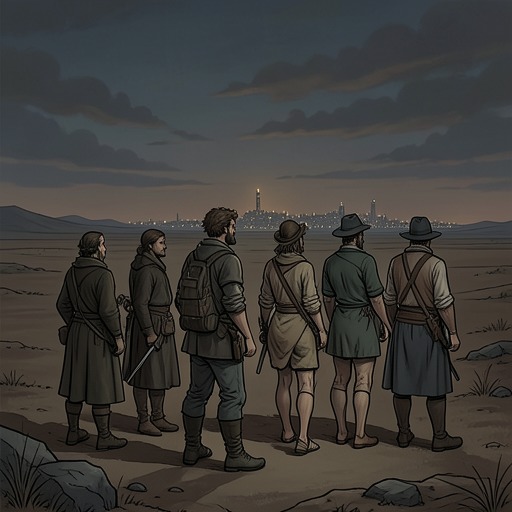
They salvage the gear they can carry and leave the rest. The remaining distance must be crossed on foot, over exposed rock and sheer ice, with heavy loads and sore limbs. They climb for hours until, from a lower peak, they see the lake below: an enormous sheet of ice. At its foot stands the weather station, a few huts and a tall antenna array. The view encourages them, but it also makes the commitment plain. They have abandoned the snowmobile and crossed the range; their new home is below, and there is no turning back.
Arrival at Lake Hazen
They camp for one final night, then begin the descent in the morning. Hours later, they cross the plateau and reach the station as the light begins to fade. The camp is modest: a low green half-cylinder tent stands beside two larger white tents, each with a small stovepipe chimney. Nearby, slender antennae rise beside a small radio shelter. Snow still covers the lakeshore, though rocky ground is beginning to show through.
The frozen lake is not silent. Ice creaks and chimes, and Arctic hares leap on a small island in its midst. The wind that swept across the tundra is absent here; a gentle breeze moves Augustine’s frozen beard. The change in weather gives the arrival a measure of welcome without erasing the uncertainty of what they will find or how they will live there. The thaw has begun, and spring is on its way.
The journey’s significance lies in the way its hazards repeatedly narrow Augustine and Iris’s choices. Their route begins with a functioning machine and a carefully selected load, is interrupted by a fuel-valve mistake, and becomes a strenuous foot crossing when the snowmobile is wrecked. Yet the arrival is not presented as a triumphant conquest of the landscape. The tundra, mountain, and weather impose their own conditions; the travelers proceed by adjusting to them, carrying only what they can and accepting that they cannot return as planned. Lake Hazen offers a possible home, while the first thaw supplies a fragile sign of renewal rather than a guarantee of safety.