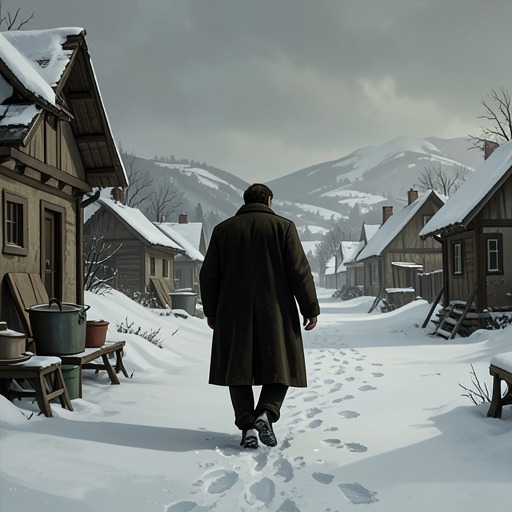
Augustine Finds and Takes in Iris
Good Morning, MidnightAugustine Lofthouse’s discovery of Iris at Barbeau Observatory turns an evacuation’s overlooked consequence into a bond neither of them knows how to name. He finds a silent child left behind in the emptied station and takes her in, first as an inconvenience to manage and then as someone whose safety matters to him. The care begins in uncertainty, but the wider silence around them leaves Augustine with no one else to rely on—and Iris with no one else to look after her.
Discovery After the Evacuation
A day or two after the scientists depart, Augustine finds Iris curled on a bare mattress in an empty dormitory. She appears to be about eight, with tangled dark hair and watchful hazel eyes; her stillness initially makes him doubt that she is really there. The observatory has been emptied in haste, and he assumes she was accidentally left behind in the confusion. Yet no one returns to collect her.
Augustine beckons Iris to follow him to the control room. She says nothing, but she goes with him. He gives her dried fruit and nuts, then makes instant oatmeal, which she eats. He offers a book, unable to tell whether she reads it, while he tries to resume his work around her unexplained presence. His practical response precedes any admission of attachment: he feeds her and makes space for her because she is there and needs care.
Improvised Care and Uncertainty
At first Augustine treats Iris with what he recognizes as clumsy kindness, without knowing how to speak to her or what she needs. He feeds her when he feeds himself, takes her on walks, and gives her objects to occupy or interest her: a walkie-talkie, a constellation map, an Arctic field guide, and a sachet of potpourri found in an empty drawer. He cannot be sure whether she understands his questions, and he compares his handling of her to caring for a pet because he has no better model for the responsibility.
That comparison sits uneasily beside his actions. Augustine tells himself that Iris does not belong to him and that he is not the kind of man who adopts strays. He also recognizes that she has no dolls, picture books, or other possessions she can call her own, and lets her keep her hiding places. When she disappears from her usual spots, he initially does not worry; she has hidden before and, in his experience, always reappears. His care is real but tentative, complicated by his effort to deny what it is becoming.
The Silence Beyond the Station
The hope that Iris’s absence is merely an evacuation mix-up collapses when no one comes back. The following day Augustine radios the Alert military base, then scans other frequencies. Amateur radio, emergency communication satellites, and military aviation channels all yield silence or static. He tells himself it may be a glitch or a storm and plans to try again, but the failed calls make the abandoned child part of a larger crisis: he cannot establish that anyone remains available to help either of them.
The observatory’s isolation sharpens the significance of his decision. Augustine had stayed behind after the other scientists left, with no one to return to; now he has company, though Iris remains silent and difficult for him to understand. During the long polar night, after several weeks of darkness, she eventually breaks that silence to ask him a question. The account marks a change in their communication without supplying the question itself: the child he had been trying to manage begins, on her own terms, to address him.
Protection Becomes Personal
Later, Augustine discovers Iris outside in dangerously inadequate clothing, sitting in the snow in her winter silks and wool socks. He runs to her, removes his parka, wraps it around her, and checks her hands. His urgency is plain in the questions he fires at her about her missing parka and boots and how long she has been outside. Iris, meanwhile, seems more concerned about him than herself and touches his cheek.
She points out a nearby herd of Musk ox, whose return she has noticed after Augustine barely registered their absence. He watches the animals with her, then draws Iris onto his lap and wraps his arms around her as she rests her head against him. The scene brings his gradual change into focus: the man who once insisted that he did not adopt strays now responds instinctively to her vulnerability, and her attention to the living world has become something they share. Taking Iris in is not presented as a formal declaration, but as a relationship made visible through repeated acts of shelter, food, attention, and protection.