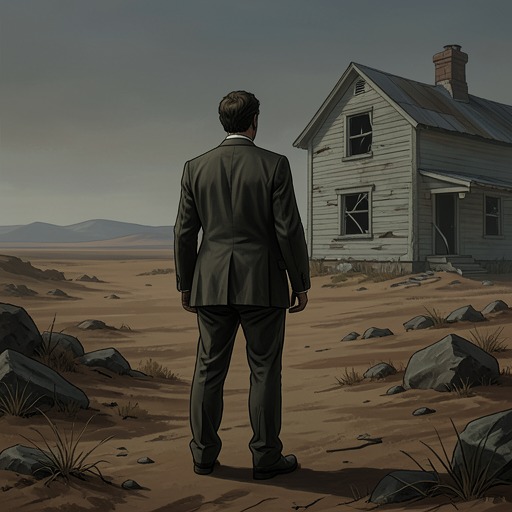
Augustine Rejects Fatherhood and Leaves Jean
Good Morning, MidnightAugustine’s rejection of fatherhood and departure from Jean become a defining rupture: when Jean tells him she is pregnant, he refuses the role of father and leaves New Mexico, then spends years trying to keep the child at a distance while making gestures toward her from afar. The episode returns as a memory in his later life, where a final visit to Jean exposes both his wish to undo the past and his recognition that he cannot simply repair it.
The pregnancy and the refusal
Augustine’s memories of Jean surface as he watches Iris by the shore at Lake Hazen. The sight brings together contentment and regret, and leads him back to Socorro, where he now understands that he had once been close to a life that might have offered the same sense of gratitude and completeness. Jean had unsettled the detached way he approached the world: he could not treat her as merely a subject to observe or quantify. He recognizes, looking back, that he loved her, though he could not admit it easily at the time.
Jean was twenty-six and Augustine thirty-seven when she told him she was pregnant. Rather than respond to their relationship or the coming child, he thought of his parents and of his own cruel experiments. He did not want to be in love, and told Jean he would never be a father. Her response, as he remembers it, was not the reaction he had expected: she did not cry, but told him she wished he were not so broken. The refusal was therefore not a disagreement over a practical arrangement. Augustine announced that he would not take part in the child’s life, and Jean recognized the damage in him even as he chose to leave.
Departure and distant gestures
Augustine went to a position in Chile, in the Atacama Desert, and left New Mexico as quickly as he could. He tried to forget Jean. In later years, however, the possibility of the child returned to him: a daughter with some of his features and genes, growing up without him. He eventually called Socorro and learned that Jean had left New Mexico soon after he did, remained in touch with some research fellows, and had given birth to a girl in November somewhere in the southern California desert.
After tracking down Jean’s work address, Augustine kept it in his wallet for months. He waited until the child’s birthday to send an expensive amateur telescope, without a note or return address. Jean could decide what to tell her daughter. He continued sending occasional gifts for several years, and sometimes sent Jean a check. These payments and presents allowed him to contribute something without claiming a place in their lives; he himself understood that the gestures were not quite thoughtful, but seemed better than nothing. Jean cashed the checks, but he heard from her only once: she sent a photograph to an old address at an observatory in Puerto Rico. His absence persisted even as he tried, at a distance, to acknowledge the child he had refused to raise.
The last visit
The memory of Augustine’s departure takes him beyond the announcement of the pregnancy to a night soon afterward. He had demanded that Jean get an abortion, then arrived late at her rented adobe guesthouse near their workplace, although he had not been invited. Jean let him in. Her dissertation work was spread across the table, and when Augustine accidentally spilled her tea over the pages, she responded by placing a towel over the spill and tending to the mess rather than confronting him in anger.
Augustine sat at the table and stared at the damaged work. Jean asked why he had come and what he was doing there. He was drunk, and began to cry; Jean cried too. When she asked what he wanted, he said that he wanted to try and to fix what had happened. Jean refused. She made him look at himself in a mirror, where he saw an older, more lost man than he had allowed himself to acknowledge. For a moment, he understood that he was the person who needed fixing, and that he lacked both the means and the conviction to do it. He concluded that Jean and their unborn child were better off without him.
Jean guided Augustine through the doorway and closed the door behind him. He leaned against it outside and looked up at a clouded sky. Their meeting ended without reconciliation, and it was the last time they spoke. His departure was not presented as a clean break that freed either of them from what had happened: it left Jean to have and raise their daughter without him, while he carried the knowledge of the child and his own refusal into the years that followed.
The meaning of the recollection
The event is recalled rather than shown as part of the present-day action. Its structure moves from Augustine’s belated understanding of love, through his long attempt to avoid its consequences, to the specific memory he had tried not to revisit. The contrast between the birthday telescope and the empty place of a father makes his later gestures legible as both care and continued absence. He sent objects and money, but left Jean to decide what to tell their daughter and did not establish a relationship with either of them.
The final visit complicates the earlier refusal without reversing it. Augustine returns to Jean asking to try, but his recognition of his own condition does not restore the life he abandoned. Jean’s refusal, followed by her steady act of ushering him out, makes the separation final: the two do not speak again. In his later recollection, the scene becomes an account not only of leaving Jean, but of the choice that shaped his relationship to fatherhood and the daughter he acknowledged only from afar.