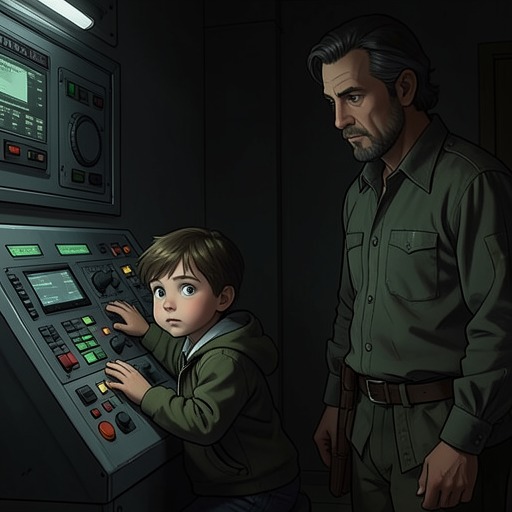
Iris Is Found at Barbeau Observatory
Good Morning, MidnightIris Is Found at Barbeau Observatory marks the moment Augustine Lofthouse’s solitary life at the evacuated observatory is interrupted by the discovery of a child left behind. What first seems like an accidental oversight becomes a new, uncertain responsibility: Augustine offers Iris food and shelter, but does not know who she is or what should be done with her. The episode places their tentative connection against a widening silence, as the expected return of the departing scientists never comes and attempts to contact the outside world find no answer.
The observatory after the evacuation
After a hostile exchange with the captain, Augustine watches the other scientists leave. From the south-facing windows, he sees them carrying books, equipment, suitcases, and keepsakes between the tents and outbuildings; loaded snowmobiles ferry people and belongings toward the hangar. The scientists then make their way to the runway, until Augustine is alone. He watches their plane disappear into the pale sky and remains at the window as its engine fades.
The departure changes the observatory from a shared workplace into a place organized around one person. Augustine clears his colleagues’ remaining work from the control room and rearranges the space for himself. The captain has warned that there will be no return trip, and the sudden quiet makes that prospect newly tangible. Augustine cannot absorb its finality for long; he has no one to return to, and staying at the observatory spares him the immediate reminder of that fact. It is in this aftermath, rather than during the evacuation itself, that he encounters Iris.
Finding Iris
A day or two after the plane leaves, Augustine finds Iris hiding in an empty dormitory. She is curled on the mattress of a bare bottom bunk, seemingly overlooked amid the departure. He studies her, uncertain that he is seeing her correctly. He estimates that she is about eight; she has dark hair falling in a tangled mass to her shoulders, round hazel eyes, and an alert stillness that makes her seem watchful. When she moves, the bunk’s metal frame groans, confirming that she is there.
Augustine does not begin with questions or an explanation. He beckons her to follow him to the control room, tosses her a bag of dried fruit and nuts, and heats water. Iris eats the food and then the instant oatmeal he makes for her. She says nothing. He gives her a book, but cannot tell whether she is reading it, and returns to his work while trying to ignore her presence. His response is practical and unsettled: he supplies what she needs in the moment, without yet understanding how she came to be alone or what his obligation to her will become.
Waiting and searching
At first, Augustine expects the separation to be temporary. He assumes that Iris will be missed and that someone will come back to collect her, attributing her presence to confusion during the evacuation. Evening passes without anyone returning. The next day, he radios the Alert military base, the northernmost year-round settlement on Ellesmere Island. When it does not answer, he scans other frequencies: amateur radio, emergency communication satellites, and military aviation channels. None carries a response. He finds only static and tries to reassure himself that the silence could be a glitch or a storm, resolving to try again the next day.
The failed calls alter the meaning of Iris’s discovery. Augustine can no longer treat her arrival simply as a short-lived inconvenience that someone else will soon resolve. Yet the evidence does not tell him why she was left behind, whether anyone is still searching for her, or what has happened elsewhere. His radio search offers no explanation—only the unsettling possibility that there may be no transmitters, or no one left to use them. The uncertainty makes his immediate care for Iris more consequential even as he resists defining it as guardianship.
An improvised form of care
Augustine has no established way to communicate with Iris. When he asks questions, she watches him with detached curiosity and does not answer. Unsure what to make of her silence, he treats her somewhat like a pet, though his attention takes the form of clumsy kindness: he feeds her when he feeds himself, talks to her when he feels like talking, and takes her for walks. He gives her a walkie-talkie, a constellation map, a musty sachet of potpourri, and an Arctic field guide—whatever he can find for her to handle or look at.
These gestures do not erase his reluctance. Augustine tells himself that Iris does not belong to him and that he is not someone who adopts strays. His conduct nevertheless begins to supply the care that his stated distance refuses to name. He allows Iris her hiding places and does not demand that she explain herself; when he cannot find her in the observatory, he is not immediately alarmed, because she sometimes hides and usually reappears. In a place with no dolls, picture books, or swing sets for her to claim as her own, even the small freedoms he leaves her become part of their improvised arrangement.
During the long polar night, after several weeks of darkness and nearly two months after the evacuation, Iris breaks her silence to ask Augustine a question. The discovery therefore begins not with a conventional introduction but with a long interval of watching, feeding, waiting, and not knowing. Its significance lies in that unresolved beginning: the evacuated observatory’s solitude becomes shared, while Augustine’s uncertain, makeshift care creates a bond before either character can explain what it means.