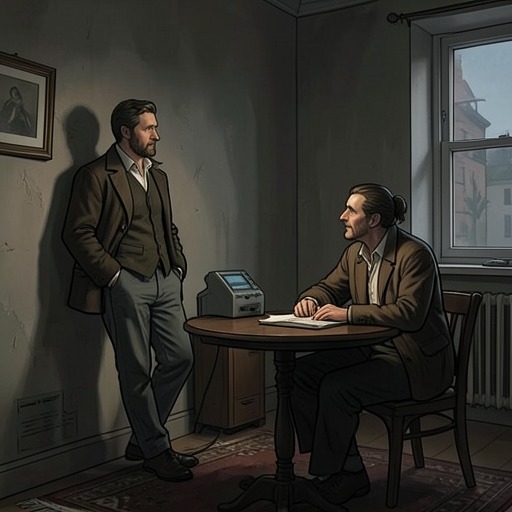
Sully and Gordon Harper
Good Morning, MidnightSully and Gordon Harper’s relationship becomes a source of companionship and tentative hope aboard Aether, where everyday rituals grow intimate against the uncertainty of the silent Earth. Their connection moves from playful card games and attentive observation toward a possible shared future, but the story leaves that future unresolved: the warmth between them is clear, while the relationship’s exact status is not settled in the available scenes.
Companionship in the Blackout
Cards give Sully and Harper a recurring reason to sit together and a structure for being close without demanding disclosure. After one game, they count the cards and Sully records their scores on a clipboard beside notes on Io’s radiation signature. Harper watches her as she writes, noticing the flush rising in her face; being observed pleases her but also makes her feel exposed. When she asks to play again, he declines because he still needs an hour on the exercise bike, promising himself a comeback the next day. Their teasing competition thus sits alongside the work and routines that organize life aboard the spacecraft.
During the communications blackout, their companionship expands beyond the game. They listen to probes in the communications pod, play cards, and share the kitchen table on Little Earth while Sully reviews Jovian data and Harper sketches her profile. Sometimes she reads him dense scientific papers as he exercises, and he jokes about their stiff language. Sully suspects that his questions about her research are less about the material than about helping her feel accompanied. That attentiveness matters in a crew increasingly pulled away from the present by memories and fears about home. Sully tries to keep herself grounded in immediate tasks; returning to Little Earth and finding Harper at the table becomes one of the small comforts that makes Aether feel like home for the time being.
Attention and Unspoken Intimacy
Their closeness emerges through gestures as much as conversation. At a crew gathering, Harper taps Sully on the shoulder and invites her to dance with him and Devi. As David Bowie’s “Space Oddity” plays, Sully briefly interprets the invitation as belonging to the two of them alone, before recognizing that Harper means the group. He takes her hand and draws her into the crowd. The moment does not establish a romance, but Sully’s private reading of it shows how readily she imagines a more exclusive bond.
That tension sharpens during another card game. Harper’s face holds Sully’s attention: she reads its lines, scars, and expressions as though they might disclose a story. When he asks what she is thinking, the question feels unexpectedly intimate to her, and she diverts her answer toward childhood memories of Goldstone and her mother’s work in signal processing. Rather than press her to explain herself, Harper lets the conversation continue at its own pace. Later, Sully asks what he misses most about home. He tells her about Bess, his chocolate Labrador, whom he has had for eight years, and says that he has never got along with humans as well as he does with his dog. Their talk turns private through the details each chooses to share: Sully’s childhood and Harper’s attachment to the animal waiting for him on Earth.
A Future Imagined, Not Secured
Harper describes himself as ready to retire after this mission. He has land arranged and asks Sully to visit him and Bess when they get home. Sully accepts the possibility in the spirit of his invitation, imagining his house, its porch and long driveway, his truck, and Bess waiting by the door. Since she has surrendered her apartment for the two-year mission and left her belongings in storage, the idea of having somewhere—and someone—to return to carries particular weight. In imagination, Harper’s home briefly becomes hers as well. The scene is hopeful, but its conditional language matters: Earth’s silence makes the return uncertain, and their imagined home is not yet a shared reality.
When Sully asks about the look she has caught on his face, Harper withholds the question he has in mind, saying he will ask her when they land. He admits that he needs something to look forward to and extends that need to the crew. His choice to wait protects the possibility of a future conversation without making Sully answer in the moment. Later, after another game, he offers his hand in a half-formal, half-playful goodnight. They hold hands rather than shake, and neither immediately lets go. Sully then turns his wrist to look at his watch and says she should go to bed. The small interruption ends the contact, but not the feeling it has exposed: she returns to her bunk thinking of his promise to ask when they get home.
Care Under Grief and Uncertainty
Harper’s importance to Sully is also visible in a crisis that is not theirs alone. After Devi dies during a spacewalk, Sully repeatedly relives seeing her drift away and struggles to return to work. She follows Harper’s instruction to put aside her thoughts and install the bolts one at a time before making her way back inside. His practical direction gives her an immediate task when grief threatens to overwhelm her, although it cannot spare her the terror or erase the loss. The relationship’s care here is not expressed through a declaration; it appears as help that enables Sully to keep moving through the next necessary action.
The day after the death, Harper and Thebes visit Sully in her compartment. She can manage only the word “Tomorrow,” pushing away even the people she trusts because the day is already full of grief. Her withdrawal marks a limit to intimacy: Harper can remain present, but he cannot make her ready to speak or be comforted. The next morning, she rises to help configure the replacement communications system, and later feels less alone after the crew has done what it can to make contact possible. Harper’s place in Sully’s life is therefore both intimate and part of a wider network of companionship among the crew. Their shared games and tentative plans give her a personal future to picture; their unresolved status, set against isolation, loss, and the uncertain prospect of landing, keeps that picture from becoming a guaranteed ending.