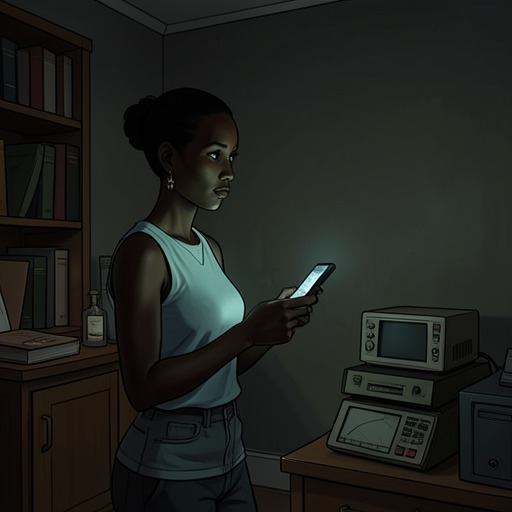
Sully and Jack
Good Morning, MidnightSully and Jack’s relationship shapes her understanding of family, ambition, and loss, but it does not resolve into a simple story of sacrifice or blame. They build a life together, have a daughter, and share moments of unmistakable joy; they also separate, divorce, and become estranged. Far from Earth aboard Aether, Sully finds that memory preserves both the warmth of their home and the bitterness she cannot disentangle from it.
Shared life and marriage
Sully remembers Jack as her husband for ten years and her ex-husband for five. Her recollections reach back to a tiny Toronto apartment where they lived while she was pregnant for the first time, finishing her dissertation, and Jack taught particle physics to undergraduates. After the pregnancy ended in miscarriage, they moved to a brick loft with large windows. Sully recalls the loss at six weeks: when the cramping began, she understood what was happening; after seeing blood, she felt relief, cleaned herself up, took four ibuprofen tablets, and wondered how to tell Jack. Later, she cradled his head in her lap and tried to share the sadness she saw in him, but felt nothing herself. As the light faded behind the undrawn curtains, the windows seemed to look both inward and outward, an image that holds the distance between their responses without explaining it away.
They married at city hall a year later, among gray tiled corridors, polished wooden benches, and other couples waiting their turns. Four years after that came Lucy’s birth in a mint-green hospital room. Sully remembers the uncontained joy on Jack’s face when he held their daughter, alongside her own fear when he handed the baby back. Their family life accumulated in small domestic details as well as milestones: copper saucepans above the stove, a raspberry-red front door, and, in their Vancouver house after Sully completed her PhD, Lucy’s favorite midnight-blue sheets scattered with yellow stars. These concrete memories make the marriage more than a prelude to separation; they show the household and shared history Sully later struggles to picture as belonging to her.
Parenthood and the choice of space
Jack was closely associated with the practical and affectionate record of Lucy’s childhood. He made her firefly costume for Halloween, complete with googly eyes, antennae, a glow-in-the-dark abdomen, and wire-and-pantyhose wings. He was also the one who took the family photographs. Years later, Sully has only one picture of Lucy in her bunk: the old costume photograph, taken when Lucy was five or six. She could not find a more recent one while packing, and her regret sharpens as she realizes Lucy would now be nine. On Aether, even the photograph’s age points to the distance between Sully and the family life continuing without her.
The astronaut career turned that distance into a choice with lasting consequences. Sully recalls that the search for Aether’s crew was announced seven years earlier and that she received an offer sixteen months afterward. She and Jack were already living separately, though neither had yet said the word divorce. They agreed that Jack would tell Lucy about Sully joining the crew. Sully recognizes that the arrangement was not only meant to make the news easier for their daughter: she herself could not face telling her only child that she was choosing to spend more than two years away. When Sully left for Houston, Lucy was five. On a later departure, just before Sully’s first spaceflight, Jack had already served her with divorce papers; Lucy was older, speaking in full sentences, and no longer looked at her with the same unquestioning trust.
Sully’s reflections do not present her ambition as an accidental detour. She asks herself whether the work and sacrifice were worth it and whether she would choose differently if she could warn her earlier self. Her answer is that she would do nothing differently: she had followed her calling. That conviction coexists with the knowledge that she left Jack and Lucy behind, and with the painful sense that the cost fell on the family as well as on her.
Separation, memory, and resentment
As the mission continues without news from home, Sully tries to reconstruct the family she left. She can summon the Christmases, birthdays, and a Colorado whitewater-rafting trip, as well as the blue spruce, old sofa, kitchen lights, plants, and packed Land Rover. The settings come back more readily than the faces. She painstakingly recalls Jack’s green eyes, bent nose, dimples, and habitual clothes: an open top button, rolled-up sleeves, no tie, and sometimes chalk on his shirt. Such careful inventory is an effort to hold him in memory, but it does not restore an uncomplicated intimacy.
When Harper asks about the man Sully was discussing, she corrects him: Jack is her ex. She cannot explain him in a way that makes the relationship coherent, because a comforting memory can sit beside resentment and bring it sharply back. One image is Jack asleep on the couch with two-year-old Lucy lying across his chest, the two of them snoring together. The tenderness of that picture does not cancel Sully’s bitterness; it is precisely the closeness of the memory that makes the emotional reversals difficult to bear. She changes the subject rather than trying to make either feeling stand for the whole marriage.
The separation also changes how Sully experiences her family history. She remembers leaving Jack and Lucy for Houston in the hope that the separation might work, even as she knew it could not, and boarding her flight with Lucy’s tears still damp on her collar. After returning, she knocks on a front door that used to be hers and is greeted by Kristen. Lucy settles into Kristen’s lap, while Sully notices her daughter’s reluctance to leave with her and Jack’s eye-roll when Sully says she must return to Houston by Monday. Watching the three of them together, Sully understands that they are loved and safe, but feels she has no part in that security. She experiences herself as replaced, and imagines the replacement as a better mother, spouse, and person. The account establishes Sully’s painful judgment of herself; it does not make that judgment an objective verdict on the people involved.
Estrangement and the limits of regret
The single photograph becomes especially charged when the crew’s isolation turns into fear about what may have happened on Earth. Sully touches the dim square on her bunk wall and wonders whether Lucy might be dead. The possibility brings her back to the life she imagines she could have had: staying in Canada, not entering the space program or moving to Houston, keeping the Vancouver house and its raspberry-red door, and folding Lucy’s small shirts. But she recognizes that this imagined life is not a solution she could simply have chosen without cost. She believes she was not made for the role Jack wanted or needed from her, and cannot identify what the right way to love Lucy would have been. Her conclusion is not that she did not care, but that having a family had always felt harder than losing it, because some needed warmth and openness had never taken root.
Sully and Jack’s relationship therefore persists in the narrative less as a present partnership than as an unresolved measure of home. Its record contains a shared household, a miscarriage met with different feelings, the happiness of Lucy’s birth, Jack’s care for their daughter, the decisions that led Sully away, and the estrangement that followed. Distance makes Sully long for what she left, while memory refuses to turn that longing into a claim that the marriage was whole or that returning to an earlier life would have repaired it. Her recollections hold love, regret, resentment, and self-doubt together, leaving the relationship consequential precisely because it offers no simple account of who failed whom.